Seats and storage compartments152
Attachment points
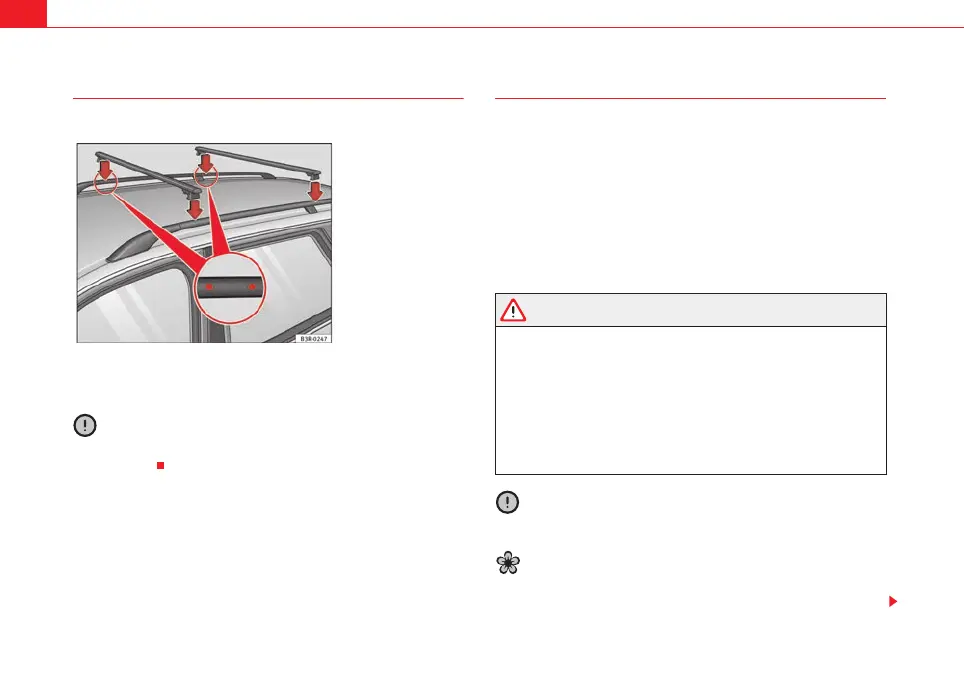
The roof rack must be attached at the marked points only.
The cross-bars must be fitted exactly between the points marked on the roof
railings ⇒ fig. 130. The markings are visible on the inside of the railings.
Caution
A roof rack unit must not be used if the vehicle is not equipped with roof rails
(basic support).
Roof load
Loads carried on the roof must be securely attached. The
vehicle's handling is affected whenever you carry loads on
the vehicle.
The authorised load on the roof of your vehicle is 75 kg. Use the weight of the
roof rack system and that of the load as a basis to calculate the roof load.
If less resistant systems are used, the roof rack must not be loaded to the
maximum weight permitted. If less resistant systems are used, these must
only be loaded to the maximum weight permitted indicated in the assembly
instructions.
WARNING
• Loads carried on the roof must be securely attached. Failure to do so
could result in an accident.
• Do not exceed the maximum roof load for the vehicle, the maximum
axle loads or the maximum gross vehicle weight. Failure to do so could
result in an accident.
• When transporting heavy or bulky loads on the roof, bear in mind that
the vehicle's handling is affected by the extra weight on the roof and a
possible susceptibility to cross winds. Adjust your speed and driving style
accordingly to avoid accidents.
Caution
Please take extra care not to let the tailgate strike the roof load when open.
For the sake of the environment
Roof racks are often left attached for convenience, even when they are not
being used. However, the increased air resistance means that the vehicle
Fig. 130 Attachment
points for cross bars
ExeoST_EN.book Seite 152 Freitag, 3. September 2010 11:41 11


 To Next Page