15
4. Operation Tips
1. To increase scan speed when measuring high frequency signals, lower buffer depth in S field. A
single frame of trace has 360 points. Adjust the X value in Q field to observe the buffered
waveforms in the memory.
2. After connecting an input signal, choose AC coupling in the input field to observe noise and
ripple in the waveform.
3. Use cursor V1 and V2 to measure voltage difference.
4. Use cursor T1 and T2 to measure time difference.
Editor’s Notes
When the new millennial was upon us, people in the Silicon Valley Forth Interest Group looked at
the possibilities of producing a low cost, high performance digital storage oscilloscope. A project
was started to build a prototype, but failed miserably. Before 2010, we did not have low power, high
speed ADC to push the sampling rate about 1 MHz. We didn’t have low-cost good color LCD’s for
displaying waveforms. Microcontrollers didn’t have enough RAM and ROM to support large
application programs.
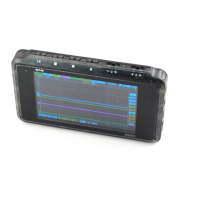
Then Seeed Studio brought out the DSO Nano Oscilloscope. Still a bit slow, but quite usable. DSO
is just getting better all the time, and now we have DSO203, sampling at 72 MHz. It is the pocket
oscilloscope we dreamed about 10 years ago. It is reality.
Thanks to those hard working souls in China to bring us this marvelous instrument. The complaints I
heard was mostly about the user manual. It’s very small characters are hard to read. It’s Chinglish is
difficult to understand. So, I took it on myself to edit the text to make it easier to read. However, I
had the fame of writing in Tinglish, and the manual still have rooms for improvements. Your
critiques, comments, and suggestions are welcome.
Dr. Chen-Hanson Ting
156 14
th
Avenue
San Mateo, CA 94402 USA
002-1-650-571-7639
ting@offete.com.


 To Previous Page