31
Cause Grease, varnish, rust or dirt on the filler material.
Solution Always use quality materials and products.
Keep the filler material always in perfect condi-
tions.
Cause Incorrect welding mode.
Solution Carry out the correct sequence of operations for
the type of joint to be welded.
Cause Pieces to be welded have different characteristics.
Solution Carry out buttering before welding.
Cold cracks
Cause Humidity in the weld material.
Solution Always use quality materials and products.
Keep the weld material always in perfect conditions.
Cause Particular geometry of the joint to be welded.
Solution Pre-heat the pieces to be welded.
Carry out post-heating.
Carry out the correct sequence of operations for
the type of joint to be welded.
For any doubts and/or problems do not hesitate to contact
your nearest customer service centre.
6 CONTINUOUS WIRE WELDING THEORY
6.1 Introduction
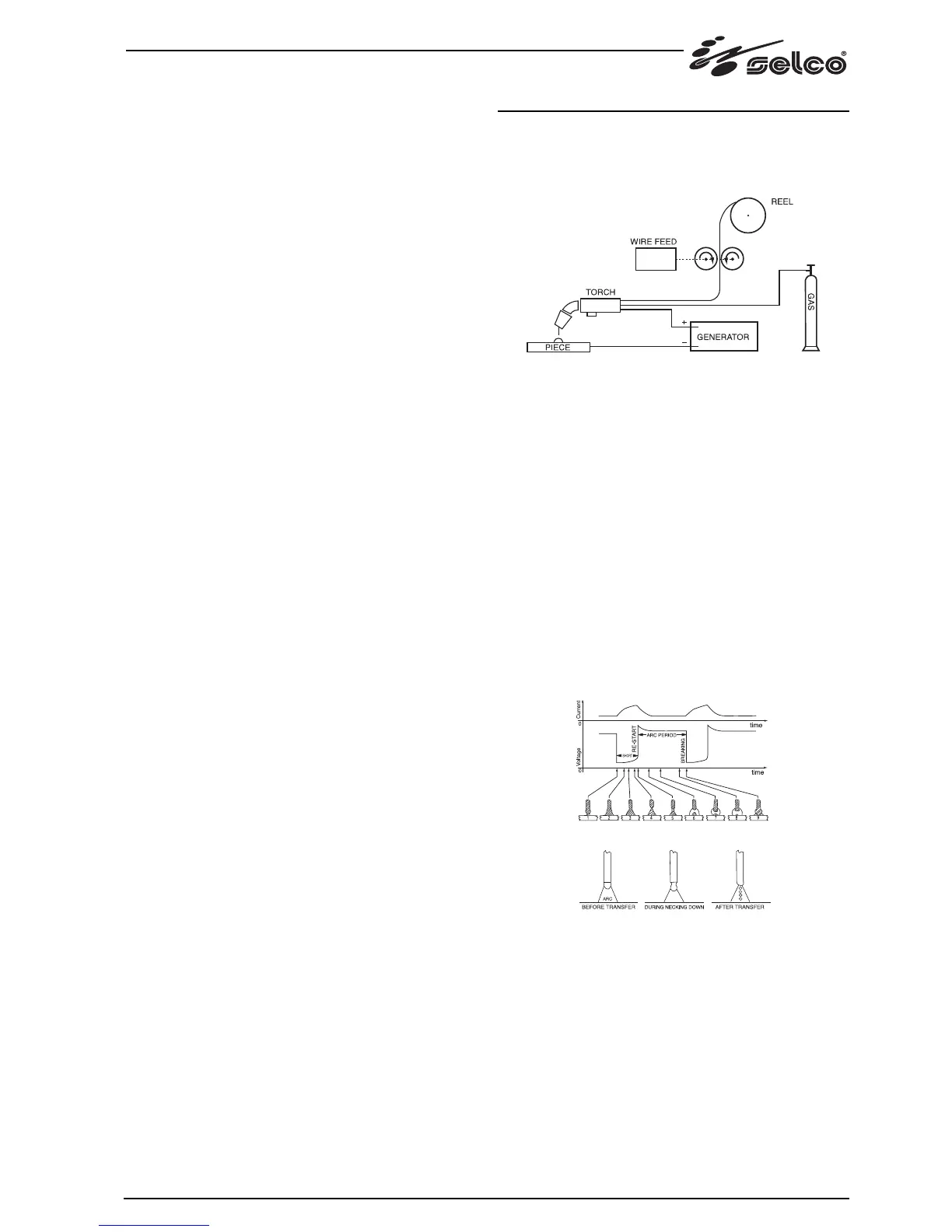
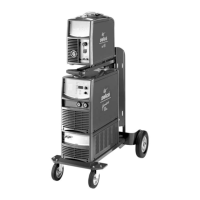
A MIG system consists of a direct current power source, wire
feeder, wire spool, torch and gas.
MIG manual welding system
The current is transferred to the arc through the fusible elec-
trode (wire connected to positive pole); in this procedure the
melted metal is transferred onto the workpiece through the arc
stream. The automatic feeding of the continuous filler material
electrode (wire) is necessary to refill the wire that has melted
during welding.
6.1.1 Methods
In MIG welding, two mains metal transfer mechanism are
present and they can be classified basing on the means by
which metal is transferred from the electrode to the workpiece.
The first one, defined “SHORT-ARC”, produces a small, fast-
freezing weld pool where metal is transferred from the electrode
to the workpiece only during a period when the electrode is
in contact with the weld pool. In this timeframe, the electrode
comes into direct contact with the weld pool generating a short
circuit that melts the wire which is therefore interrupted. The
arc then turn on again and the cycle is repeated (Fig. 1a).
SHORT cycle (a) and SPRAY ARC welding (b)
Another mechanism for metal transfer is called “SPRAY-ARC”
method, where the metal transfer occurs in the form of very
small drops that are formed and detached form the tip of the
wire and transferred to the weld pool through the arc stream
(Fig. 1b).
Fig. 1a
Fig. 1b





 To Next Page