“1
Light -
K\
~b+fi
,
Ov
.
. .
@
.
.’
.-
@,..
\
~~> ‘,:.’””””
CGL> “=’\
Aluminiurn
\
●
layer
I
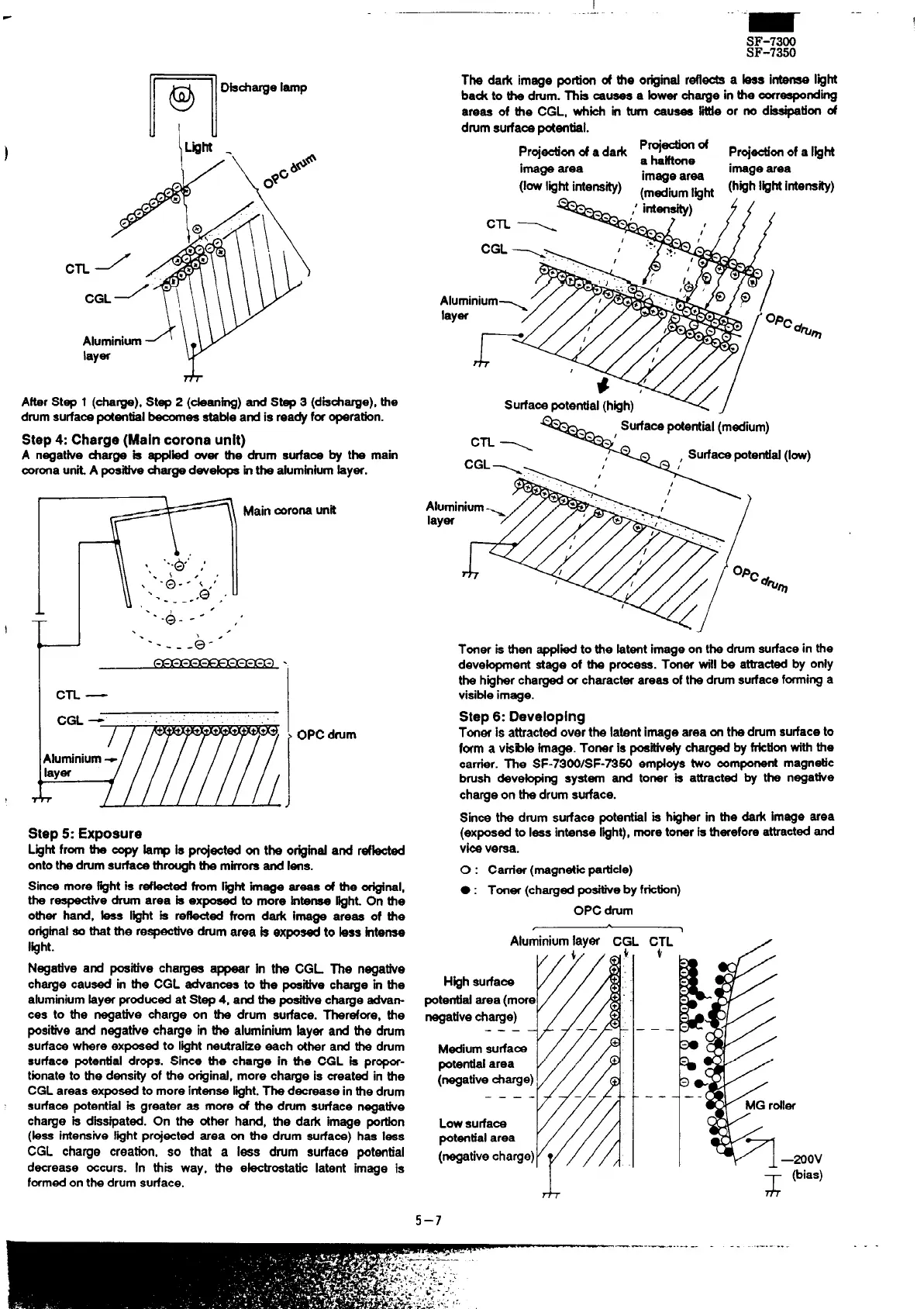
AfterStep 1 (chew), Step 2 (cben~) and Step 3 (dis+arge), the
drumsutiacepotmtial becomesstaNe and is readyfw operation.
Step 4: Charge (Main corona unit)
A negattie charge h -H over the drum surface by the main
-rona unk A positfvechargedevebpe .mthe akmhh kyer.
~Main””””’
I
-w -- ,
J
‘... -_ Q-’
I
‘m “-
SF-7300
SF-7350
OPC drum
J
Step5: Exposure
Lig~ from & copy k~ b p~eoted on the Origrndand rd~
ontothe dmm surfacethroughthe mhore and lens.
Since more @ht is rafbcted from light image areas of the ~nel,
the reepecttie drum area k exposed to more hte- %h~ On the
other hand, W l~ht is re-ed from dti image areas of the
originalso thattie respectie drum area b exposedto kss htense
l~M.
Negatie and postie chagea -r in the CGL The negatie
ch~e caused in the CGL advances to the poetie charge m the
aluminiumkyer prduced at Step 4, and the positivecharge advsm
ces to the negatie charge on the drum sudace. Therefore, the
positiveand negattie charge in the aluminiumhyer ad the drum
surfacewhere exposed to Ight neutrdhe each other and the drum
surface pote~al drops. Since the charge in the CGL is pr~-
tiorrateto the density of the original,more ch~e is created in the
CGL areas exposedto more intense light.The decrease inthe drum
sutiace poterrtid is greater as more of the drum surface negative
charge .S dksipated. On the other hand, the dak image portbn
(kss intensive light prqected area on the drum surface) has less
CGL charge creatbn, so that a less drum surface potential
decrease occurs. In this way, the ebctroetatic latent im~e is
formedon the drumsurface.
The dak image potion of the o~rnd r~ti a bs intense ligM
ba& to b drum. This causes a bww ch~e in the corresponding
areas
oftheCGL, whbh in turn muses tie
dmm surfacepotmdal.
or no dissipationof
Prqectfonof a l~ht
imagearea
(highl~M intensity)
Alumi
layer
cd~h
low)
Alumi
layer
Toner is then appfiedto the ktent image onthe drumsudace in the
devebpment stage of ~ process. Tonw wiil be attractedby only
the hgher che~ or characterareas ofthe drumsurfaceforminga
visiMeimage.
Step 6: Developing
Toner is attractedover the latent image area on thedrumsufiace to
fm a visbk hage. Toner is pos~~ chargedby frfctionwiththe
carrier. The SF-73001SF-73W em~oys two mmponent magnetic
brush devebpirrg system end toner is attracted by the negsfie
chargeon thedrum sudace.
Since the drum surface potential b h~her in the da~ imqe area
(exposedto lees intense ~ht), moretoneris thwefore attractedend
vi~ versa.
O : Cader (magneticpetide)
● : Toner (chargedpositiveby friction)
OPC drum
AluminiumlayW CGL CTL
/
t
—
—
--
--
-*
MGroller
—200V
~ (bias)
I
5–7
—.—..—. ..... .. . . . .. .. ..



 To Next Page