EasyManua.ls Logo

Sharp SF-7700 - User Manual

Sharp SF-7700
98 pages
Print Icon
To Next Page IconTo Next Page
Loading...
—...—-.—. ,.-
.-,....
.—.. ....... ..—.... .
‘m ‘“-’--
sF-77m
k.
SF-77W
SHARP SERVICEMANUAL
g’
CODE: OOXN750S~
mj
.“ ‘.-
SF-7700
~
MODELSF-7750
.
v
CONTENTS
%
[1]
[2]
[3]
[4]
[5]
[6]
[7]
[8]
[9]
[10]
[11]
[12]
[13]
[14]
[15]
[16]
BASIC SPECIFICATIO~S .......................................................................
1-1
UNPACKINGAND INSTALLATION
........................................................
2?1
INSTAL~TION OF OPTIONAL EQUIPMENT .......................................
copy QUALITY ADJUSTMENTS
3-1
...........................................................
41
SUPPLIES
................................................................................................
5-1
E~ERNAL AND INTERNAL STRUCTURE ............................................
6-1
COPY PROCESS
7-1
....................................................................................
PAPER FEED UNIT
.................................................................................
8-1
HIGH VOLTAGE UNITS -..........................................................................
91
OPTICAL SYSTEM
..................................................................................
1o-1
DEVELOPER UNIT
................................................................................
11-1
SEPARATION UNIT
............................................................................... 12-1
FUSER UNIT
..........................................................................................
13-1
OTHERS
................................................................................................. 14-1
MAINTENANCE .....................................................................................
15-1
SELF-DIAGNOSIS ANDTEST FUNCTIONS
........................................ 16-1
.
,,
1
SHARP CORPORATION
-
—.—.—

Question and Answer IconNeed help?

Do you have a question about the Sharp SF-7700 and is the answer not in the manual?

Overview

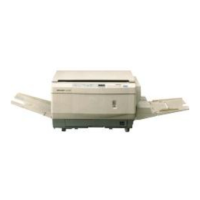
The Sharp SF-7700 and SF-7750 are photocopiers designed for office use, offering a range of features for document reproduction. The SF-7750 model includes variable magnification capabilities, while the SF-7700 operates at a fixed magnification.

Function Description

Both models utilize an Organic Photo Conductor (OPC) drum for the copy process. The process involves several steps:

  1. Charging: A uniform negative charge is applied to the OPC drum surface by the main corona unit.
  2. Exposure: The original document is illuminated by a copy lamp, and the reflected light is projected onto the drum. This dissipates the charge in non-character areas, forming an electrostatic latent image.
  3. Developing: Positively charged toner is attracted to the negatively charged latent image on the drum, forming a visible image.
  4. Transfer: The visible toner image is transferred from the drum to the copy paper by the transfer corona unit, which applies a negative charge to the back of the paper.
  5. Fusing: The toner image is permanently fixed to the paper by heat and pressure from the fuser unit.
  6. Cleaning: Residual toner on the drum is removed by a cleaning blade, and the drum surface is optically discharged by a blank lamp to prepare for the next copy cycle.

The SF-7750 features an optical system with a stepping motor that allows the lens position to shift, enabling reduction and enlargement from 0.64 to 1.54 in 91 increments of 0.01. The SF-7700 has a fixed lens, operating only at normal magnification. Both models use a slit exposure and a moving light source with a stationary original table.

Important Technical Specifications

  • Copying System: Dry-type electrostatic plain paper copier.
  • Originals: Sheets, books.
  • Original Size: Up to 11" x 17" (A3) maximum.
  • Copy Size: 11" x 17" (A3) to 8-1/2" x 5-1/2" (A6).
  • Copy Speed:
    • SF-7750 (AB Series): A4 portrait: 15 sheets/min (normal), 10 sheets/min (reduce), 10 sheets/min (enlarge). A4 landscape: 9 sheets/min (normal), 8 sheets/min (reduce), 9 sheets/min (enlarge). B5 landscape: 9 sheets/min (normal), 8 sheets/min (reduce), 9 sheets/min (enlarge). A3: 8 sheets/min (normal), 8 sheets/min (reduce), 8 sheets/min (enlarge).
    • SF-7750 (Inch Series): 8-1/2" x 11" portrait: 15 sheets/min (normal), 10 sheets/min (reduce), 10 sheets/min (enlarge). 8-1/2" x 14": 9 sheets/min (normal), 8 sheets/min (reduce), 9 sheets/min (enlarge). 11" x 17": 8 sheets/min (normal), 8 sheets/min (reduce), 8 sheets/min (enlarge).
    • SF-7700 (Same for AB and Inch Series): 15 sheets/min (8-1/2" x 11" / A4 portrait).
  • First Copy Time: 10 seconds (maximum).
  • Warm-up Time: 60 seconds (at rated voltage and room temperature of 68 degrees Fahrenheit, 20 degrees centigrade, and 65% relative humidity).
  • Multicopying: 1 to 99 copies.
  • Paper Feed: Double cassettes (250-sheet x 2), automatic feed, and single manual feed.
  • Magnification Ratios:
    • SF-7750 (AB Series): Normal (1:1 ± 1%), Reduction (64% to 95%, 91 increments of 1% each), Enlargement (104% to 154%, 91 increments of 1% each).
    • SF-7750 (Inch Series): Reduction (64% to 95%, 91 increments of 1% each), Enlargement (104% to 154%, 91 increments of 1% each).
    • SF-7700: Fixed ratio (1:1).
  • Exposure System: Slit exposure with stationary platen and moving light source, variable light intensity control.
  • Developing System: Two component magnetic brush development (positively charged toner and negatively charged carrier).
  • Toner Supply: Automatic toner control system, with magnetic sensor.
  • Photoreceptor: OPC drum.
  • Paper Separation: Separation with the remover tape and separation roller.
  • Cleaning System: Blade cleaning of the drum.
  • Original System: Front frame, left side aligned.
  • Charge System: Negative DC corona.
  • Transfer System: Negative DC corona.
  • Paper Transport System: Feed roller.
  • Discharge System: Optical discharge by means of a discharge lamp.
  • Light Source: Halogen lamp.
  • Power Requirements: 100V, 50/60Hz; 120V, 60Hz; 220V, 50/60Hz; 240V, 50/60Hz.
  • Power Consumption: Max. 1130W, 1180W (including SADF and Sorter). Average during standby/ready: 130W (20-25°C).
  • Fusing System: Heat roller type. Upper roller: Teflon coated. Lower roller: Silicon.
  • Physical Dimensions: 600mm (23.6") wide x 550mm (21.7") deep x 325mm (12.8") high.
  • Machine Installation Area: 1500mm (60") wide x 1200mm (48") deep.
  • Weight: Approximately 39kg (86 lbs).

Usage Features

  • Paper Feed Options: The devices offer versatile paper feeding with two cassettes and a manual feed tray. The manual feed tray supports paper weights from 13.8 lbs (52g/m²) to 34.1 lbs (128 g/m²), while cassettes support 14.9 lbs (56g/m²) to 21.3 lbs (80g/m²).
  • Local Mode Programming: Control programs can be adjusted to meet local requirements using test commands 79 and 78. This allows customization of model and local versions, paper size preferences, and supply voltage specifications.
  • Copy Quality Adjustments: Users can adjust copy density, void area, image loss, resolution, and skew to ensure optimal copy quality. The copy density correction level can be set to compensate for drum fatigue or dust in the optical system.
  • Optional Equipment: The copiers support optional accessories such as the SF-466 SADF (document feeder) and SF-413 (10-bin sorter), enhancing document handling capabilities.

Maintenance Features

  • Scheduled Maintenance: The SF-7700/7750 requires specific maintenance every 40,000 copies, including inspection and replacement of various components.
  • Developer Section: Developer (black), DV shield sheets, DV cover sheet, and drive gears require regular inspection and replacement.
  • OPC Drum Section: OPC drum, toothed wheel, cleaning blade, and paper separation sensor need attention.
  • Fuser Section: Upper and lower heat rollers, thermistor, separator pawls, lower heat roller cleaning roller, thermistor cleaning roller, and drive gears are critical components for maintenance.
  • Paper Feed Section: Cassette take-up rollers, PS rollers, paper transport rollers, paper feed rollers, spring clutch, and drive gears are part of routine maintenance.
  • Optics Section: Discharge lamp, CL harness, mirrors/lens/copy lamp/reflector, MHPS, mirror base drive wire and pulleys, mirror base rail/spring plate, AE sensor, LHP sensor (SF-7750 only), and blank lamp require inspection and cleaning.
  • Corona Unit: Main corona wires and transfer corona wires need regular cleaning and replacement.
  • Separator/Transport Section: Separation tape, separation roller, sub separation roller, transfer guide and wheel, and transport guide are subject to maintenance.
  • Other Components: Ozone filter, waste toner collect bottle, and various gears are also part of the maintenance schedule.
  • Test Commands for Diagnostics: A comprehensive set of test commands (e.g., 01-92) allows service engineers to diagnose malfunctions, adjust settings, and perform self-diagnosis functions such as checking sensor activation, motor operations, voltage levels, and counter readings.
  • Corona Wire Replacement: Detailed procedures are provided for replacing main and transfer corona wires, including precautions to prevent twisting or kinking.
  • High Voltage Unit Adjustments: Procedures for adjusting the DC output (DCD) of the main and transfer high voltage units are outlined, ensuring proper charging during the copy process.
  • Optical System Adjustments: Adjustments for mirror base parallelism, lens home position, and vertical/horizontal skew are crucial for maintaining copy quality, especially for the SF-7750's variable magnification.
  • Developer Unit Adjustments: Main pole and DV doctor blade to MG roller gap adjustments are detailed to prevent issues like lack of copy density, background on copies, or toner dusting.
  • Fuser Unit Maintenance: Procedures for replacing the lower heat roller cleaning roller, thermistor cleaning roller, separator pawls, and heater lamp are provided, along with checks for proper temperature control and safety devices.
  • Paper Separation Sensor Adjustment: This adjustment is necessary after replacing the sensor or its control PWB to ensure proper paper handling.
  • Self-Diagnosis Functions: The device includes self-diagnosis capabilities that display status codes (e.g., U1, H3, H4) to indicate malfunctions, aiding in troubleshooting.

Sharp SF-7700 Specifications

General IconGeneral
BrandSharp
ModelSF-7700
CategoryPrinter
LanguageEnglish

Related product manuals