&&: -.: . . : . .
.
-
“-’‘
SF-77W
SF-77S0
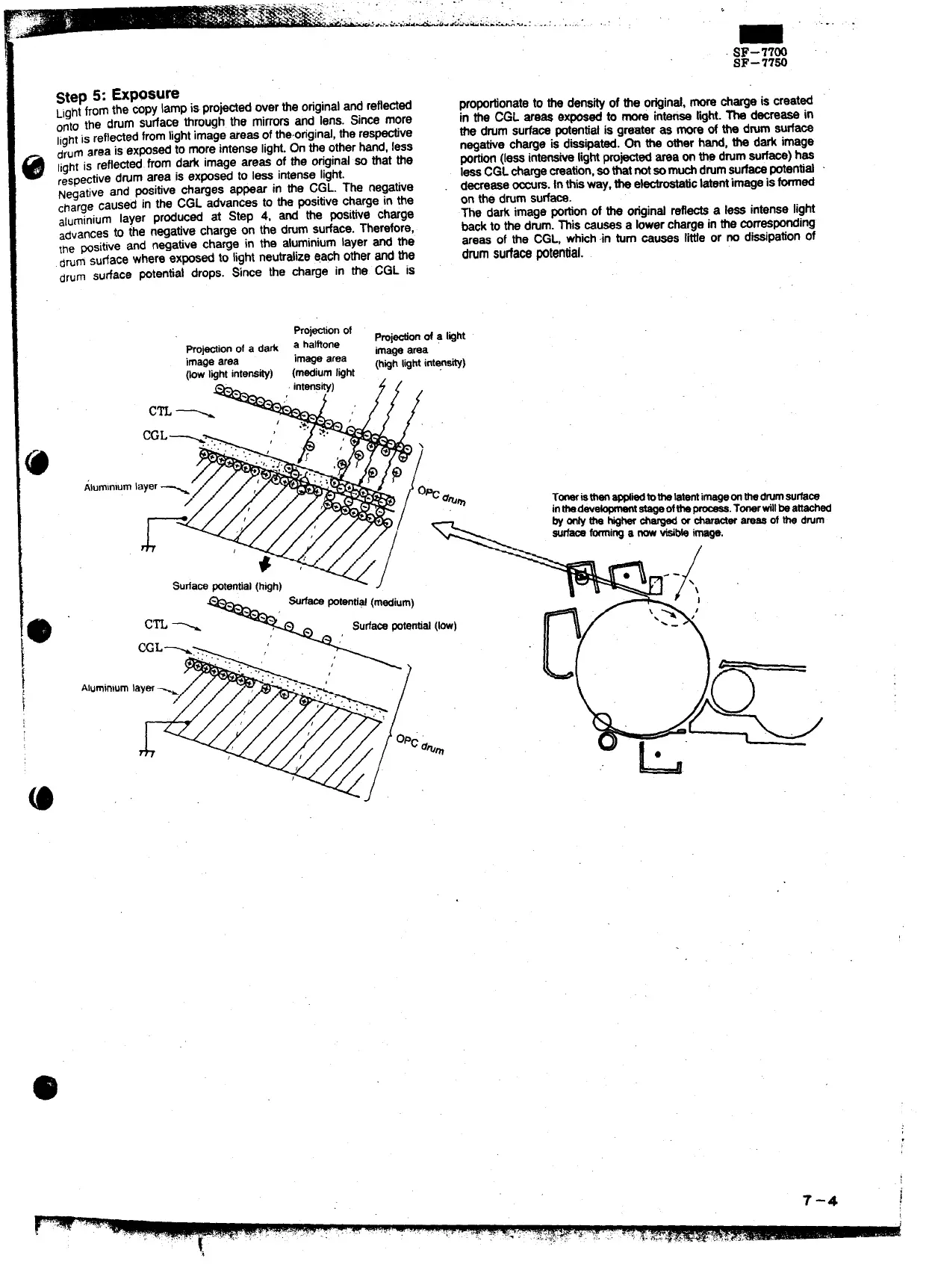
step5: Exposure
LightfrOrnthe ~PY lamPispropaed overthe originaland reflected
onto the dmm sudac,eth~ugh the mirrorsand lens. Since more
Ilghtis reflected~OmIlghtImageareas ofthe-original,the respective
drumarea is exwsw to Mre intenselight.On the otherhand,less
lightis reflectedfrOmda Image areas of the originalso that the
respectivedrumarea is eXPOSSdto leas intenselight.
NegatlVeand ~Slbve MaWeS appear in the CGL. The negative
charge caused In the CGL advances to the positivecharge in the
a!uminium layer pr~uc~ at SteP !, ~ Me Wsitie ch~9e
advancesto the nS9ativecharge on the drum surface. Therefore,
lhe positive and negative charge in the aluminiumlayer and the
drumsuflace where exm to lightneu~~ize each Ornerad me
drum sudaCe wtential drops. since the charge in the CGL is
proportionateto the densityof the mind, mora chargeis created
in the CGL areas exposedto more in~se rght. h decrease in
the dmm surfacepotentialis greater as moreof the drum surface
negativecharge is dissipated.On the other hand, the dark image
portion(leas intensivefightpro~ed area onme drumsurface)has
leaaCGLchargecreatiOn,sothatnotaomuch dmmsuti- potential
decreaseoccurs.Inthisway, the el
~tic latentimageis formed
on the drumsurface.
The dark image portionof the origirrdreflectsa less intenselight
&ck to the dmm. This causesa lowercharge in the com@iW
areas of the CGL, whichin turn causes Itie or no dissipationof
dwm SUtiaCS@tential.
Proj~on of
Proj@ti ofa dafi
a halftone
imagearea
imagearea
(W I@htintensW) (mediuml@ht
Pro@on ofa l@t
imagearea
(hQhtightint~~)
.-
Atummlum
AluminlumI
7-4
j
.... .
~.
d


 To Next Page