Why can't I adjust my Shure Receiver controls?
- SSean SnyderAug 28, 2025
If you see 'LK' on the receiver display of your Shure Receiver when buttons are pressed, the controls are locked. Please refer to the section on Locking and Unlocking Controls.
Why can't I adjust my Shure Receiver controls?
If you see 'LK' on the receiver display of your Shure Receiver when buttons are pressed, the controls are locked. Please refer to the section on Locking and Unlocking Controls.
Why I am unable to adjust the gain control on my Shure Receiver?
If you are unable to adjust the gain control on your Shure Receiver, check the transmitter. The transmitter must be on to enable gain changes.
Why is the transmitter ID function not responding on my Shure device?
If the transmitter ID function does not respond and the transmitter LED flashes green three times, the controls are locked. Please refer to the section on Locking and Unlocking Controls.
Why is the transmitter information not showing on my Shure Receiver LCD?
If the transmitter information does not appear on the Shure Receiver LCD, the linked transmitter is either off, or the receiver is not linked to a transmitter.
Why does my Shure Transmitter power off after one hour?
GLX-D transmitters automatically turn off after one hour to conserve battery life if the signal from a linked receiver is not detected. Ensure that the linked receiver is turned on.
What to do if my Shure Receiver has no sound?
If your Shure Receiver has no sound, check the following: * If the Receiver RF LED is on, verify all sound system connections or adjust gain as needed and ensure the receiver is connected to the mixer/amplifier. * If the Receiver RF LED is off: * Turn on the transmitter. * Make sure the batteries are installed correctly. * Link the transmitter and receiver. * Charge or change the transmitter battery. * If the Receiver LCD screen is off: * Make sure the AC adapter is securely plugged into the electrical outlet. * Make sure the receiver is powered on. * If the Transmitter indicator LED is flashing red, charge or change the transmitter battery. * If the Transmitter is plugged into the charger, disconnect it.
What to do if my Shure Music Pedal has no sound?
If your Shure Music Pedal has no sound or a faint sound, there could be several reasons: * If the Receiver RF LED is on, verify all sound system connections or adjust the gain as needed, and ensure the receiver is connected to the mixer/amplifier. * If the Receiver RF LED is off, turn on the transmitter, ensure the batteries are correctly installed, link the transmitter and receiver, and charge or change the transmitter battery. * If the Receiver display is off, ensure the AC adapter is securely plugged into the electrical outlet and that the receiver is powered on. * If the Transmitter indicator LED is flashing red, charge or change the transmitter battery. * If the Transmitter is plugged into the charger, disconnect it from the charger.
Why does my Shure Music Pedal have audio artifacts or dropouts?
Audio artifacts or dropouts in your Shure Music Pedal can occur if the RF LED is flickering or off. Here's what you can do: * Change the receiver and transmitter to a different group or channel. * Identify and remove nearby sources of interference such as cell phones, Wi-Fi access points, or signal processors. * Charge or change the transmitter battery. * Ensure the receiver and transmitter are positioned within system parameters. * Set up the system within the recommended range and keep the receiver away from metallic surfaces. * Use the transmitter in line of sight from the receiver for optimal sound.
What to do if my Shure Music Pedal has distortion?
If your Shure Music Pedal is experiencing distortion and the receiver audio LED blinks rapidly, reduce the transmitter gain.
Why won't my Shure Music Pedal receiver/transmitter turn off?
If your Shure Music Pedal receiver or transmitter won't turn off and the transmitter LED is flashing rapidly, the controls are likely locked. Refer to the section on Locking and Unlocking Controls.
Essential safety guidelines for operating the wireless system and related equipment.
Critical safety information regarding battery use, replacement, and potential hazards.
Lists the parts that come with the system and other available accessories for purchase.
Step-by-step guide for initial system setup and establishing a wireless link.
Identifies and explains the function of all controls and connectors on the GLXD4 receiver.
Describes the status indicators, battery life, and other information displayed on the receiver's LCD screen.
Details the transmitter's power switch, antenna, ports, and status LED behavior.
Instructions for properly positioning headworn and bodypack microphones for optimal audio capture.
Explains how to charge batteries using the receiver bay or external sources and interpret LED charge indicators.
Step-by-step guide for inserting rechargeable batteries into bodypack and handheld transmitters.
Guidance on setting up systems with multiple receivers and configuring combo systems.
Describes the process for manually linking transmitters to receivers and vice versa.
Strategies for overcoming challenges in the 2.4 GHz band, including Wi-Fi coexistence and performance tips.
Tables detailing frequency assignments for different groups and channels, along with latency information.
How to adjust audio gain and lock/unlock system controls to prevent accidental changes.
Features for identifying linked devices and manually choosing system groups and channels.
A guide to diagnosing and resolving common problems encountered with the wireless system.
Instructions for resetting the receiver and transmitter to their original factory configurations.
Detailed technical data including range, audio response, RF sensitivity, and output connection details.
Dimensions, weight, power requirements, and housing materials for the GLXD4 receiver.
Technical details specific to the GLXD1 bodypack transmitter, including its dimensions and connector.
Technical details specific to the GLXD2 handheld transmitter, including its dimensions and weight.
Information on FCC, IC, and European Union certifications and compliance standards.
Guidance for users on RF energy, interference, and best practices for installation.
Explains Shure's intelligent automatic frequency management for seamless audio connections.
Details the smart battery system, charging options, and runtime benefits of GLX-D transmitters.
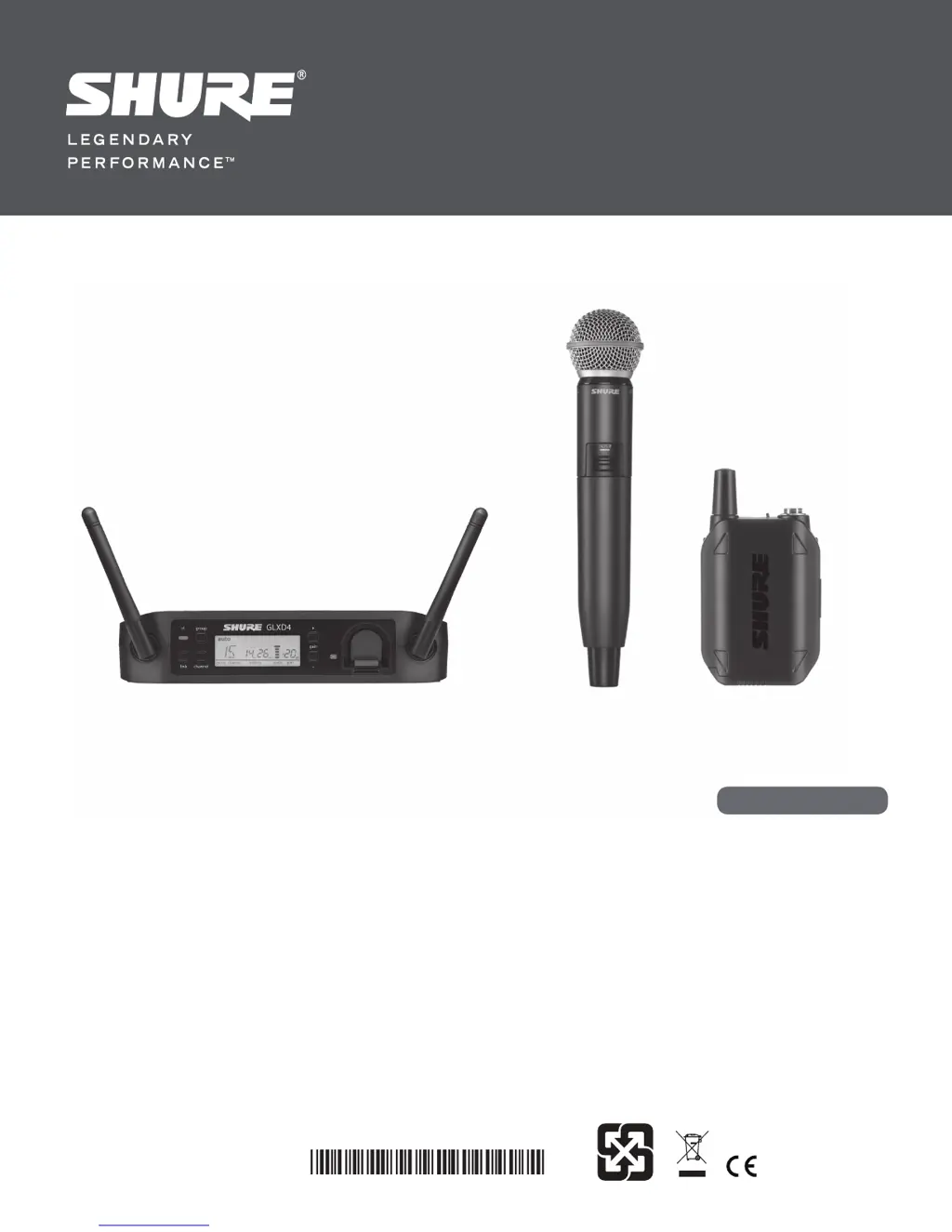
Features of the GLXD4 Wireless Receiver and GLXD6 Wireless Guitar Pedal Tuner & Receiver.
Features of the GLXD2 Handheld Transmitter and GLXD1 Bodypack Transmitter.
Various handheld microphone options for vocal applications with the GLXD2 transmitter.
Options for guitar, instrument, presenter, and headset applications using the GLXD1 bodypack transmitter.
Lists system options, included components, and technical specifications for GLXD2 and GLXD1 systems.
Covers operating range, frequency band, audio range, power, and battery life for the GLX-D system.
| Battery Life | Up to 16 hours |
|---|---|
| System Type | Digital Wireless |
| RF Output Power | 10 mW |
| Connector Type | 1/4" |
| Rechargeable Battery | Yes (Li-ion) |