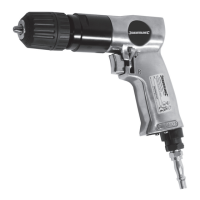
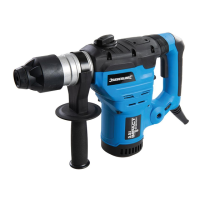
Air Drill Reversible793759
5
silverlinetools.com
• Inspect the tool periodically to verify that the ratings and markings required by ISO 11148
(detailed in the Description of Symbols) are legibly marked on the tool. The user (and employer
if appropriate) should contact the manufacturer to obtain replacement marking labels when
necessary.
• Compressedaircancausesevereinjury.
• Always disconnect the tool from the air supply when not in use.
• Always disconnect the tool from the compressed air supply before changing accessories, making
adjustmentsand/orrepairsandwhenmovingawayfromanoperatingareatoadifferentarea.
• Keepngersawayfromtriggerwhennotoperatingthetoolandwhenmovingfromone
operating position to another.
• Never direct compressed air at yourself, others or animals.
• Whippinghosescancausesevereinjury.Alwayscheckfordamagedorloosehosesorttings.
• Never carry or drag an air tool by its hose.
• When using air tools, do not exceed the maximum operating pressure.
• Inspect tools and accessories before each use. Do not use if damaged or excessively worn.
• Air tools should only be powered by compressed air at the lowest pressure required by the task to
reduce noise and vibration and minimise wear.
• Never use pure oxygen or combustible gases to power an air tool. Air tools are not designed for
thesepowersourcesandtheirusecreatesareandexplosionhazard.
• Be aware that air tools may become cold during use, affecting grip, control and susceptibility to
vibration-relatedinjury.
IMPORTANT: Even when this tool is used as prescribed it is not possible to eliminate all residual risk
factors. If you are in any doubt as to the safe use of this tool, do not use it.
Projectile Hazards
a) Be aware that failure of the workpiece, accessories, or tool itself can generate high-velocity
projectiles.
b) Always wear impact-resistant eye protection during operation of this tool. The grade of protection
required should be assessed for each use.
c) Assessrisktootherswhenconsideringprojectilehazardrisk.
d) Ensurethattheworkpieceissecurelyxed.
e) Remove the chuck key before drilling starts.
f) Ensurethatthedrillbitissecurelyxedinthechuck.Insecuredrillbitscanbeejectedfromthe
machine causing a hazard.
Entanglement Hazards
a) Injurycanoccuriflooseclothing,personaljewellery,neckwear,hairorglovesarenotkeptaway
from the tool and its accessories.
Operating Hazards
a) Ensure users and maintenance personnel are physically able to handle the bulk, weight and
power of the tool.
b) Hold the tool correctly; be ready to counteract normal or sudden movements such as recoil. Have
both hands available.
c) Maintain a balanced body position and secure footing.
d) Only use lubricants recommended by the manufacturer.
e) Personal protective safety glasses should be used; suitable gloves and protective clothing are
recommended.
f) For overhead work, wear a safety helmet.
g) Avoiddirectcontactwithmovingpartstopreventinjurybypinchingorcutting.
h) Be aware that there is a risk of electrostatic discharge if used on plastic and other non-conductive
materials. Take appropriate steps to reduce this risk when working with these materials (e.g.
using a grounding system).
i) Beawarethatcertainmaterialsmaypresentreorexplosionriskswhenbeingprocessed.Take
appropriate precautions to reduce hazards. Employers should make risks clear to operators.
j) Switchoffdevice/releasestart-and-stopcontroliftheair/powersupplyisinterrupted.
k) High-reaction torque can be developed in the case of stalling, which can be caused by excessive
loads being applied to the drill bit, by the drill bit snagging on the material being drilled into or
by the drill bit breaking through the material being drilled.
l) In cases where the means to absorb the reaction torque are requested, it is recommended to use
a suspension arm whenever possible. If that is not possible, side handles are recommended for
straight-case tools and pistol-grip tools. In any case, it is recommended to use a means to absorb
thereactiontorqueabove4N⋅mforstraighttoolsandabove10N⋅mforpistol-griptools.
m) Keep hands away from the rotating chuck and drill bit.
n) Use of the tool can expose the operator’s hands to hazards, including cuts, abrasions and heat.
Wear suitable gloves to protect hands.
o) Always wait until the drill has come to a complete stop before putting it down.
p) Use metal and voltage detectors to locate concealed electric, water or gas lines. Avoid touching
live components or conductors.
Repetitive Motions Hazards
When using the tool the user may experience discomfort in the hands, arms, shoulders, neck or
other parts of the body.
a) Adopt a comfortable posture whilst maintaining secure footing and avoiding awkward or
off-balance postures. Change posture during extended tasks; this can help avoid discomfort and
fatigue.
b) Symptoms such as persistent or recurring discomfort, pain, throbbing, aching, tingling,
numbness, burning sensations or stiffness, should not be ignored. Inform employer if
appropriateandconsultaqualiedhealthprofessional.
Accessory Hazards
a) Disconnectthetoolfromtheairsupplybeforettingorchangingtheaccessory.
b) Avoid direct contact with the accessory during and after use. Accessories are often sharp and may
become hot during use.
c) Use only sizes and types of accessories and consumables that are recommended by the
manufacturer of the tool; do not use other types or sizes of accessories or consumables.
d) Ensure the maximum operation speed of any accessory equals or exceeds the rated speed
marked on the tool.
Work Area Hazards
a) Be aware of slippery surfaces caused by use of the tool and trip hazards caused by the air line.
Slips,tripsandfallsaremajorcausesofinjury.
b) Where possible do not obstruct thoroughfares and passageways with air lines or cables. Take
appropriatemeasurestoreducetriprisksuchaserectingwarningsignsandxingcablesandair
lines in place.
c) Proceed with care in unfamiliar surroundings to minimise risk from hidden hazards such as
utility lines.
d) The tool is not intended for use in potentially explosive atmospheres and is not insulated against
contact with electric power.
e) Ensure that there are no electrical cables, gas pipes, etc., which could cause a hazard if damaged
by use of the tool.
Dust and Fume Hazards
Dust and fumes can cause ill health (e.g. cancer, birth defects, asthma and/or dermatitis); risk
assessment and implementation of appropriate controls for these hazards are essential.
a) Risks assessed should include dust created by the use of the tool and the potential for disturbing
existing dust.
b) Direct the exhaust to minimise disturbance of dust.
c) Control dust and fumes at the point of emission as a priority.
d) Select, maintain and replace consumables / accessories as recommended in the instructions, to
prevent an unnecessary increase in dust or fumes.
e) Use respiratory protection in accordance with any employer's instructions and as required by
occupational health and safety regulations.
f) Take into account the risks associated with different materials. Working in certain materials
creates dust and fumes that may cause an explosive environment.
g) Always use dust extraction or suppression systems which are suitable for the material being
processed.
h) Operate and maintain this tool as recommended in these instructions, to minimize dust and
fume emissions.
i) All integral features or accessories for the collection, extraction or suppression of airborne dust
and fumes should be correctly used and maintained in accordance with the manufacturer’s
instructions.
Noise Hazards
Exposure to high noise levels can cause permanent, disabling hearing loss and other problems,
such as tinnitus (ringing, buzzing, whistling or humming in the ears). Risk assessment and use of
appropriate controls for these hazards are essential.
a) Useappropriatecontrolstoreducetheriskofnoise-relatedinjury.Thesecanincludeactionssuch
as damping materials to prevent workpieces from ‘ringing’.
b) Use hearing protection in accordance with any employer's instructions and as required by
occupational health and safety regulations.
c) Operate and maintain this tool as recommended in the instructions to prevent an unnecessary
increase in the noise level.
d) Select, maintain and replace the consumable / accessory as recommended in the instructions, to
prevent an unnecessary increase in noise.
e) Where a silencer is available, ensure it is in place and in good working order when the tool is
being operated.
f) Take steps to reduce noise in the work area where possible (e.g. by using damping mats).
793759_OwnerManual.indd 5793759_OwnerManual.indd 5 19/04/2024 08:5019/04/2024 08:50


 To Next Page
 Loading...