- 11 -
CZ sincro
DG83 D
To sensor
AD33A needle
TL 220 cable
To ECU
Continuous voltage or peak measurements allow to diagnose various faults,
such as: low battery voltage, sensors’ power supply, throttle potentiometer,
air flow meters, knock sensors, peak voltage of RPM sensors, reluctance sensors
of ignition modules, etc.
Press key
V
, LED 4 will light up (Fig. 1).
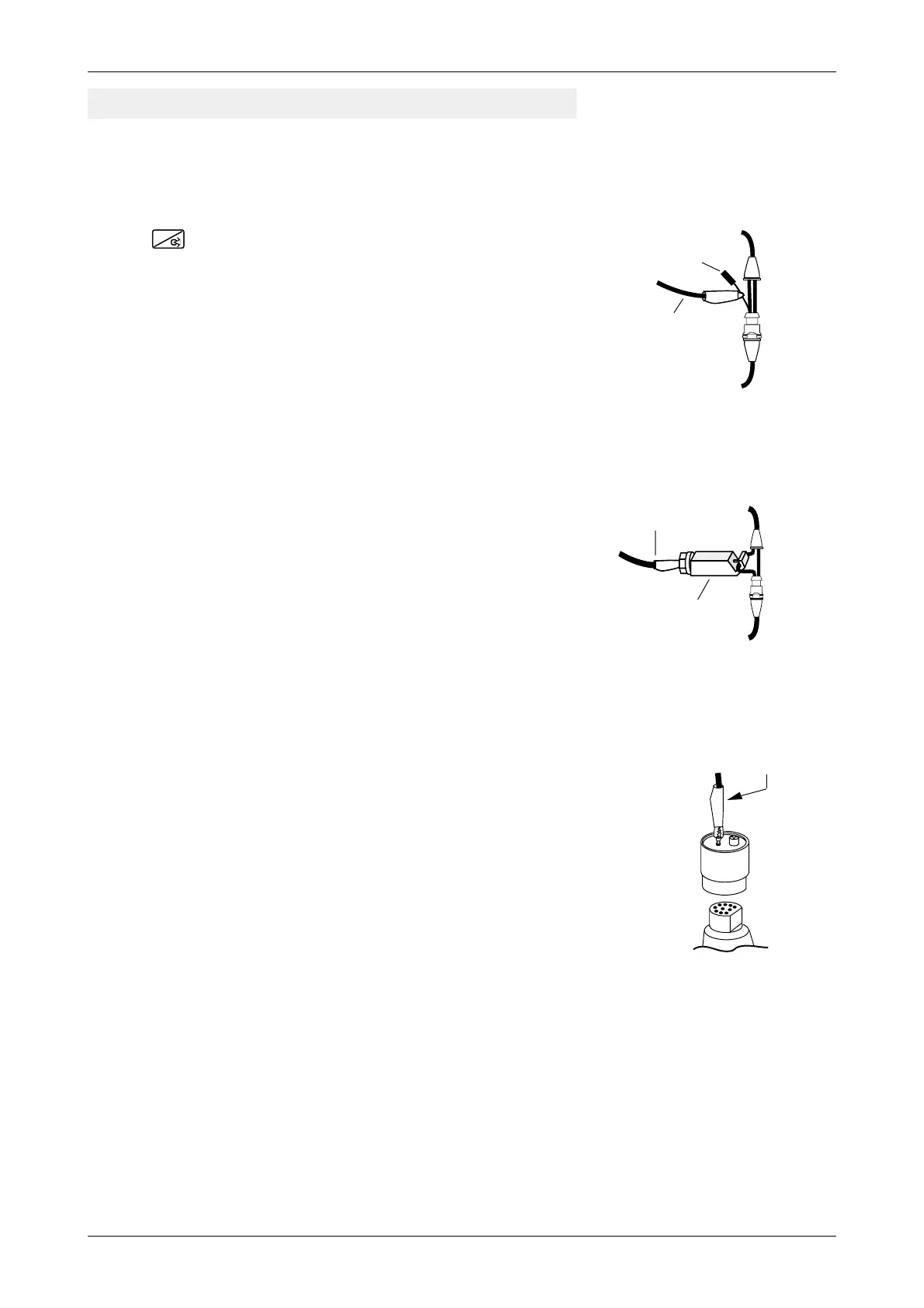
Signals can be picked up by piercing the wire (Fig. 13), through the AD33A
needle (Fig. 12) or by using the special adapter (Fig. 15 -16).
A blinking zero shows a lack of electrical signal.
6.1 Voltage on the air flow meter and throttle potentiometer
Connect the AD33A
needle as shown in Fig. 12, turn ignition on and
check that power supply voltage is within the limits foreseen by the
Manufacturer (usually 5 V).
Shift the connection to the sliding contact of the air flow meter, slowly
rotate the acceleration mechanism and check that voltage variation is
regular and within the limits foreseen by the manufacturer.
Eg.: on ALFA 75 Turbo with LE2 JETRONIC ECU, the voltage variation
on the sliding contact goes from 0.2 to 7.5 Volts.
If power supply voltage is missing, the cause could be an interruption
in the power supply cables, contacts’oxidation, etc.
Voltage variation instabilities are due to sliding contacts or worn
potentiometer tracks.
A high voltage residue cause an increase in RPM while the accelerator
pedal is released. Check that resistance of the ground return (battery
negative pole) is not higher than 0,2 V; higher resistances can be due
to interruptions in the connection from the engine to the chassis, oxidized
contacts, etc.
6.2 Peak voltage measurement on inductive sensors
Figs. 12 - 15 - 16. show the connection to inductive and RPM sensors.
A correct voltage of the RPM sensor ensures the engine start even at
low engine speeds (discharged battery, low temperature, etc.).
Output voltage of this type of sensor is about 4 Volts with the engine at
idle. Otherwise check: distance from teeth, presence of iron filings on
the sensor, filed teeth, contacts’oxidation.
NOTE
Faulty TDC sensors or an excessive gap can cause a wrong operation
of the injection ECU. Faulty RPM sensors usually make it stop.
If peak voltage goes below the values foreseen by the manufacturer
(about 1 V at 800 RPM) with the engine at 80°C, replace the sensor.
Problems at next cranking at a low temperatures could otherwise occur.
ADAPTERS FOR PEAK VOLTAGE
MEASUREMENTS
Fig. 13
Fig. 12
piercing
adapter
TL 220 cable
Fig. 14
adapter
Diagnostic
socket
BMW 320A
TL 220 cable
6.0 VOLTAGE MEASUREMENTS


 To Next Page