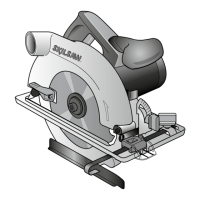
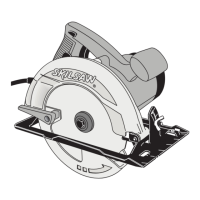
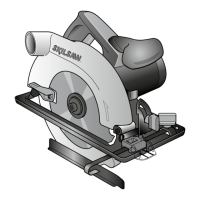
ATTACHINGTHE BLADE
_ Disconnect the plug from
the power source before
making any assembly, adjustments or
changing accessories. Such preventive
safety measures reduce the risk of starting
the tool accidentally.
1. Turn BLADE STUD with wrench provided
counter-clockwise and remove BLADE STUD
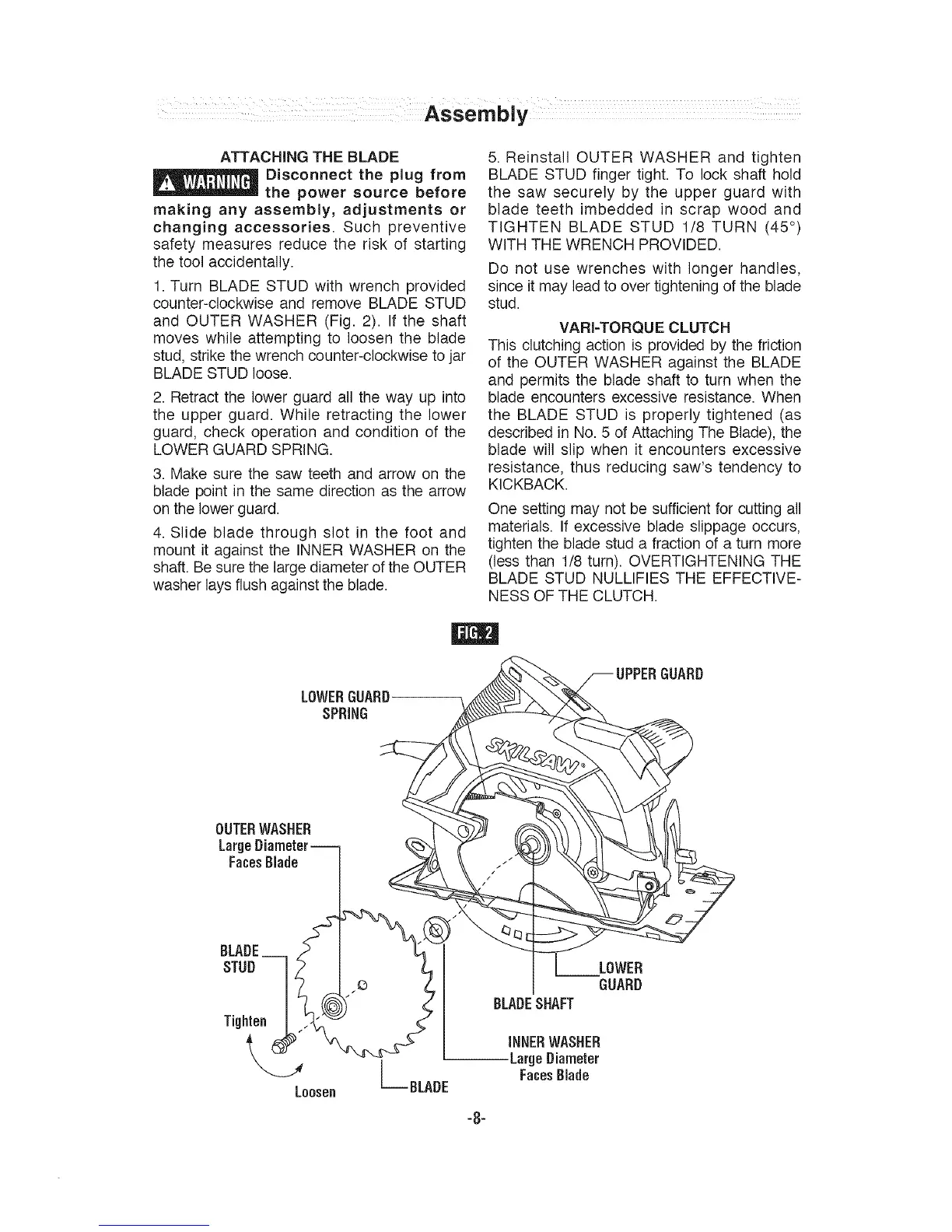
and OUTER WASHER (Fig. 2). If the shaft
moves while attempting to loosen the blade
stud, strike the wrench counter-clockwise tojar
BLADE STUD loose.
2. Retract the lower guard all the way up into
the upper guard. While retracting the lower
guard, check operation and condition of the
LOWER GUARD SPRING.
3. Make sure the saw teeth and arrow on the
blade point in the same direction as the arrow
on the lower guard.
4. Slide blade through slot in the foot and
mount it against the INNER WASHER on the
shaft. Be sure the large diameter of the OUTER
washer lays flush against the blade.
5. Reinstall OUTER WASHER and tighten
BLADE STUD finger tight. To lock shaft hold
the saw securely by the upper guard with
blade teeth imbedded in scrap wood and
TIGHTEN BLADE STUD 1/8 TURN (45 °)
WITH THE WRENCH PROVIDED.
Do not use wrenches with longer handles,
since it may lead to over tightening of the blade
stud.
VARFTORQUE CLUTCH
This clutching action is provided by the friction
of the OUTER WASHER against the BLADE
and permits the blade shaft to turn when the
blade encounters excessive resistance. When
the BLADE STUD is properly tightened (as
described in No. 5 of Attaching The Blade), the
blade will slip when it encounters excessive
resistance, thus reducing saw's tendency to
KICKBACK.
One setting may not be sufficient for cutting all
materials. If excessive blade slippage occurs,
tighten the blade stud a fraction of a turn more
(less than 1/8 turn). OVERTIGHTENING THE
BLADE STUD NULLIFIES THE EFFECTIVE-
NESS OF THE CLUTCH.
|
LOWERGUARD
SPRING
OUTERWASHER
Large
FacesBlade
BLADEj
STUD
Tighten
Loosen
--BLADE
LOWER
GUARD
BLADESHAFT
INNERWASHER
--Large Diameter
FacesBlade
GUARD
-8-



 To Next Page