10
A problem for many beginners is recognizing that a polar-aligned, equatorial mount acts like an alt-azimuth mount
where the RA axis has been aligned to a celestial pole.
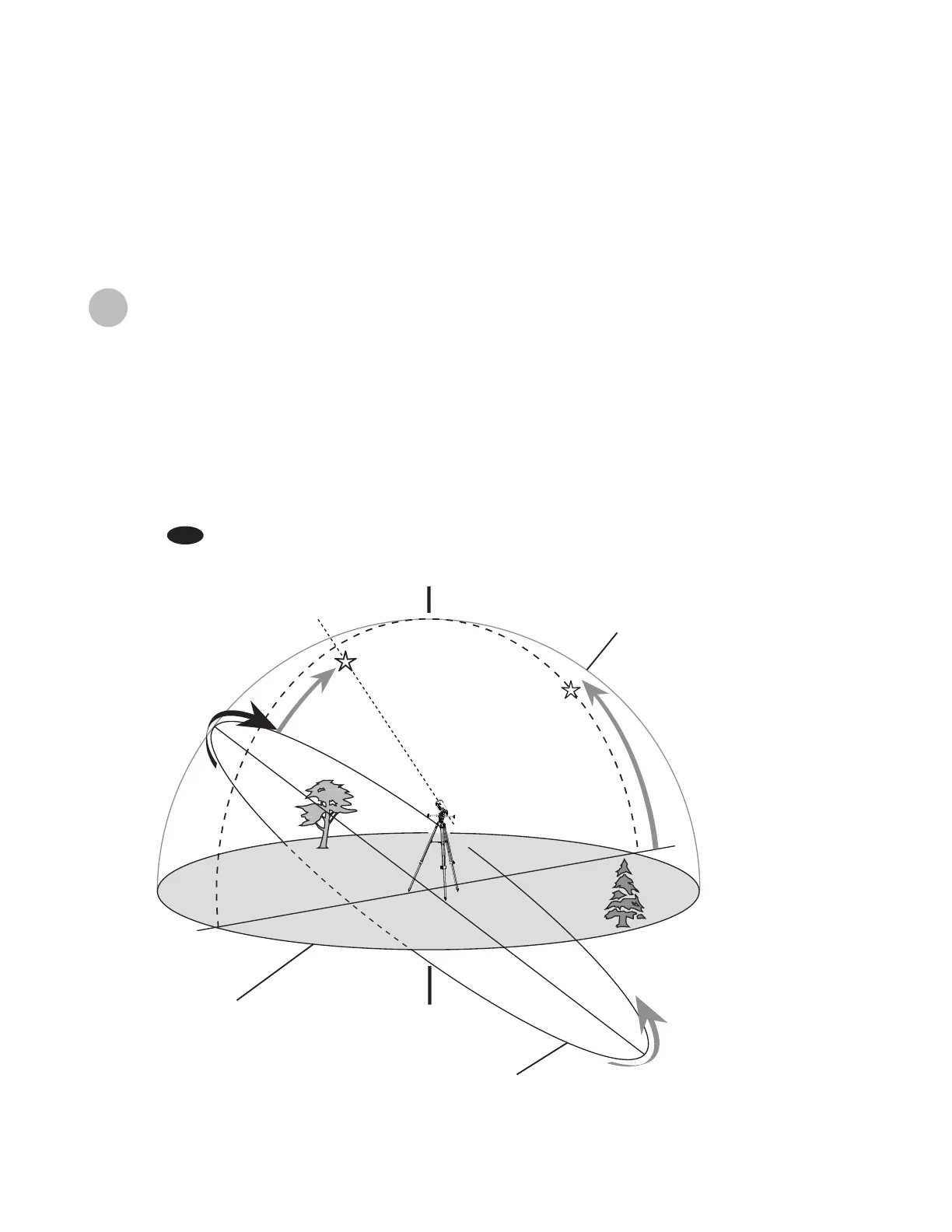
Once aligned The RA axis allows rotation as shown in g.14 where it scans the “new horizon”.
That scanning movement is the Right Ascension (RA) movement.
Part of the new horizon is usually blocked by the Earth.
This “new horizon” is called Plane of Celestial Equator.
The other movement of the mount, square to this rst movement, is the DEClination(DEC)movement.
Movement examples of the CQ40equatorial mount
Plane of local horizon
Nadir
Equatorial Mount
(Northern Hemisphere)
Mount aligned on
North Celestial Pole
Zenith
Right
Ascension
Apparent
movement
of stars
Plane of Celestial
Equator
Meridian
Line
Declination
Object you
are viewing
Polaris
Latitude
W
S
E
N
Vertical adjustment:
This is the role of the latitude adjustment lever. Loosen the latitude locking lever, adjust the height till the
marker of the latitude scale indicates the latitude of your observing site, and lock the latitude locking lever
again. The adjustments described to reach EQ mode orientation of the mount, can be done with or without
the telescope attached. But be aware the weight of the counterweight and the telescope puts a heavy load
on the latitude adjustment lever. Do not force on this lever, and help the rotation to reach the correct lati-
tude, if needed. For further easy operation, once the telescope is attached, it needs to be balanced with the
counterweight.
Adjust the balance of the telescope around the right ascension (RA) axis by loosening the right ascension
clutch knob and shifting the counterweight to the position where a balanced situation is obtained (g.5).
Fig.14




 To Next Page