11
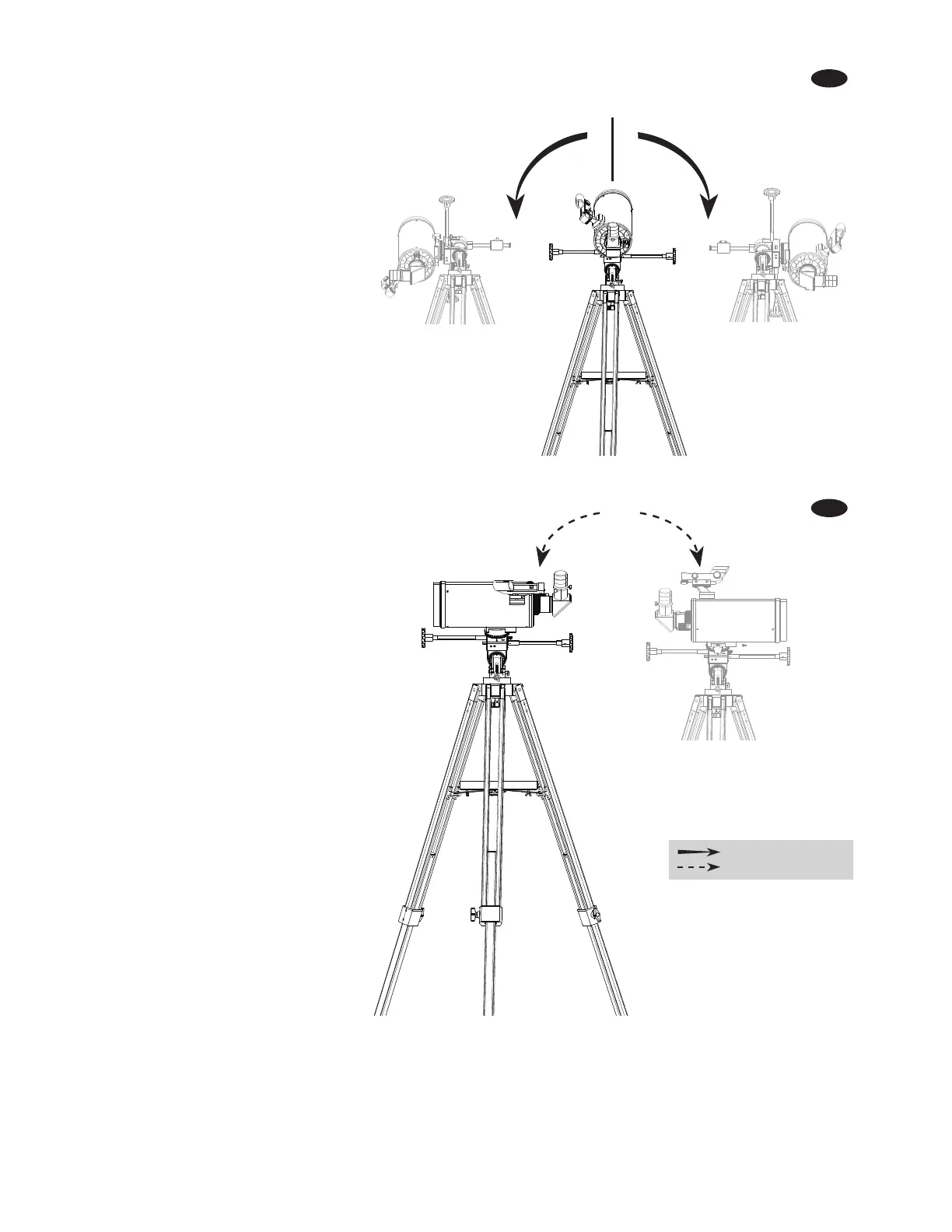
For the following examples, it is as-
sumed that the observing site is in the
Northern Hemisphere. In the rst case
(Fig.15.2), the optical tube is pointing
to the NCP. This is its probable position
following the polar-alignment step. Since
the telescope is pointing parallel to the
polar axis, it still points to the NCP as it is
rotated around that axis counter-clockwise
(Fig.15.1), or clockwise (Fig.15.3).
Now, consider pointing the telescope
to the western (Fig.16.1) or eastern
(Fig.16.2) horizon. If the counterweight
is pointing North, the telescope can be
swivelled from one horizon to the other
around the Dec axis in an arc that pass-
es through the NCP (any Dec arc will
pass through the NCP if the mount is
polar-aligned). It can be seen then that
if the optical tube needs to be pointed
at an object north or south of this arc,
it has to be also rotated around the R.A
axis (Fig.15).
Pointing to the North Celestial
Pole (NCP):
Pointing toward the western
or eastern horizon:
1
2
3
Celestial Pole
+
Telescope pointing West
Counterweight pointing North
Telescope pointing East
Counterweight pointing North
+
Celestial
Pole
1 2
Rotation of the Dec. axis
Rotation of the R.A. axis
Fig.15
Fig.16




 To Next Page