12
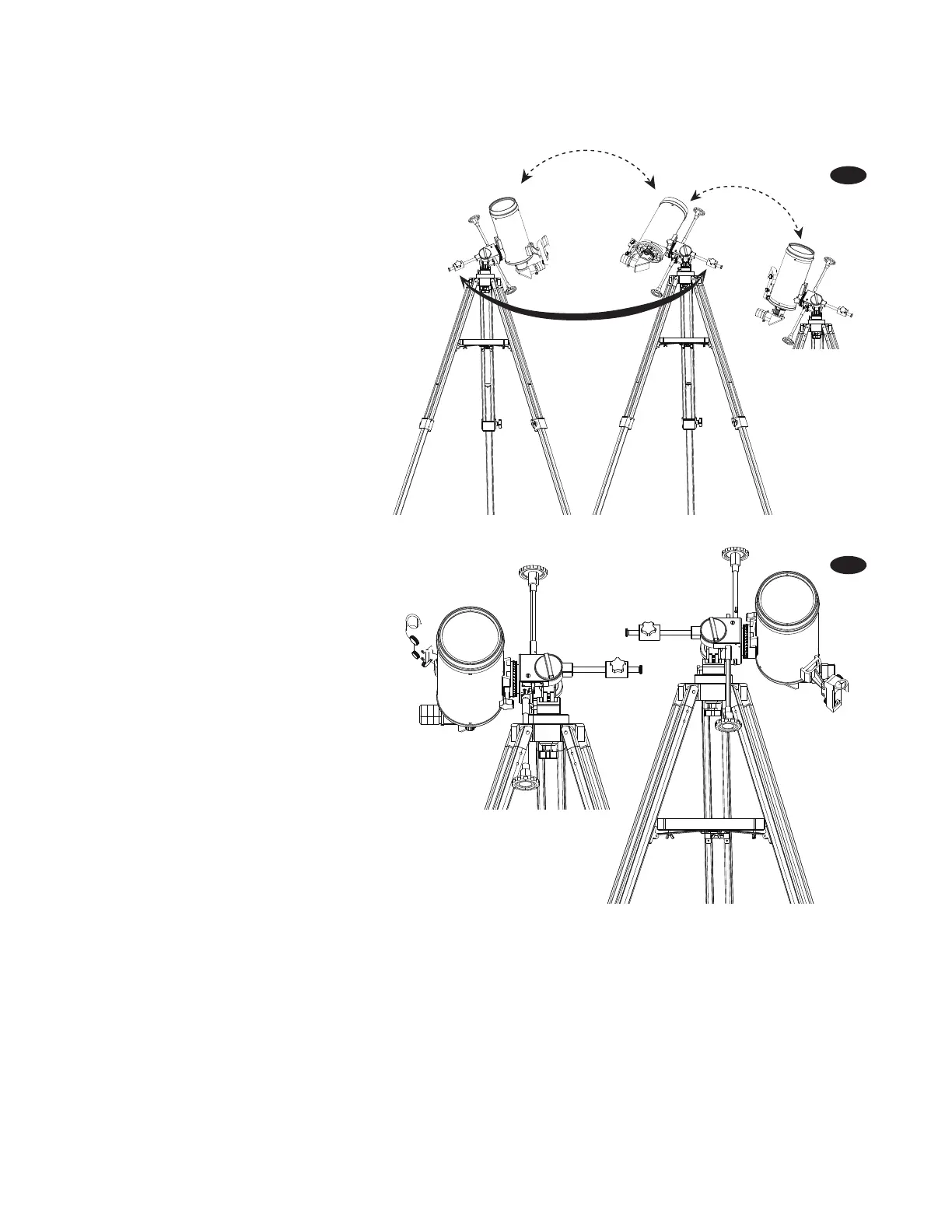
Pointing in any direction other than due North requires a combination of R.A. and Dec positions (Fig.17).
This can be visualized as a series of Dec arcs, each resulting from the position of rotation of the R.A. axis. In
practice however, the telescope is usually pointed, with the aid of a finderscope, by loosening both the R.A.
and Dec clutch wheels and swivelling
the mount around both axes until the
object is centered in the eyepiece field.
The swivelling is best done by placing
one hand on the optical tube and the
other on the counter-weight bar, so
that the movement around both axes
is smooth, and no extra lateral force is
applied to the axis bearings. When the
object is centered, make sure the R.A
and Dec clutch wheels are both retight-
ened to hold the object in the field and
allow tracking by adjusting only in R.A.
with the R.A. slow motion knob.
Pointing at an object, for example to the
South (Fig.18), can often be achieved with
the optical tube positioned on either side
of the mount. When there is a choice of
sides, particularly when there could be
a long observing period, the East side
(Fig.18.1) should be chosen in the North-
ern Hemisphere because tracking in R.A.
will move it away from the mount’s legs.
Pointing to directions other than due North:
Pointing at an object:
Fig.17
Fig.18
1 2




 To Next Page