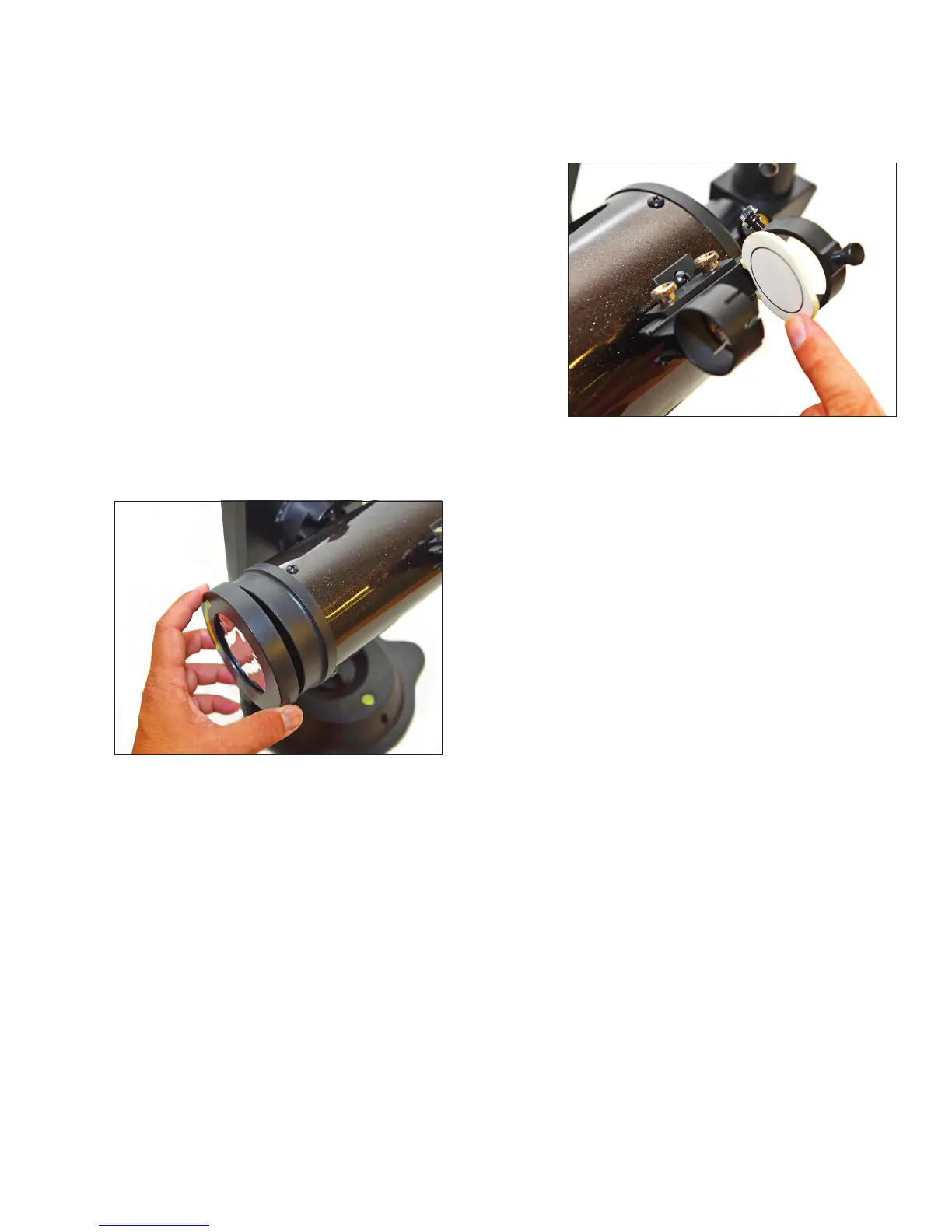
To install the solar filter:
1. Remove the finderscope from its bracket by loosening the
three adjustment screws and sliding the finderscope out.
Next, lift the white solar finder target on the lower part of
the finder bracket until it rests against the ring with the
setscrews in it. (Figure 13)
2. Point your telescope away from the Sun and remove the lens
cap.
3. Slide the lens cap over the main lens of your telescope in
the exact same way the telescope’s lens cap attaches. The
filter should be tight so that it will NOT fall off even when the
telescope is pointed toward the ground. For extra security,
use small pieces of masking tape to secure the filter to the
front of the telescope to prevent anyone from accidentally
knocking it loose. (Figure 14)
Once the solar filter is securely in place you are ready for your first
look. Point the telescope in the general direction of the Sun. Now, look at the white disk on the finder bracket.
Move the telescope towards the Sun until the shadow
cast by the front ring of the finder bracket appears in the
center of the white disk. You should be pointing directly
at the Sun. Look through a low-power eyepiece to see if
the solar image is there. If not, slowly sweep around until
the Sun comes into the field.
To clean the filter, use a photographic cleaning brush
to remove dust and other debris. Never rub the filter.
Be sure not to touch the filter itself when handling your
solar filter.
When not in use, store your filter in its box. Place the box
in a dry, warm environment that is relatively dust free.
Moisture on the filter will degrade its performance.
Do NOT use the solar filter if it is punctured in any way.
PeRfORMANCe LIMITATION ANd OPTIONS
The accuracy of tracking celestial objects depends on multiple factors, such as:
• Leveling of the base
• Accuracy of aligning to Polaris or the South Celestial Pole before turning the power on
• Accuracy of setting local latitude
• The type of the celestial object being observed (the Sun, Moon and planets appear to move
at a different rate than stars)
• The position of the celestial object in the sky
It is normal to find that celestial targets still drift slowly in the eyepiece of the telescope while the Virtuoso
is tracking the object, but the drift will be considerably slower than a telescope without the tracking function.
You’ll need to locate celestial objects and point the telescope to them manually. If you wish to locate celestial
objects automatically, you may consider purchasing an optional SynScan GOTO hand control, available
through your local Sky-Watcher distributor.
P.12
.:. Figure 13
.:. Figure 14




 To Next Page