crushed between the vehicle occupant
and seat belt.
R
objects are
never secured with a seat belt
if the seat belt is also being used by one
of the vehicle's occupants.
Seat belts are only intended to secure and
restrain vehicle occupants. Always observe
the "Loading guidelines" for securing
objects, luggage or loads (Y page 198).
Fastening seat belts
Observe the safety notes on the seat belt
(Y page 40) and the notes on correct use of
seat belts (Y page 41).
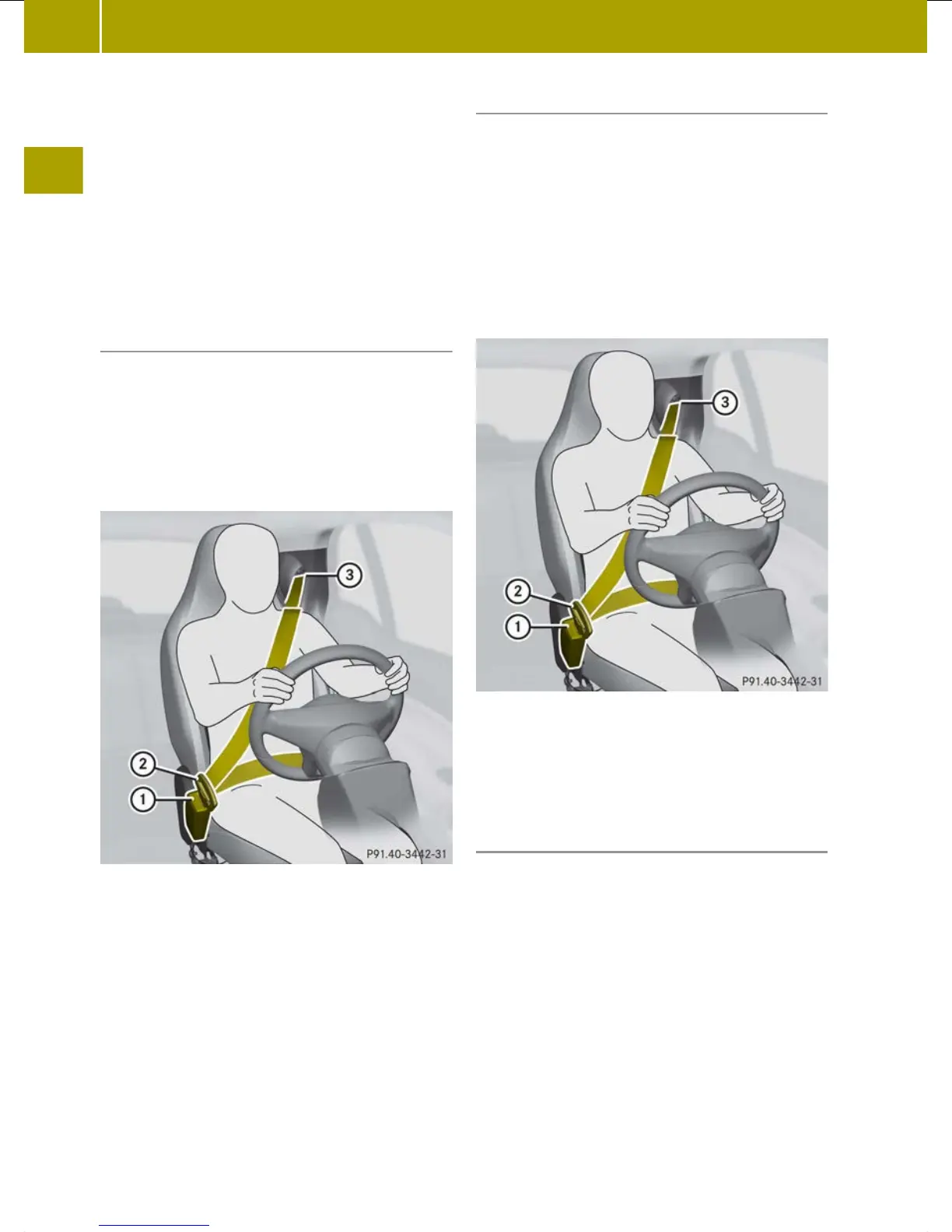
For easy
fastening, the seat belt is guided
through a belt loop on the side of the driv-
er's seat.
X
Adjust the seat (Y page 78).
The seat backrest must be in an almost
vertical position.
X
Pull the seat belt smoothly from belt out-
let = and engage belt tongue ; into
belt buckle :.
X
If necessary, pull upwards on the shoul-
der
section
of the seat belt to tighten the
belt across your body.
Releasing the seat belts
!
Make sure that the seat belt is fully
rolled up. Otherwise, the seat belt or
belt tongue
will be trapped in the door or
in the seat mechanism. This could dam-
age the door, the door trim panel and the
seat belt. Damaged seat belts can no lon-
ger fulfil their protective function and
must be replaced. Visit a qualified spe-
cialist workshop.
X
Press release button :, hold belt
tongue ; and
guide it back towards belt
outlet =.
Belt warning for the driver and front
passenger
The 7 seat belt warning lamp in the
instrument cluster is a reminder that all
vehicle occupants must wear their seat
belts. It
may light up continuously or flash.
In addition, a warning tone may sound.
The 7 seat belt warning lamp goes out
and the warning tone ceases when the driver
and the front passenger have fastened their
seat belt.
i
If you are using an ISOFIX child
restraint system on the front-passenger
seat and the child is not secured using
the seat belt of the front-passenger seat,
42
Occupant safety
>> Safety.




 To Next Page