S3215L/S3215E/S3219E/S3220E/S3226E/S4726E/S4732E – 1500834 31
Potential service and safety problems may be detected
by inspecting the aerial platform. This chapter includes
information on properly inspecting the aerial platform and
includes a prestart inspection check list at the end of this
chapter to ensure that no areas are overlooked.
Warning
The potential for an accident increases when operat-
ing an aerial platform that is damaged or malfunction-
ing. Death or serious injury could result from such
accidents. Do not operate the aerial platform if it is
damaged or malfunctioning.
Perform a prestart inspection at the beginning of each
shift, before using the aerial platform on the job. The
inspection site must have a smooth and level surface.
Note
Carefully read, understand and follow all safety rules,
operating instructions, labels and National Safety Instruc-
tions/Requirements.
Operator’s Manual
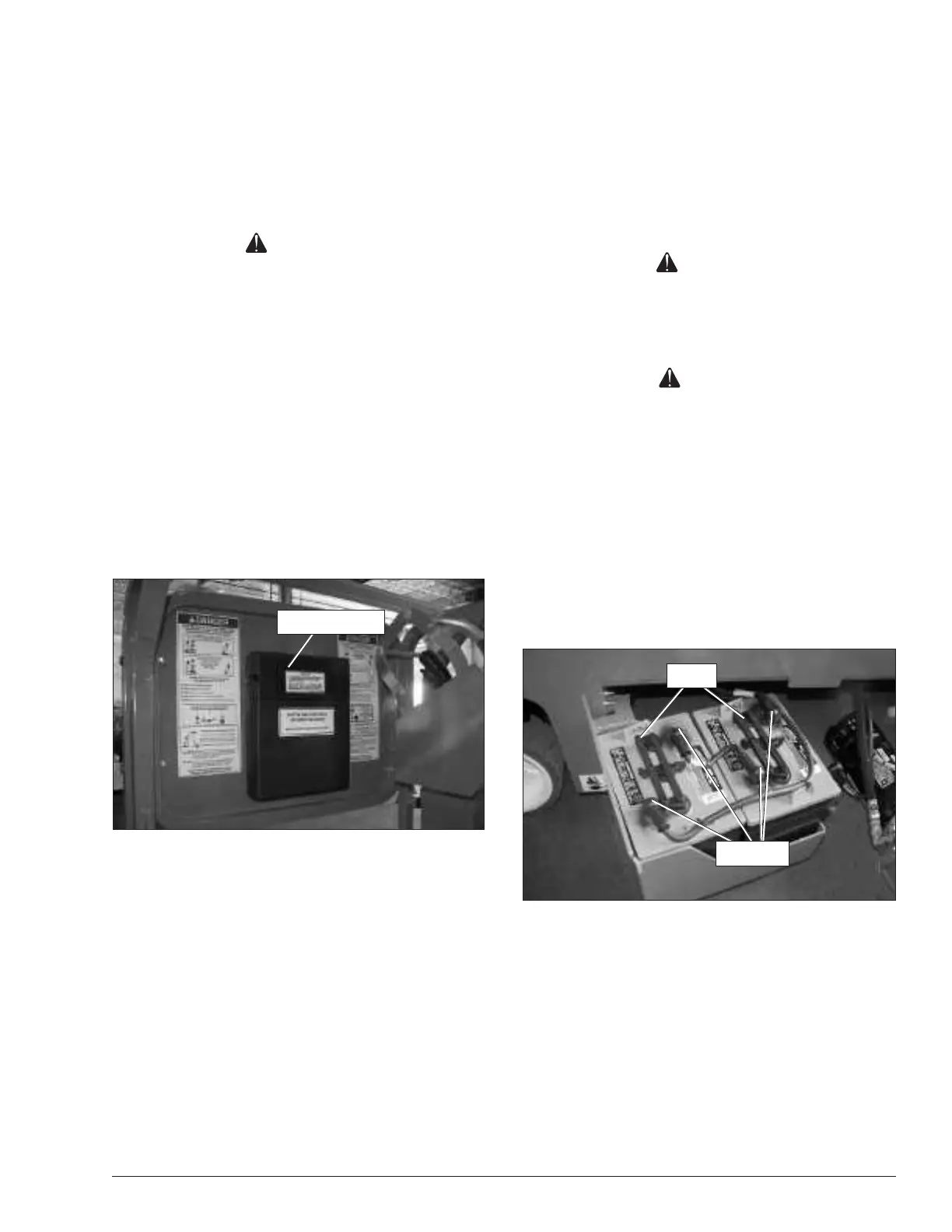
The manual holder is located on the oor of the platform
(refer to Figure 8.1).
Figure 8.1 – Operator’s Manual Holder
To inspect the operator’s manual and manual holder:
1. Make certain the Operator’s Manual holder is se-
curely fastened in place.
2. Check to see that the proper Operator’s Manual is in
the holder.
3. Check to see that the manual is complete with all
pages intact and in readable condition.
4. Make certain ANSI publication “Manual of Respon-
sibilities for Dealers, Owners, Users, Operators,
Lessors and Lessees of ANSI/SIA A92.6-2006 Self-
Propelled Elevating Work Platforms” is in the manual
holder.
Chapter 8 – Prestart Inspection
Electrical System
Electrical power is supplied from four, 6 volt batteries.
The batteries supply 24 volt DC electrical power to op-
erate the aerial platform drive and control system. There
is a battery tray on each side of the machine. Each tray
contains two batteries.
Warning
Batteries give o hydrogen and oxygen that can com-
bine explosively. Death or serious injury could result
from a chemical explosion. Do not smoke or permit
open ames or sparks when checking the batteries.
Caution
Even with low voltage electrical systems, severe arc-
ing can occur. Electrical shock or component damage
may result from contact with energized conductors.
Use caution when working with any electrical device.
For optimal battery performance the battery uid level
must be maintained and the battery connections must
be kept clean.
Battery Fluid Level
To inspect the battery uid level:
1. Remove the caps from the batteries (refer to Figure
8.2).
Figure 8.2 – Battery Tray
2. Visually check the battery uid level making sure the
level is ¼″ (6 mm) above the plates.
3. If necessary, add distilled water.
Note
Use only distilled water when relling the battery. Tap
water may contain metallic solids such as iron which can
reduce the life of the battery.
Caps
Terminals
Manual Holder



 To Next Page