Chapter 10 – Stowing and Transporting
S3215L/S3215E/S3219E/S3220E/S3226E/S4726E/S4732E – 1500834 55
6. Drive the aerial platform forward or reverse and then
stop to reset the parking brakes.
7. Verify that the drive system and brakes operate
properly before operating the aerial platform.
Valves with Brake Release/Free-Wheeling Valve on
Back of Valve
1. Unlatch and swing out the control valve tray on
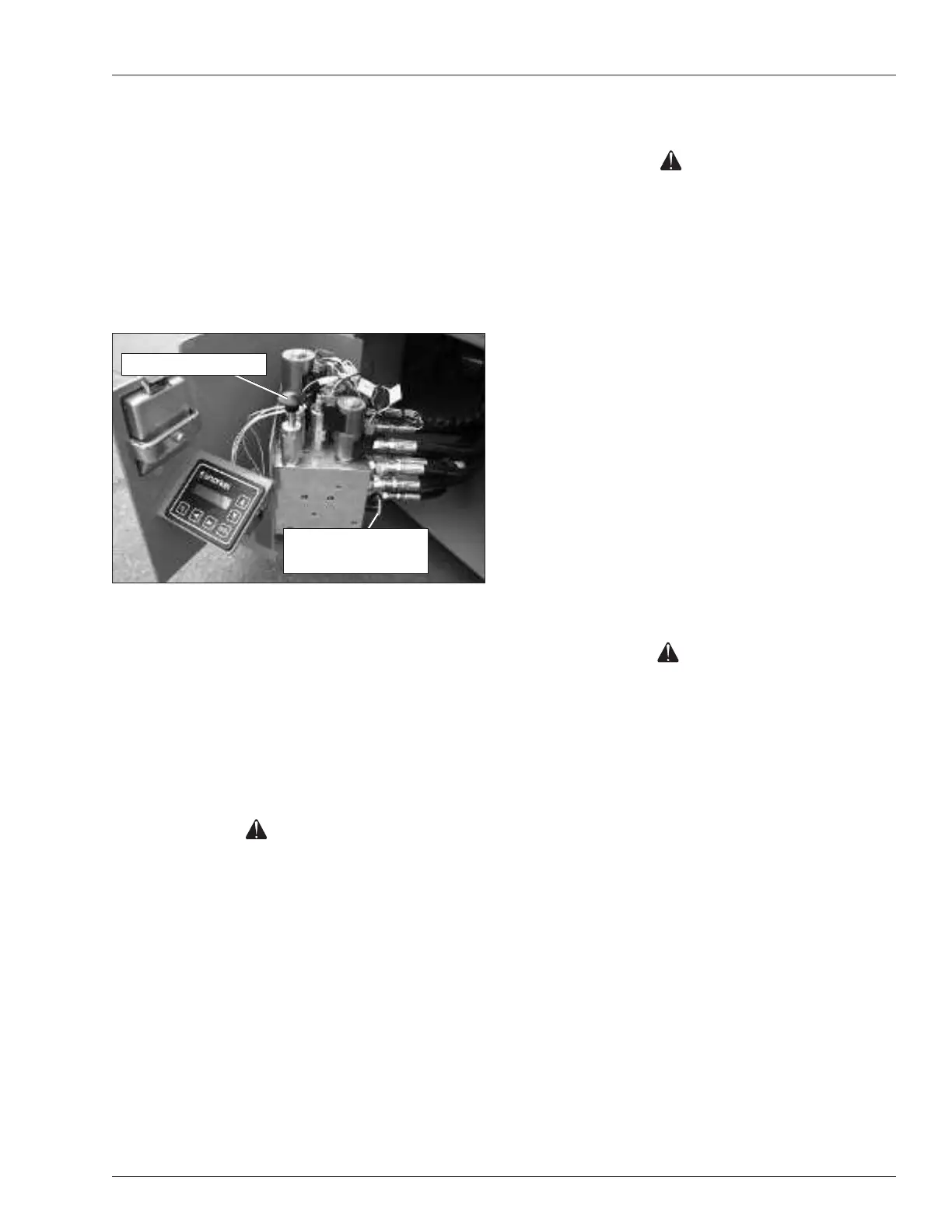
the right side of the machine. The brake release/
free-wheeling valve is located on the back of the
hydraulic manifold (refer to Figure 10.5).
Figure 10.5 – Hydraulic Tray
2. Turn the brake release/free-wheeling valve clock-
wise to the fully closed position. Push and release
the brake release pump knob several times, until it
becomes hard to push, to release the brakes.
3. Attach the winch line to the tie-down lugs (refer to
Figure 10.3) on the front of the chassis.
4. Remove the wheel chocks and use the winch to
position the aerial platform on the transport vehicle.
Warning
The aerial platform is free to move when the brakes
and free-wheeling valve are disabled. Death or serious
injury could result. Close the free-wheeling valve and
reset the brakes before operating the aerial platform.
5. Turn the brake release/free-wheeling valve fully
counterclockwise to the fully open position.
6. Drive the aerial platform forward or reverse and then
stop to reset the parking brakes.
7. Verify that the drive system and brakes operate
properly before operating the aerial platform.
Driving
Danger
The aerial platform can tip over if it becomes unstable.
Death or serious injury will result from a tip-over acci-
dent. Do not drive on ramps that exceed the machine
gradeability specication, or where conditions of the
ramp could cause driving to be hazardous.
Use a winch to load and unload the aerial platform on
ramps that exceed the machine gradeability specication.
A winch may also be used when poor traction, uneven sur-
faces, or stepped ramp transitions make driving hazardous.
Drive the aerial platform onto the transport vehicle if a
winch is not available and the ramp incline is within the
25 percent grade capability of the aerial platform.
Use the following procedure to drive the aerial platform
onto the transport vehicle.
1. Position the transport vehicle so the aerial platform
will not roll forward after it is loaded.
2. Chock the vehicle wheels so it cannot roll away from
the ramp while the aerial platform is loaded.
3. Remove any unnecessary tools, materials, or other
loose objects from the platform.
Caution
The extension deck is free to move when the extension
handle locks are disengaged. Personal injury may
result from accidentally extending or retracting the
deck. Make certain both extension handle locks are
fully engaged when the deck is extended in the work-
ing position and when it is stowed. Do not attempt to
extend or retract the platform unless the aerial platform
is on a level surface.
4. Fully retract the platform extension deck and ensure
that it is secured in position, with the latch handles
fully lowered and the locks fully engaged. Fully lower
the platform.
5. Drive the aerial platform to the foot of the loading
ramp with the rear wheels nearest the ramp. Make
sure the aerial platform is centered with the ramps
and that the steering wheels are straight.
6. Place the drive range switch in low (turtle) for climbing
or descending a ramp.
7. Drive the aerial platform on or o the transport vehicle
in a straight line through the grade transitions with
minimal turning.
Brake Release
Free-Wheeling Valve
Brake Release Pump



 To Next Page