Chapter 10. Stowing and Transporting
To prevent unauthorized use and damage,
properly stow the aerial platform at the end of
each work day. It must also be properly stowed
while transporting.
■
Stowing
Use the following procedure to properly stow the
aerial platform.
1. Retract the platform extension.
2. Fully lower the platform.
3. Close the emergency stop switch cover to
activate the emergency stop switch.
4. Turn the battery disconnect switch off.
5. Padlock the battery disconnect switch.
■
Transporting
The aerial platform may be moved on a transport
vehicle. Depending on the particular situation, the
aerial platform may be lifted with a forklift,
winched, driven, or hoisted onto a vehicle such
as a truck or trailer. Lifting with a forklift is the
preferred method.
The aerial platform can tip over if it becomes
unstable. Death or serious injury can result
from a tip-over accident. Do not drive on
ramps that exceed 20 percent grade, or where
conditions of the ramp could cause driving to
be hazardous.
Use a winch to load and unload the aerial
platform on ramps that exceed 20 percent grade.
A 20 percent grade is a 24² (61 cm) vertical rise
in 10¢ (3.05 m) horizontal length. A winch may
also be used when poor traction, uneven
surfaces, or stepped ramp transitions make
driving hazardous.
Drive the aerial platform onto the transport
vehicle if a winch is not available and the ramp
incline is within the 20 percent grade capability of
the aerial platform.
The aerial platform weighs approximately 3,750
pounds. The equipment used to load, unload, and
transport the aerial platform must have adequate
capacity.
The user assumes all responsibility for making
sure the equipment used is capable of supporting
the weight of the aerial platform.
❑
Winching
Use the following procedure to winch the aerial
platform onto the transport vehicle.
1. Locate the transport vehicle so the aerial
platform will not roll forward after it is loaded.
2. Remove any unnecessary tools, materials, or
other loose objects from the platform.
3. From the upper controls, center the aerial
platform with the loading ramps and transport
vehicle bed. Make sure that the steering
wheels are straight.
4. Properly stow the aerial platform.
5.
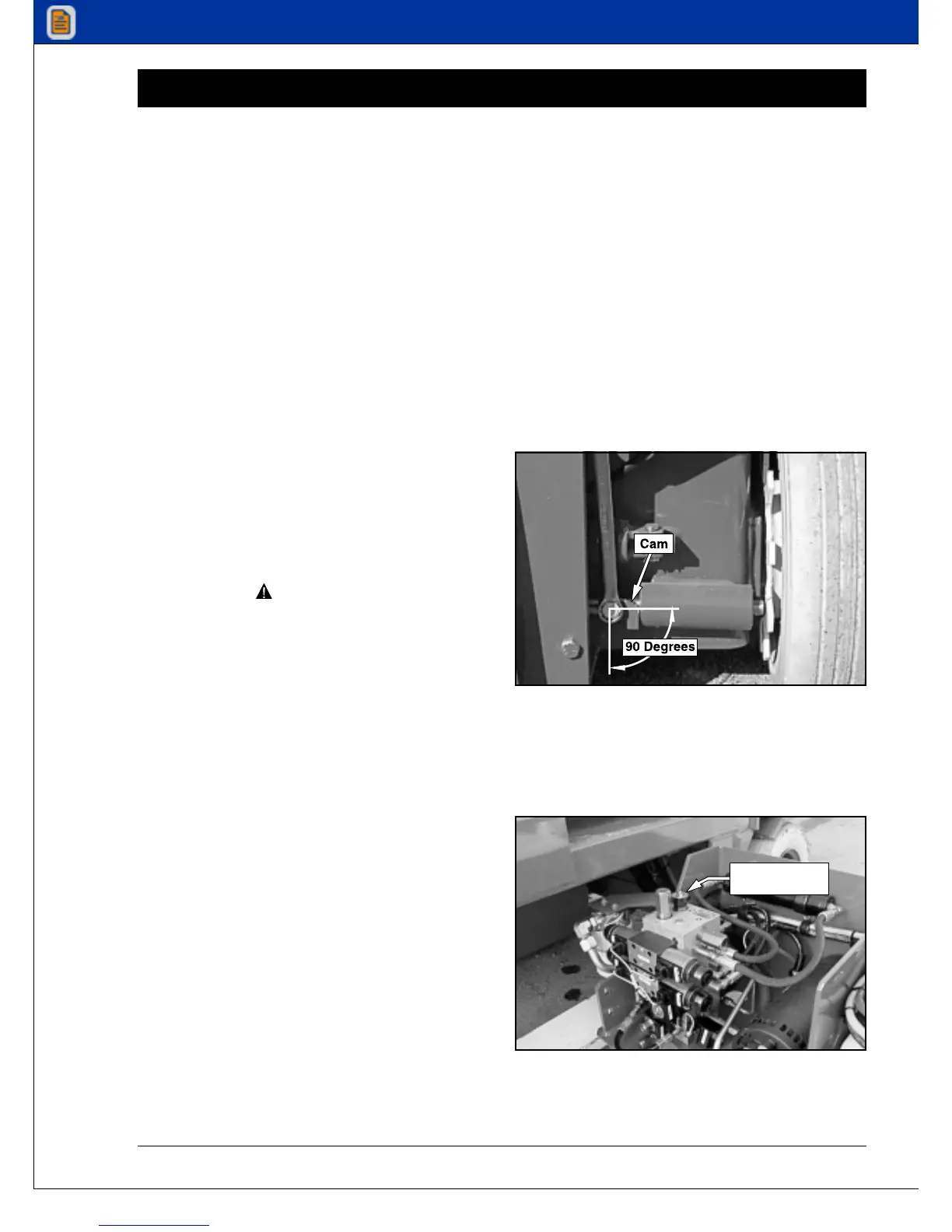
Use a $ wrench to rotate each brake release
cam 90° (refer to Figure 10.1). Rotate the cam
on the right brake cylinder counterclockwise
and the one on the left brake cylinder
clockwise. This will retract the brake pins from
the wheel lugs releasing the brakes. Remove
the wrench.
Figure 10.1—Brake Release Cam
6. Unlatch and swing out the hydraulic tray. The
free-wheeling valve is located on the
hydraulic manifold (refer to Figure 10.2). Turn
the free-wheeling valve counterclockwise to a
fully opened position.
Figure 10.2—Free-Wheeling Valve
7. Attach the winch to the tie-down lugs (refer to
Figure 10.3) on the front of the chassis.
SL 20 – 300206 page 10 - 1
DANGER
Free-Wheeling
Valve



 To Next Page