
 Need help?
Do you have a question about the Sony Ericsson T610 and is the answer not in the manual?
Accesses service menu for testing phone functions like display, camera, audio, and keyboard.
Visual inspection for corrosion/oxidation from liquid damage. Handle according to GSP directives.
Tests vibrator function via service menu. Checks pads and vibrator for damage or dirt.
Tests polyphonic ring signal via service menu. Checks speaker and gaskets for damage or dirt.
Tests earphone function via service menu. Checks speaker and sound channel gasket for damage or dirt.
Tests microphone function via service menu. Checks microphone pads and microphone for damage or dirt.
Checks battery charging process and system connector for mechanical damage or dirt.
Explains factors reducing standby time like light and Bluetooth usage.
Tests side keys, volume, camera, internet, and on/off keys via service menu for proper function.
Tests keyboard response and checks dome foil, flex-film, and connector for damage or dirt.
Tests joystick movement and response via service menu. Checks button and gasket for damage or dirt.
Tests LCD display for patterns, lines, or discolouring. Checks flex-film and connector.
Tests illumination flashing and LED strength via service menu. Checks keyboard flex-film and connector.
Checks battery pads and charging process. Replaces battery if damaged or dirty.
Checks the power on/off key for mechanical damage or dirt. Replace if necessary.
Tests camera module via service menu for focus, black spots, and viewfinder function.
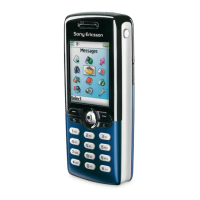
This document outlines a comprehensive troubleshooting guide for the Sony Ericsson T610 and T618 mobile phones, focusing on mechanical and software-related issues. It serves as a resource for technicians and users to diagnose and resolve common problems, offering step-by-step instructions and visual aids.
The guide covers various functional aspects of the phone, including its core operations, alert mechanisms, audio capabilities, charging and power management, data communication, key input, display and illumination, network connectivity, and camera functions. It also addresses general appearance issues and software-related problems.
The phone's software includes a built-in service functionality accessible via a specific key combination (***). This service menu allows for testing various phone functions, such as the display, camera, LED/illumination, keyboard, polyphonic speaker, vibrator, earphone, and microphone. It also provides access to service information, settings, and text labels. Furthermore, the software offers a reset function to revert language and themes to default settings using specific key combinations (0000⇒ for English and default themes, and 8888 for automatic language and default themes).
The troubleshooting process often begins by utilizing the phone's service test menu to verify the functionality of specific components. For instance, to check the vibrator, users are instructed to navigate to the "Vibrator" option in the service test menu and press any key to confirm its operation. Similarly, the "Polyphonic" option allows for testing the ring signal, and "Earphone" and "Microphone" options facilitate audio checks. The "Keyboard" test allows users to press all keys and observe their indication on the LCD, along with an audible click, to ensure proper response. The joystick's functionality is also tested through the "Keyboard" menu by moving it in all directions and pressing it downwards. The "Display" test presents a color pattern to assess LCD performance, while "LED/Illumination" checks the lighting of the LCD and key LEDs. For camera issues, the "Camera" option in the service test menu displays the viewfinder, allowing users to check for black spots, focus, and overall functionality.
A crucial first step in troubleshooting any issue is a general visual inspection for corrosion or oxidation, particularly in cases of suspected liquid damage. If liquid damage is identified, no further action should be taken, and the unit should be handled according to local company or GSP directives.
For appearance problems, the guide recommends checking the front cover, battery cover, frame, antenna cover assembly, keyboard, and camera ring for damage, scratches, and proper fit. Faulty components should be replaced.
In cases of alert problems, such as issues with the vibrator or polyphonic speaker, the guide suggests checking for dirty or oxidized vibrator pads, and mechanically damaged, dirty, or oxidized vibrators. For polyphonic issues, the speaker, speaker gasket, and sound channel gasket are inspected for damage or dirt.
Audio problems, including earphone and microphone issues, involve checking the speaker, speaker gasket, and sound channel gasket for damage or dirt. For echo or high background noise complaints, a specific software download ("T610 TxPGA TRIMMNING" from EMMA II) and subsequent microphone test in the service menu are recommended. Microphone pads and the microphone itself are also inspected for dirt or damage.
Charging and capacity problems require checking the system connector for mechanical damage, dirt, or oxidation. Battery pads are also inspected for damage or oxidation. If the phone doesn't charge, inserting a working battery and charger is advised, noting that a very low battery may charge without the phone turning on initially.
Data communication problems, such as issues with synchronizing with MS Outlook, also point to checking the system connector for damage, dirt, or oxidation.
Key problems, affecting side keys, the main keyboard, or the joystick, involve checking the mechanical response of the keys, inspecting the dome foil assembly, keyboard flex-film, and FPC connector for damage or proper fit. For joystick issues, the joystick button and dust gasket are specifically mentioned for inspection and replacement.
LCD and illumination problems require checking the LCD for missing lines or discolouring, and ensuring the LCD flex-film fits correctly into the FPC connector. For illumination, the LCD's lighting and the uniformity of the 8 key LEDs are checked. When replacing the LCD, adjusting and saving the contrast in the service settings menu is crucial.
Network issues involve inserting a functioning SIM card and verifying service and signal strength. The antenna assembly and antenna connector are inspected for damage, dirt, or oxidation.
On/Off problems, related to the battery or the power key, involve checking battery pads for damage or oxidation, and the power on/off key for mechanical damage or dirt.
SIM-related problems necessitate inserting a functioning SIM card and observing display messages ("Insert card" or "Insert correct card"). The SIM-lock lid and SIM-reader are inspected for mechanical damage, dirt, or oxidation.
Camera problems involve checking the camera module for proper functionality, black spots, and focus. The camera module gasket is also inspected for damage during replacement.
Finally, software problems are addressed by recommending a master reset and flashing the phone with the latest software from EMMA II if keypad commands are unresponsive or spelling errors occur. The software revision can be checked in the "Service info / SW information" section of the service menu.
In all cases where the failure persists after following the outlined steps, the guide directs users to handle the unit according to local company or GSP directives.
 General
| Resolution | 128 x 160 pixels |
|---|---|
| Internal Memory | 2 MB |
| Camera | VGA |
| Dimensions | 102 x 44 x 19 mm |
| Weight | 95 g |
| Status | Discontinued |
| Network | GSM |
| 2G bands | GSM 900 / 1800 / 1900 |
| GPRS | Class 8 |
| EDGE | No |
| SIM | Mini-SIM |
| Phonebook | 510 entries |
| Call records | 20 dialed, 20 received, 20 missed calls |
| Video | No |
| Alert types | Vibration; Downloadable polyphonic ringtones |
| Loudspeaker | No |
| 3.5mm jack | No |
| Infrared port | Yes |
| Radio | No |
| Messaging | SMS, EMS, MMS |
| Browser | WAP 2.0/xHTML |
| Games | Yes + downloadable |
| Java | Yes, MIDP 1.0 |
| Talk time | Up to 14 h |
| Announced | 2003 |
| Bluetooth | Yes |
| Colors | 3 |


 To Next Page


