EasyManua.ls Logo

Sony PS-2250 - Page 4

Sony PS-2250
26 pages
Print Icon
To Next Page IconTo Next Page
To Previous Page IconTo Previous Page
Loading...
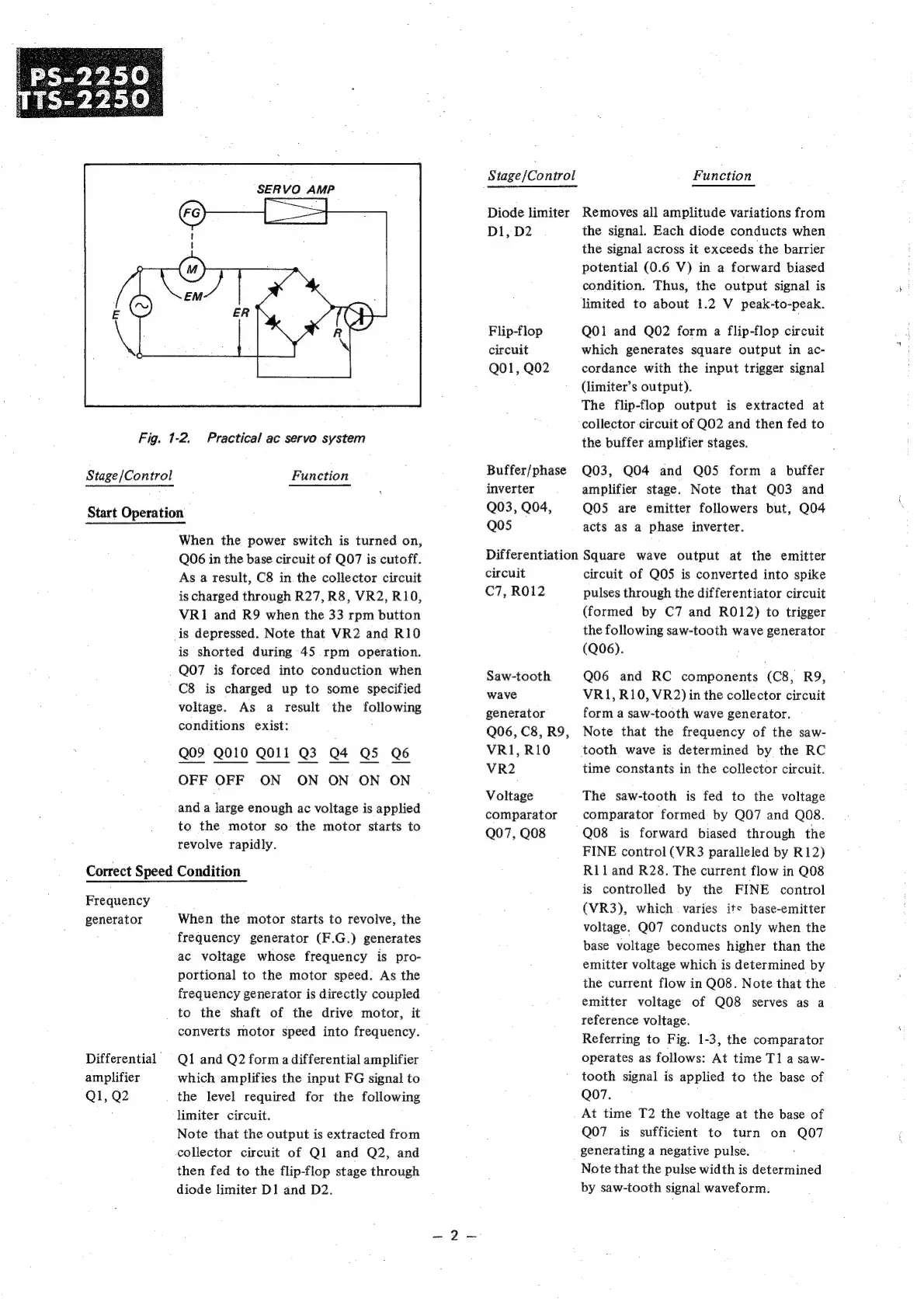
SERVO
AMP
Fig.
1-2.
Practical
ac
servo
system
Stage/Control
Function
Start
Operation
When
the
power
switch
is
turned
on,
Q06
in
the
base
circuit
of
QO7
is
cutoff.
As
a
result,
C8
in.
the
collector
circuit
is
charged
through
R27,R8,
VR2,
R10,
VRI
and
R9
when
the
33
rpm
button
is
depressed.
Note
that
VR2
and
R10
is
shorted
during
45
rpm
operation.
Q07
is
forced
into
conduction
when
C8
is
charged
up
to
some
specified
voltage.
As
a
result
the
following
conditions
exist:
:
Q09
QO10
QOlI
Q3
Q4
Q5
Q6
OFF
OFF
ON
ON
ON
ON
ON
and
a
large
enough
ac
voltage
is
applied
to
the
motor
so
the
motor
starts
to
revolve
rapidly.
Correct
Speed
Condition
Frequency
generator
When
the
motor
starts
to
revolve,
the
frequency
generator
(F.G.)
generates
ac
voltage
whose
frequency
is
pro-
portional
to
the
motor
speed.
As
the
frequency
generator
is
directly
coupled
to
the
shaft
of
the
drive
motor,
it
converts
motor
speed
into
frequency.
Differential
Q1
and
Q2
forma
differential
amplifier
amplifier
which
amplifies
the
input
FG
signal
to
the
level
required
for
the
following
Ql,
Q2
limiter
circuit.
Note
that
the
output
is
extracted
from
collector
circuit
of
Ql]
and
Q2,
and
then
fed
to
the
flip-flop
stage
through
diode
limiter
D1
and
D2.
Stage/Control
Function
Diode
limiter
Removes
all
amplitude
variations
from
D1,
D2
the
signal.
Each
diode
conducts
when
the
signal
across
it
exceeds
the
barrier
potential
(0.6
V)
in
a
forward
biased
condition.
Thus,
the
output
signal
is
limited
to
about
1.2
V
peak-to-peak.
Flip-flop
Q01
and
QO02
form
a
flip-flop
circuit
circuit
which
generates
square
output
in
ac-
Q01,
Q02
cordance
with
the
input
trigger
signal
(limiter’s
output).
The
flip-flop
output
is
extracted
at
collector
circuit
of
QO2
and
then
fed
to
the
buffer
amplifier
stages.
Buffer/phase
Q0O3,
Q04
and
QOS
form
a
buffer
inverter
amplifier
stage.
Note
that
Q03
and
Q03, Q04,
Q05
are
emitter
followers
but,
Q04
Q05
acts
as
a
phase
inverter.
Differentiation
Square
wave
output
at
the
emitter
circuit
circuit
of
QO5
is
converted
into
spike
C7,
RO12
pulses
through
the
differentiator
circuit
(formed
by
C7
and
RO12)
to
trigger
the
following
saw-tooth
wave
generator
(Q06).
Saw-tooth
Q06
and
RC
components
(C8,
R9,
wave
VR1,
R10,
VR2)
in
the
collector
circuit
generator
form
a
saw-tooth
wave
generator.
Q06,
C8,
R9,
Note
that
the
frequency
of
the
saw-
VRI,
R10
tooth
wave
is
determined
by
the
RC
VR2
time
constants
in
the
collector
circuit.
Voltage
The
saw-tooth
is
fed
to
the
voltage
comparator
comparator
formed
by
QO7
and
QO8.
Q07,
Q08
Q08
is
forward
biased
through
the
FINE
control
(VR3
paralleled
by
R12)
R11
and
R28.
The
current
flow
in
Q08
is
controlled
by
the
FINE
control
(VR3),
which.
varies
its
base-emitter
voltage.
Q07
conducts
only
when
the
base
voltage
becomes
higher
than
the
emitter
voltage
which
is
determined
by
the
current
flow
in
QO8.
Note
that
the
emitter
voltage
of
QO8
serves
as
a
reference
voltage.
Referring
to
Fig.
1-3,
the
comparator
operates
as
follows:
At
time
T1
a
saw-
tooth
signal
is
applied
to
the
base
of
Q07.
At
time
T2
the
voltage
at
the
base
of
Q07
is
sufficient
to
turn
on
QO7
generating
a
negative
pulse.
Note
that
the
pulse
width
is
determined
by
saw-tooth
signal
waveform:

Other manuals for Sony PS-2250

Related product manuals