LSE.Q THEORY AND USE
INSTALLATION STEP 7
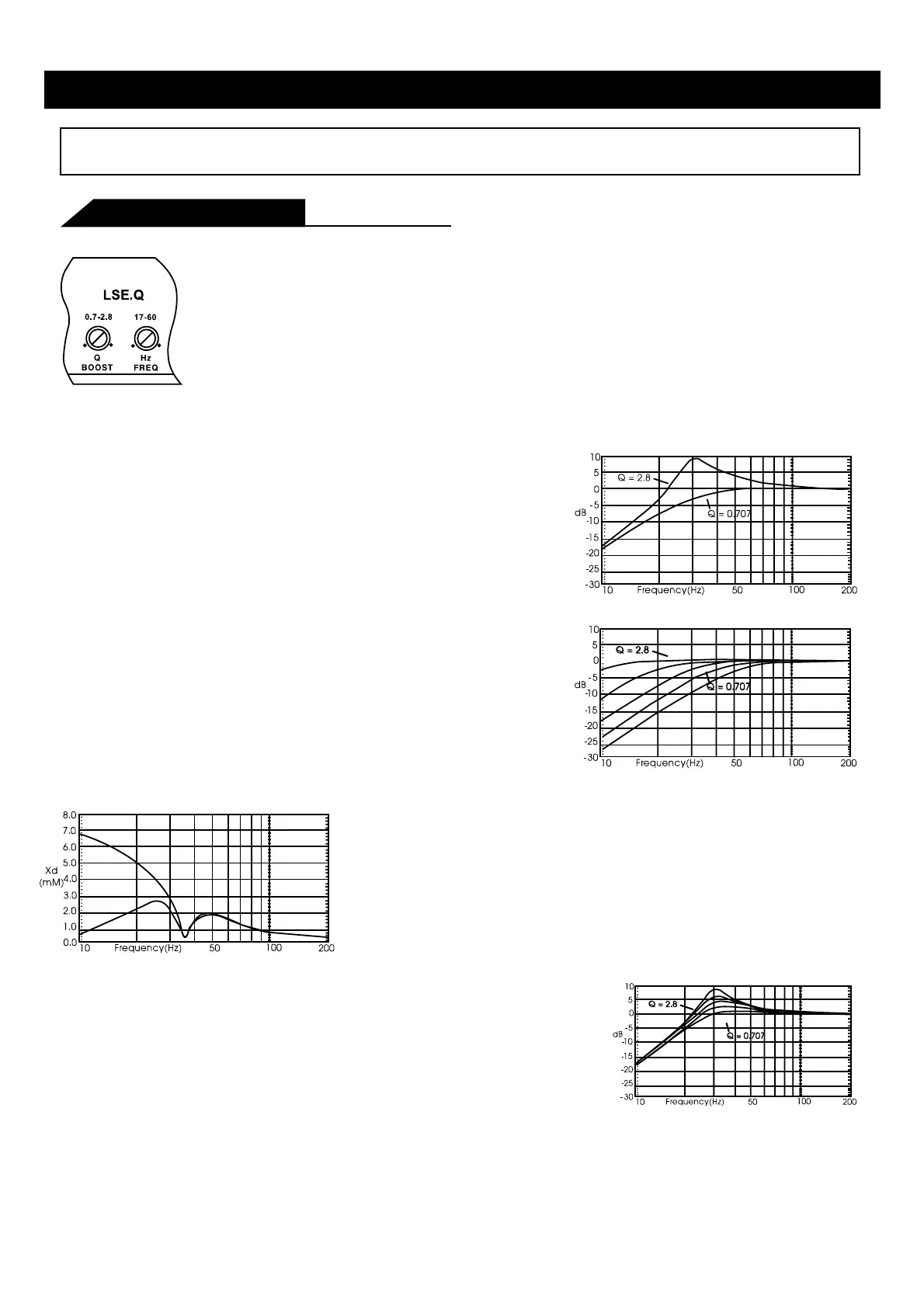
LSE.Q is a proprietary subwoofer control circuit included with the DaVinci amplifier. It is
capable of both removing subsonic energy in program material and providing a variable boost
at low frequencies. The circuit consists of two controls. One adjusts the frequency of operation,
and the other adjusts the range of boost. With both controls adjusted fully counter-clockwise, no
boost is applied and the amplifier is flat in response down to 20 Hz.
The frequency control (Hz) adjusts the starting point of the subsonic filter. This high
pass filter can be adjusted from 20 Hz up to a maximum of 60 Hz. This control is useful for
setting the lowest frequency that your subwoofer will see. (See Figure 1)
The Q control adjusts the amount of boost applied at the set frequency.
This is adjustable from. 707(flat) to 2.8 (+9dB). (See figure 2)
When the Q is set to . 707 (Butterworth), LSE.Q acts as a subsonic filter
only.(See Figure 3)
The simple act of removing the signal below the vented tuning frequency
can improve system output by as much as 3 dB. With Q values greater than
.707, boost is added in addition to the subsonic filter. (See Figure 4)
Application
Woofers in vented enclosures have good power handling characteristics
above the tuning frequency, but below the tuning frequency, power handling
drops off considerably. This is due to the loss of any appreciable resistive
air mass. At frequencies below resonance, the woofer starts to behave as if
it were mounted in”‘free- air”. If we wish to improve the performance of a
vented system, we should remove these unwanted signals by adding the
subsonic filter. Figure 5 shows the effectiveness of LSE.Q on woofer
excursion. Woofer travel is 7.5 mm at 10 Hz, with LSE.Q properly adjusted, this
excursion can be reduced to less than
1 mm. This is of great benefit to lowering woofer distortion and increasing
output.
Adjustment
An easy method of optimizing your existing subwoofer enclosure with
LSE.Q’s “Hz” control is as follows.
1. Adjust frequency and boost control to full CCW position.
2. While listening to music with strong bass
content at a moderate level, slowly adjust the frequency control clockwise. Listen
for a reduction of bass response. Now, rotate frequency control slightly
backwards. This serves the purpose of removing the “subsonic” bass energy.
Soundstream’s LSE.Q contains the same type of circuit with the added benefit of
infinite adjustability. Our ”‘Q” and “Hz” control can provide virtually any
combination of boost and cut to suit your designs. So, LSE.Q can provide the
“tailoring” needed for any type of “assisted” design and any woofer.
16
FIG. 1 LSE.Q
FIG. 2 Variable “Q”
FIG. 3 Variable High Pass
FIG. 5 Limited Excursion
FIG. 4 Variable “Q”






 To Next Page