L03
IMPORTANT
PERSONAL SAFETY DURING BUILDINGS CONSTRUCTION
Some of the building components may contain sharp edges prior to assembly. Wear protective
work gloves while handling these components. Wear eye protection when using any form of power
tool. Do not use household voltage power tools in a wet or damp environment. Household voltage
power tools must be monitored and controlled by a Ground Fault Interrupter or more commonly
called a G.F.I. Do not use any part of the building's frame as a means of personal support while
attaching components during assembly.
PREPARATION OF BUILDING SITE
This building must be constructed on a SOLID
BASE FOUNDATION. We recommend a
poured concrete pad or large size concrete
patio stone squares for a suitable floor and
base. Which ever you select…make sure your
foundation area is firm and level and will allow
drainage away from the site. Make your solid
base foundation at least 4” (100mm) larger than
your building. The manufacturer is not re-
sponsible for the choice and the construc-
tion of the foundation.
NOTE: For a concrete pad base, prepare a
level bed for a firm footing layer of crushed
stone. The concrete pad should then be poured
to a thickness of 4” (100mm) to 5” (125mm).
When completed, allow to dry thoroughly for at
least 48 hours.
YOUR BUILDING MUST BE
ANCHORED
Your building must be firmly anchored to your concrete
pad or large concrete patio stone squares…to help
protect against damage in high winds.
FURTHER ANCHORING INSTRUCTIONS
FOLLOW AFTER ALL WALL AND ROOF
PANELS HAVE BEEN INSTALLED.
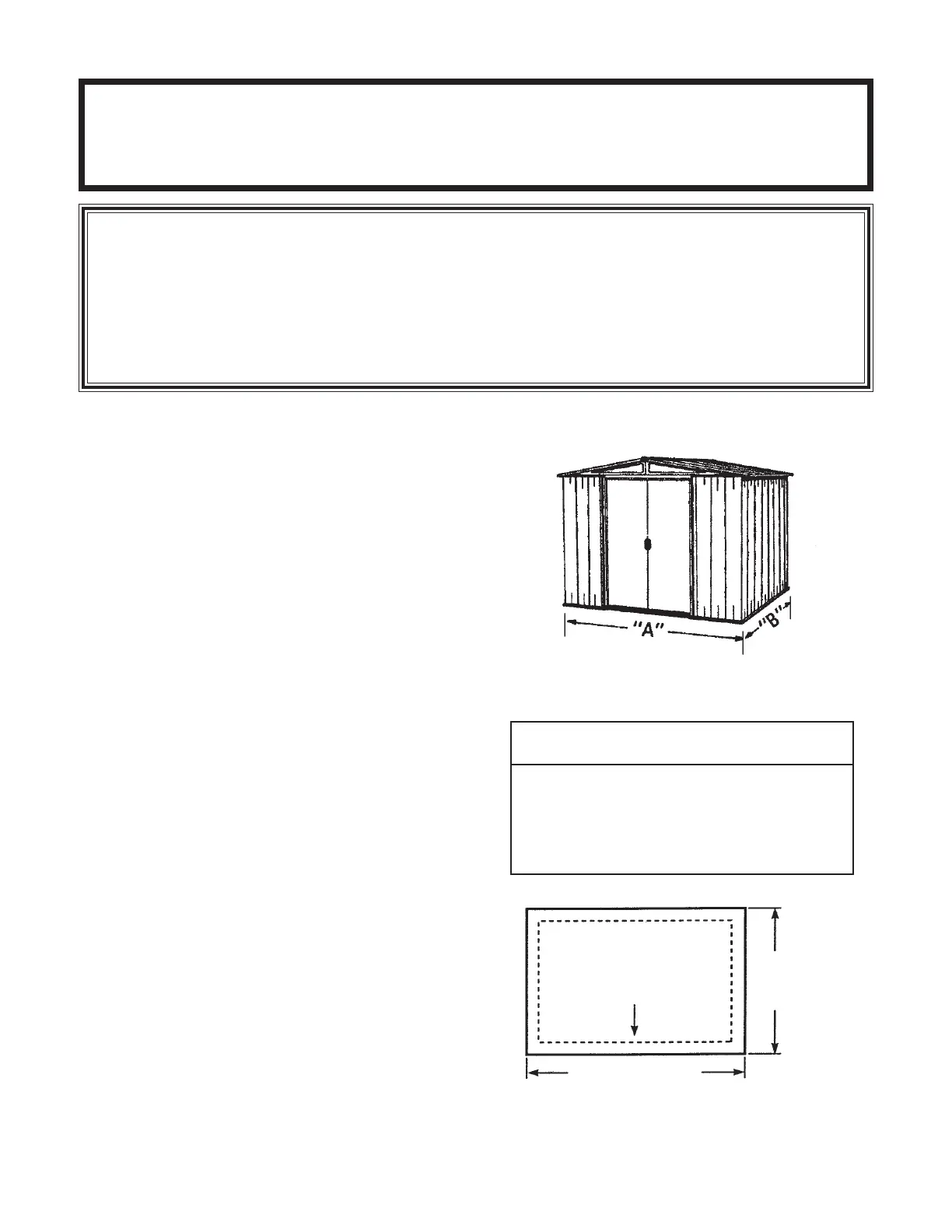
MODEL "A" "A" "B" "B"
CM INCH CM INCH
6x4 172.7 68 114.9 45 1/4
6x5 172.7 68 146.1 57 1/2
6x6 172.7 68 177.2 69 3/4
6x7 172.7 68 208.3 82
6x9 172.7 68 270.5 106 1/2
3
OUTSIDE MEASUREMENTS OF BUILDING AT BASE
“B” + 100mm (4")
MINIMUM
“A” + 100mm (4")
MINIMUM
DOORWAY


 To Next Page