EasyManua.ls Logo

SPL Passeq - User Manual

SPL Passeq
30 pages
Print Icon
To Next Page IconTo Next Page
Loading...
SPL Analog Code
®
Plug-in
Manual
Passeq
Dual-Channel Three-Band EQ
Question and Answer IconNeed help?

Do you have a question about the SPL Passeq and is the answer not in the manual?

Summary

Installation

Plugin Alliance Activation

Activation of the Analog Code plug-in requires an account on Plugin Alliance. Setup can be done anytime via their website.

System Requirements and Compatibility

Information regarding system requirements and supported platforms or formats can be found by visiting the provided web page.

MAC and Windows Installation

Instructions for installing the plug-in on MAC and Windows systems, including checking for the latest version and executing the installer.

Introduction

The most powerful passive EQ system ever

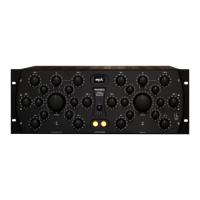
Describes the Passeq as the most powerful passive EQ system, highlighting its 12 switchable frequencies per band for boost and cut stages.

The Passeq Analog Code Plug-in

Details how the Passeq Analog Code plug-in faithfully reproduces the unique sound quality of the original hardware, emphasizing complex filter interactions.

Operation

Allocation of Frequencies

Explains the selection of fixed frequencies for the Passeq, driven by audio experts' preferences and designed for musically sensible choices and S-curve EQ-ing.

Control Elements

LF-LMF Cut and LF Boost

Details the low cut frequency range (30 Hz - 1.9 kHz) and low boost band (10 Hz - 550 Hz), explaining their shelving characteristics and frequency choices.

MF-MHF Cut and LMF-MHF Boost

Describes the midrange bands' peak filter characteristics, the MF-MHF cut overlap, and the LMF-MHF boost band frequencies and range.

MHF-HF Cut and HF Boost

Explains the MHF-HF cut band's shelving characteristic and the HF boost band's variable Q peak filter characteristic in the high frequency range.

HF Boost Q with Proportional Q

Details the proportional or variable Q principle for HF boost, explaining how settings affect boost levels and bandwidth for desired sonic results.

MHF-HF Cut

Describes the MHF-HF cut band as a shelving filter for reducing higher frequencies with a wide bandwidth, extending to 19.5 kHz.

Output Control

Explains the output control as an output level regulator, allowing reduction of level up to -66dB with fine resolution for smooth adjustments.

Using Equalizers

First control levels, then apply EQ

Advises setting levels properly before using EQ, suggesting that if more than 6dB boost is needed, initial levels should be thoroughly investigated.

M;S Basics

M;S

Details M/S encoding as a useful stereo technique for signal processing, explaining how signals are separated and converted between L/R and M/S formats losslessly.

Summary

Installation

Plugin Alliance Activation

Activation of the Analog Code plug-in requires an account on Plugin Alliance. Setup can be done anytime via their website.

System Requirements and Compatibility

Information regarding system requirements and supported platforms or formats can be found by visiting the provided web page.

MAC and Windows Installation

Instructions for installing the plug-in on MAC and Windows systems, including checking for the latest version and executing the installer.

Introduction

The most powerful passive EQ system ever

Describes the Passeq as the most powerful passive EQ system, highlighting its 12 switchable frequencies per band for boost and cut stages.

The Passeq Analog Code Plug-in

Details how the Passeq Analog Code plug-in faithfully reproduces the unique sound quality of the original hardware, emphasizing complex filter interactions.

Operation

Allocation of Frequencies

Explains the selection of fixed frequencies for the Passeq, driven by audio experts' preferences and designed for musically sensible choices and S-curve EQ-ing.

Control Elements

LF-LMF Cut and LF Boost

Details the low cut frequency range (30 Hz - 1.9 kHz) and low boost band (10 Hz - 550 Hz), explaining their shelving characteristics and frequency choices.

MF-MHF Cut and LMF-MHF Boost

Describes the midrange bands' peak filter characteristics, the MF-MHF cut overlap, and the LMF-MHF boost band frequencies and range.

MHF-HF Cut and HF Boost

Explains the MHF-HF cut band's shelving characteristic and the HF boost band's variable Q peak filter characteristic in the high frequency range.

HF Boost Q with Proportional Q

Details the proportional or variable Q principle for HF boost, explaining how settings affect boost levels and bandwidth for desired sonic results.

MHF-HF Cut

Describes the MHF-HF cut band as a shelving filter for reducing higher frequencies with a wide bandwidth, extending to 19.5 kHz.

Output Control

Explains the output control as an output level regulator, allowing reduction of level up to -66dB with fine resolution for smooth adjustments.

Using Equalizers

First control levels, then apply EQ

Advises setting levels properly before using EQ, suggesting that if more than 6dB boost is needed, initial levels should be thoroughly investigated.

M;S Basics

M;S

Details M/S encoding as a useful stereo technique for signal processing, explaining how signals are separated and converted between L/R and M/S formats losslessly.

SPL Passeq Specifications

General IconGeneral
TypePassive Equalizer
Channels2
Equalization TypePassive
Input Impedance20 kOhms
Dimensions482 x 88 x 237 mm

Related product manuals