6
Passeq Analog Code
®
Plug-in
The most powerful passive EQ system ever
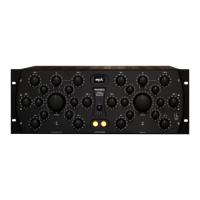
The original Passeq hardware is the first passive EQ which pro-
vides three separate frequency ranges for both boost and cut
stages. One famous, if not the most famous, passive design was
the Pulteq EQ from the decades of the 1950’s and 60’s. This EQ
sported two frequency bands (low and high frequencies, or LF and
HF), and had only a few switchable frequencies to offer. In con-
trast, the Passeq has 12 switchable frequencies per band, totaling
36 boost and 36 cut frequencies. Boost and cut frequencies are
NOT identical, thus the resultant 72 frequencies per channel offer
an enormous choice for the most elaborate EQ curves.
The Passeq offers for the first time passive filter control possibili-
ties extending throughout the relevant audio frequency range—
and that with an unheard of abundance of filter choices.
The Passeq Analog Code
®
Plug-in
The fantastic qualities of SPL’s Analog Code programming faithfully
reproduce the unique sound quality of the original hardware. All
the complex interactions between each single filter are reproduced
in every detail. One of the peculiarities of passive filter designs is
that they can be seen as one big filter — the signal always runs
through the whole network. Whenever the settings change, a flow
of interactions takes place between the filters, providing the char-
acteristic and unique sound of these EQs — something that will
never happen with active EQ designs.
Special Features
Two Graphical User Interfaces (GUI): The plug-in list of your host
program will show two entries after installation: “Passeq” and
“Passeq Single.” Aside from the standard dual-channel GUI, the
single GUI represents a space saving alternative showing one
Passeq channel. Nevertheless, the single version can be applied
to a stereo track — you simply control both channels simultane-
ously with one knob. >
Introduction


 To Next Page