10
Passeq Analog Code
®
Plug-in
Low Frequency Bands
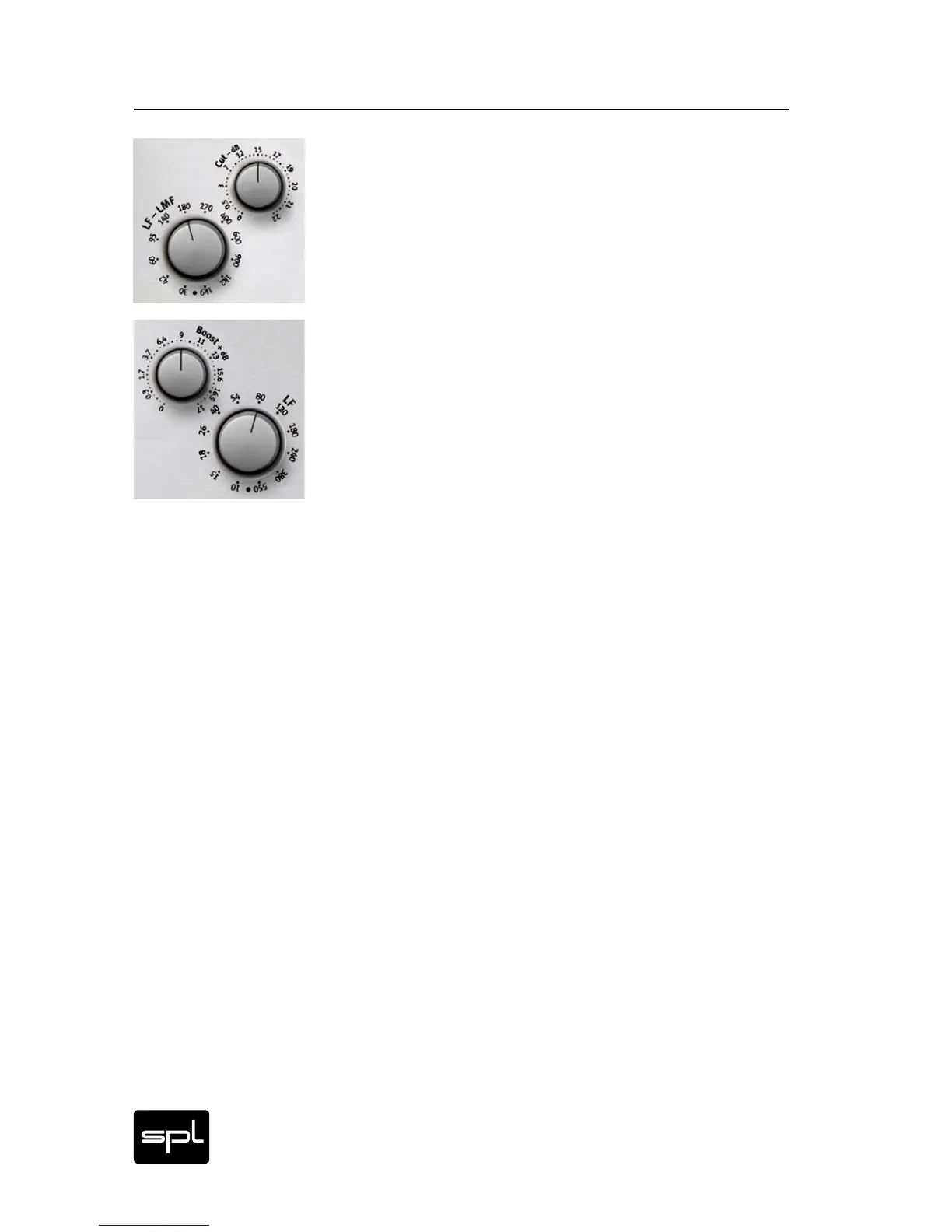
LF-LMF Cut and LF Boost
The low cut frequency range extends from 30 Hz to 1.9 kHz
and will be ref erred to in this text as LF-LMF (Low to Low-
Mid frequencies ). In con trast, the low boost (LF Boost)
band en com passes a range of 10 Hz to 550 Hz. The maxi-
mum available in crease in this LF boost band is (+)17 dB,
while the maximum reduc tion of the LF-LMF cut band is
(-)22 d B .
Optically these filter bands may be represented as having
a shelving characteristic with an 6 dB slope. Passive fil-
ters do not allow for direct alteration of the slope gradi-
ent because this quality is pre-determined by component
selection and not, as with active filters, by a variable value.
The lowest frequencies begin here with 10 Hz, then follow
with 15, 18, 26, 40 Hz, and so on. At this point one might think
that such a lavish set of frequency choice in this range might be
a bit overdone, as there is acoustically a rather limited amount of
audio material of any real significance below 26 Hz. However, these
choices are anything but arbitrary. These frequencies represent
a consistent -3 dB point of a sloping down response curve. That
is, the gentle 6 dB slope also allows frequencies above 10 Hz to
be processed. For the hardware original, special condenser/coil/
resistor filter networks have been designed for each frequency
range. The choice of one or the other inductances produces differ-
ences in sonic coloration even when limited differences between
frequencies such as 10 Hz or 15 Hz play a subordinate role. Along
with this differing phase relationships may come into play and
affect tonal color. Because modern productions often demand a
definite number of choices in an engineer’s options for achieving
an optimal result in bass emphasis, the Passeq has been designed
with a very complete set of low frequency options to insure real-
izing these goals.
Control Elements


 To Next Page