Passeq Analog Code
®
Plug-in
11
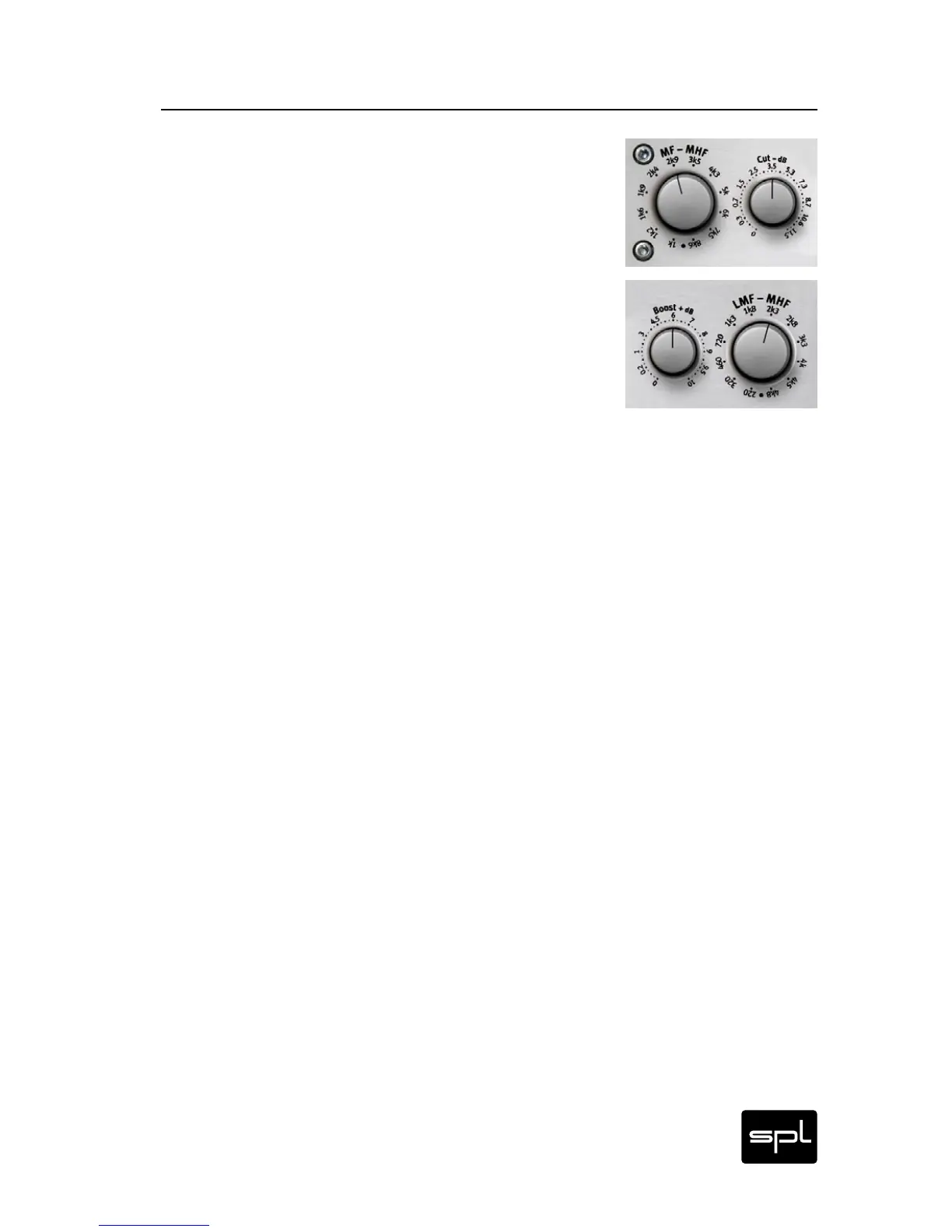
MF-MHF Cut and LMF-MHF Boost
The midrange bands elevate the Passeq to a com-
plete combination of filter options that classic passive
designs do not offer. Both midrange bands exhibit
peak filter characteristics, that is, when viewed from
the boost band, the frequency curve appears as bell-
shaped slopes above and below the chosen frequency
range. The slope or Q-value is, again, not variable, but
attuned through the choice and configuration of the
passive filter‘s components for a maximum in musi-
cal efficiency, relying in the Passeq on its developer,
Wolfgang Neumann‘s years of musical experience. The middle
bands‘ peak structure is chosen for a clean separation of LF and HF
bands. Were the choice here to be for a shelving filter design, too
many neighboring frequencies would be processed, with resulting
undesirable influences extending into LF and HF bands. Along with
this is the simple fact that a midrange peak filter characteristic is
accompanied by a more easily focused center point processing of
critical voice and instrument fundamental frequencies.
The MF-MHF cut band overlaps the LF-LMF cut band by approxi-
mately an octave, with its lowest frequency extending from 1 kHz.
The LF boost and LMF-MHF boost bands are set up in a similar
fashion, with the lowest LMF-MHF boost band frequency set at
220 Hz and thereby 1-1/2 octaves under the highest LF boost band
frequency. The maximum values of the MF-MHF cut and LMF-MHF
boost band extend from -11.5 dB to +10 dB.
The overlapping band characteristics give a good idea of the avail-
able degree of precision in frequency adjustment: For example,
one can boost in the LMF-MHF boost band at 220 Hz while in the
LF boost band, 240 Hz can be followed by 320 Hz in the LMF-MHF
boost band: The next step could be at 380 Hz in the LF boost band,
followed by 460 Hz in the LMF-MHF boost band and 550 Hz in the
LF boost band ...
Mid Bands
Control Elements


 To Next Page