67
Example:
thermostat for minimum comfort temperature: switch-on temp. 50°C ; switch-off temp. 60°C
temp. input: E3 (regulator) ; output: R4 (regulator)
Time function Times Mo to Fr: from 11:00 A.M. to 11:59 P.M.
Times Sa and Su: from 11:00 A.M. to 11:59 P.M.
output: R4 (regulator)
Note:
When setting the individual time windows ensure that the switch-on time is always
before the corresponding switch-off time. So if a time function must be active between 11:00
A.M. and 4:00 A.M., for example, 2 time windows
must be programmed: 11:00 A.M: – 11:59 P.M.
and 12:00 A.M.– 4:00 A.M.!
Since two functions and the "NH" layout plan now access the after-heating pump a logical link of these
functions is required (see chapter 6).
Under 'Settings' -> 'Service' -> 'Link' the output used for the after-heating pump (R4 (regulator) in the
above example) must now be programmed as follows:
7.3 Supplementary Heating
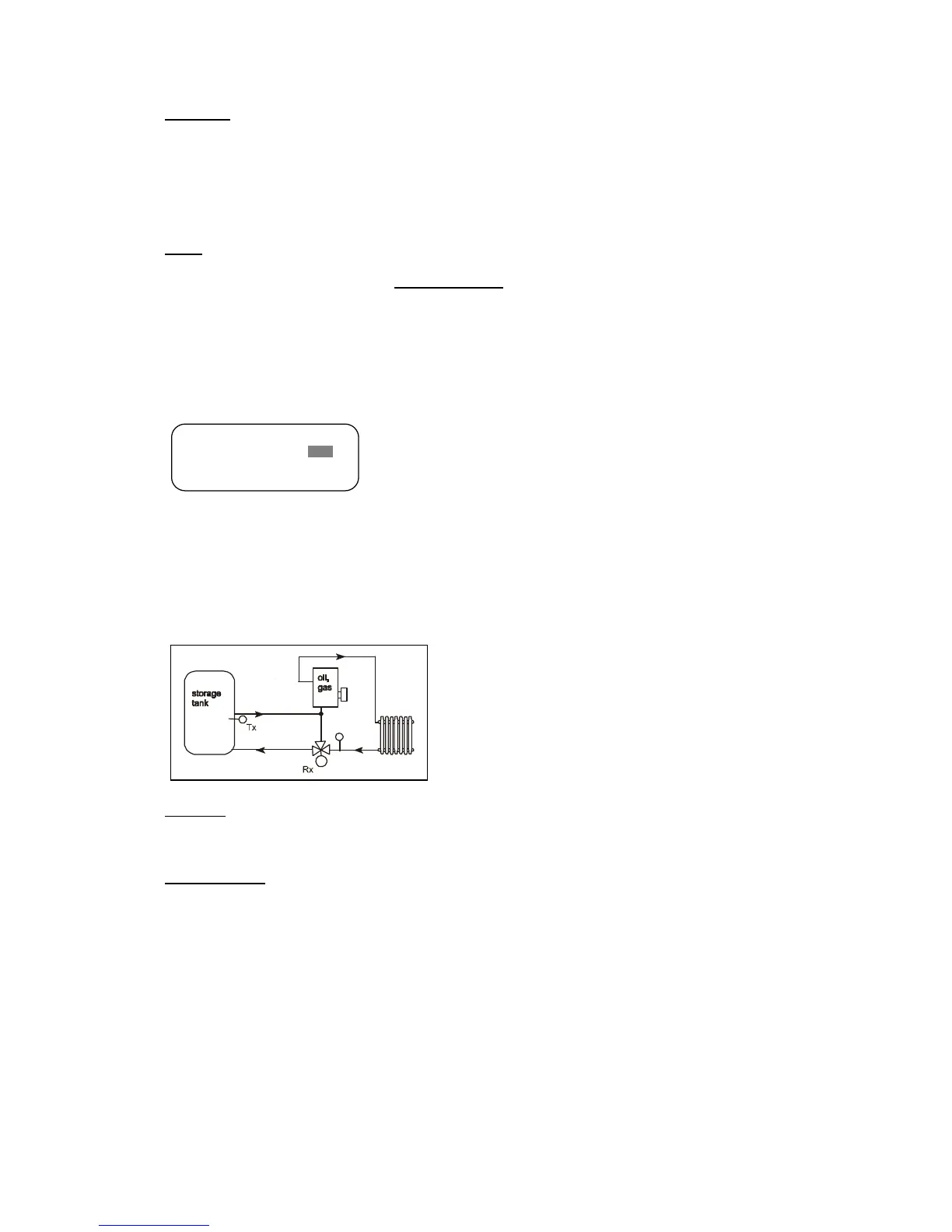
In the system selection (chapter 4) several layout plans are
already pre-programmed for the supplementary heating. If
the layout plan you selected does not provide this function it
can be programmed very simply with the help of a
differential thermostat.
To enable supplementary heating you need only one of the
four differential thermostat functions (chapter 5.2), two
available inputs and an available output (called Tx, Ty and
Rx in the adjacent diagram).
Function:
If the temperature in the storage tank (Tx) is an adjustable differential higher than that of the
heating return flow (Ty), the 3-way valve (Rx) switches the return flow via the storage tank. This
means the return flow temperature increases and energy is saved in the heating system.
Implementation
: Open the menu item 'Settings' -> 'Service' -> 'Functions' -> 'diff. thermostats' and
activate an available diff.thermostat ( --2sec OK-->:). Then under Settings enter the desired switch-
on and switch-off differential and also the terminal positions of the temperature sensors (Tx and Ty)
and the 3-way valve. With a corresponding entry of min.temp input W, excessive cooling of the
storage tank can be prevented. In the event of falling below this temperature in the storage tank, the
function of the supplementary heating is deactivated. Max.temp input C is not needed with this
application and should therefore be selected so that it is outside the expected temperature range.
M
Ty
R4 (regulator) 'on' , if:
System control 'on' and
Time function 1 'on' or
Therm ostat 1 'on'


 To Next Page