27 © STULZ SpA . – all rights reserved EN/39B/06.2018
SAL
releasing heat to the air in the environment. Pushed through the thermal expansion valve, the liquid
refrigerant loses pressure, which makes it prone to evaporation. This takes place in the evaporator,
where the refrigerant absorbs the heat of the warm air from the shelter, which is therefore cooled.
Compressor
A reciprocating compressor is used for the SAL40 model with 400V/3Ph+N/50Hz power supply,
while SAL40 with 230V/1Ph/50Hz power supply is provided with a rotary compressor. Scroll
compressors are used for all the other models. Compressors are basically composed of an electric
motor and a mechanical section which is powered by this motor for pumping the refrigerant gas.
In reciprocating compressors the pumping unit consists of a piston which slides inside a cylinder and
which generates, depending on its phase, compression and aspiration.
In rotary compressors, the pumping unit consists of a rotor with sliding blades, inside a stator. As the
rotor turns, compression is obtained with space reduction between rotor, blades and stator.
In scroll compressors the pumping unit consists of two spirals positioned one inside the other. One
spiral is fixed while the other performs orbital motion which aspirates and compresses the gas.
Condenser
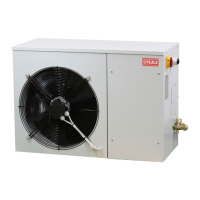
This part allows the release of the heat of the coolant gas in the environment. It's a microchannel
type, completely made of aluminium, with copper connections to the external piping. It's not suitable
for acid and salt environments and it cannot be exposed to metal dust projections. For optimal
protection against salt spray, see option "Protective treatment on heat exchangers – TREATS".
Evaporator
This component is where heat from inner air passes to the refrigerant gas. It's an heat exchanger
with copper pipes and aluminium fins (designed for use in non-acid and non-saline environments
only). Surface has hydrophilic treatment. For optimal protection against salt spray, see option
"Protective treatment on heat exchangers – TREATS".
The sloping positioning of the evaporator, compared to the air flow, maximizes its dimensions to
have lower pressure drops.
Thermostatic valve
The thermostatic expansion valve keeps the superheating at a constant value, adapting coolant
evaporation pressure to the real thermal load. This component is factory set during testing and must
not be tampered with.
4.5. Safety components of refrigerant circuit
High pressure safety switch
It stops compressor operation when the pressure inside the refrigeration circuit exceeds the
following value: 29,5 bar. The compressor starts when the pressure goes below 24,5 bar.
4.6. Protection components of refrigerant circuit
Low pressure safety switch
It stops compressor operation when the pressure inside the refrigeration circuit drops below the
following value: 0,4 bar. The compressor starts when the pressure goes above 1,5 bar.
Filter dryer
This is a mixed mechanical/chemical filter and it serves the purpose of filtering the impurities of the
coolant which goes through it and, at the same time, eliminating humidity particles.



 To Next Page