45 © STULZ SpA . – all rights reserved EN/39B/06.2018
SAL
Selecting and laying the gas and liquid lines
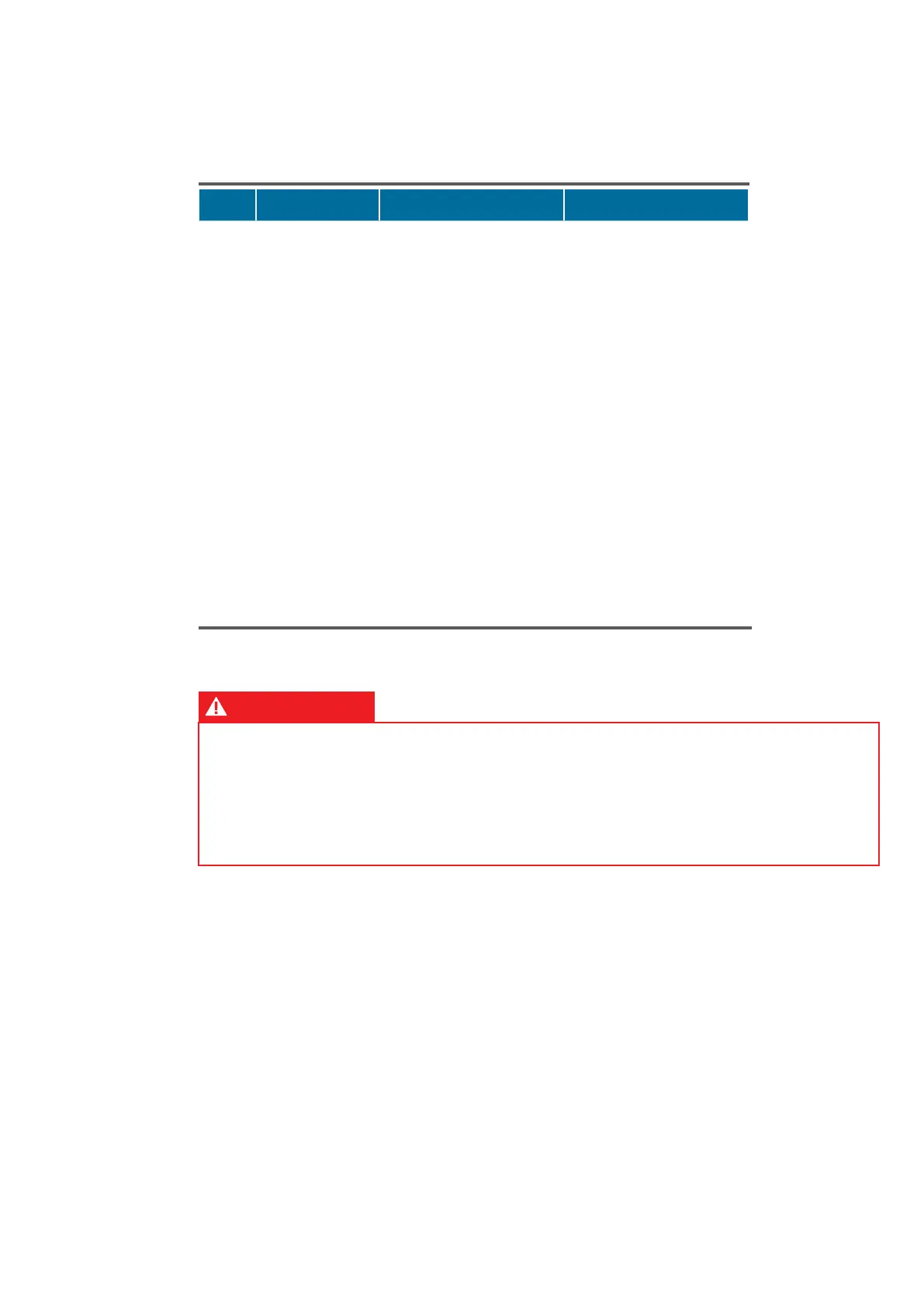
Refrigerant lines must be made of hard or soft copper. In case of R407C, diameters of pipes must
be those indicated in table 1.
Model Piping distance [m]
Gas pipe ext. diameter x
thickness [mm]
Gas/liquid pipe ext. diameter
x thickness [mm]
40
Up to 10 16 10
From 10 to 20 16 10
From 20 to 30 16 12
60
Up to 10 16 10
From 10 to 20 18 10
From 20 to 30 18 12
80
Up to 10 18 10
From 10 to 20 22 12
From 20 to 30 22 12
A0
Up to 10 18 12
From 10 to 20 22 12
From 20 to 30 22 16
A2
Up to 10 18 12
From 10 to 20 22 16
From 20 to 30 22 16
A5
Up to 10 22 12
From 10 to 20 22 16
From 20 to 30 28 16
TABLE 1: Standard diameters of R407C pipes
ATTENTION
With larger pipe diameters, the gas speed inside the intake pipe is insufficient and problems
of oil transport occur. In the table above you can see in which cases this problem occurs. In this
case the following measures have to be carried out:
• All the horizontal piping sections must have a minimum slope of 1/250 towards the
compressor;
• At the evaporator outlet a trap (siphon) must be installed in order to help the oil suction.
1. Routing must be over the shortest routes, except when the path requires an excessive number of
pipe elbows.
2. Limit the number of pre-shaped bends; if this is not possible every bend must have a radius of at
least 100 mm.
3. The gas line must be insulated.
4. The liquid line must be properly insulated with insulation thickness of 6 mm, in order to reduce
heat transfer in case of high external temperatures.
5. If the condensing unit is placed above the evaporating unit, the last segment of the intake pipe
must lean towards the condensing unit. If, on the other hand, the condensing unit is placed under
the conditioner, it's advisable to create a trap on the intake pipe.
6. Maximum distance allowed between evaporating unit and motor-condensing unit is 30 m.
7. Maximum height difference covered by connecting pipes must not exceed 10 m (please refer to
the drawings of the refrigerant connections in the following pages).



 To Next Page