
 Need help?
Do you have a question about the Sun Gold Power SGR-18K20E and is the answer not in the manual?
This document outlines the user manual for a battery system designed for home storage, providing comprehensive information on its operation, maintenance, and safety. The system is a lithium battery, specifically a 48V100Ah model, identified as SG48100P, with specifications of 51.2V and 100Ah.
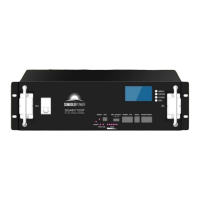
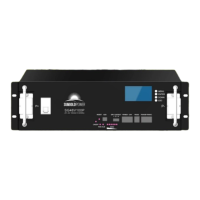
The battery system is equipped with a Battery Management System (BMS) that plays a crucial role in its functionality and safety. The BMS monitors various parameters of the battery, including voltage, current, temperature, State Of Charge (SOC), and State Of Health (SOH). This monitoring capability allows for precise control and management of the battery's performance, ensuring its longevity and safe operation. The system's interface includes several key components: a handle for carrying, SOC status lights (six green LEDs) to indicate the current charge, an ALM (Alert) red LED that illuminates during fault conditions and provides a voice prompt, and a RUN green light that is always on when the product is operating. Additionally, there is an ADD DIP switch (4-bit binary, optional) for setting address allocation when multiple units are used in parallel.
Communication with the battery system is facilitated through multiple interfaces. An RS232 communication port serves as an uplink for data transfer to a host computer, providing system parameters, status, and alarm information at a default baud rate of 9600bps. The wiring definitions for this port adhere to BMS product specifications. Dual RS485 interfaces are also available, allowing for monitoring of the battery pack information at a default baud rate of 9600bps. This interface supports communication with monitoring devices, where the monitoring device acts as the host to poll data based on an address range of 2 to 15. Furthermore, the system supports CAN communication with a baud rate of 500K, offering another robust communication option.
The battery system incorporates various protection mechanisms to ensure safe and reliable operation. These include cell overcharge protection, single overvoltage protection, cell overdischarge protection, charging current limit, charge overcurrent protection, discharge overcurrent protection, short circuit protection, MOS high temperature protection, cell temperature protection, and ambient temperature alarm. Each of these protections is designed with specific alarm voltages, protection voltages, delays, and release conditions, many of which can be customized according to customer requirements. For instance, cell overcharge protection triggers an alarm at 3600mV and initiates protection at 3650mV with a 4.0-second delay. Similarly, cell overdischarge protection alarms at 2700mV and protects at 2500mV with a 1.0-second delay. After 30 seconds of over-discharge protection, if the battery cannot recover, it enters a low power consumption mode. Short circuit protection is designed to disarm automatically once the load is removed.
The system also features a sleep and wake-up function to optimize power consumption and extend battery life. The system enters a low-power (hibernate) mode under several conditions: if single or overall over-discharge protection is not released within 30 seconds, if the reset button is pressed for 3 seconds, if the minimum cell voltage drops below the sleep voltage for a specified delay time (without communication, protection, balance, or current), if the standby time exceeds 24 hours (without communication, charging, discharging, or mains power), or if a forced shutdown is initiated via host computer software. It is crucial that the input terminal is not connected to an external voltage before entering sleep mode to ensure proper low-power consumption. The system can be woken up by connecting a charger with an output voltage greater than 48V, pressing the button for 3 seconds, or connecting to the communication line and opening the upper computer software (though this method cannot wake the protection board if it entered sleep due to over-discharge protection). After over-discharge protection, the system wakes up regularly every 4 hours to attempt charging; if it cannot be charged after 10 automatic wake-ups, it will no longer wake automatically.
Maintenance of the battery system involves several routine checks. Monthly, the operating environment should be kept away from heat sources and direct sunlight. Quarterly, a visual inspection should be performed for any damage, leaks, or deformation, with faulty packs being disconnected, photographed, and replaced. The exterior should be cleaned with a cotton cloth, taking care due to the high voltage. Bolts at each terminal should be checked and retightened if loose. If the connection line temperature exceeds 40°C, the cause should be investigated. Every half-year, busbar and terminal voltages should be measured and recorded after charging to ensure consistency. Real-time data collection at the end of discharge should be performed at least every six months in the first year. From the second year onwards, on-site capacity determination should be conducted every three months. If historical alarm information indicates frequent overcharging or over-discharging of a cell, replacement is recommended.
The packing list for the battery system includes the 48V100Ah lithium iron phosphate battery, positive and negative output lines (25mm2 flame retardant cable, 0.5m long, with copper noses), RS485 cascade communication lines (0.5m long, with RJ45 crystal heads), RS485 USB and RS232 USB cables (1.5m long), a product manual, a certificate, hanging ear screws (M6*16), and dry contact terminals.
For storage, the battery pack should be kept at 20-40% SOC in a clean, dry, ventilated, and rain-proof room with an ambient temperature of -5°C to 35°C and relative humidity not exceeding 75%. It should be placed flat, with a pad height of at least 100mm from the ground. Batteries must not be stored with active chemicals or dusting items, subjected to mechanical shock or heavy pressure, or exposed to direct sunlight or fire sources (distance not less than 2M). Every 3 months of storage, it should be charged with a current of 0.2-0.5C for 30-60 minutes at 25°C±5°C. During transportation, the battery pack should be packaged to avoid severe vibration, shock, extrusion, sun, and rain.
Usage precautions emphasize correct polarity during charging, avoiding adverse environments (extreme temperatures, deep cycling, frequent overcharge/overdischarge), and immediately reporting any abnormalities to a professional. Batteries and BMS should be kept away from dangerous goods. Short-circuiting, burning, or destroying the battery is forbidden, as is discarding it in garbage. Using other types of batteries in series or parallel, or mixing new and old batteries in series or parallel, is also prohibited. The company stresses strict adherence to the product specifications to prevent accidents and reserves the right to change the contents of the specification without prior notice.
 General
| Model | SGR-18K20E |
|---|---|
| Rated Power | 18kW |
| Output Voltage | 120/240V |
| Efficiency | 93% |
| Frequency | 50/60 Hz |
| Battery Voltage | 48V |
| Operating Temperature | -10°C to 50°C |
| Cooling Method | Fan |
| Protection Features | Overload, Short circuit, Over temperature |


 To Next Page