Voltage
value
If
the
voltage
value
falls
below
9.6V
after three
seconds
into
the
test
sequence or
anytime
before
the
15-second
test
sequence
begins, testing
should
continue
despite
a BAD
display reading.
Peak
running
current
If the
starter
current
drops
below
50 amps
after the
test has
begun,
the
test will
be aborted,
the BEEPER
will sound
twice
at the
end
of the
test but
no GOOD-
/BAD
indication
will
be made.
8 . Crank
engine
15
seconds
and observe
results.
Starting
system
test
indications:
a. AMPS
DISPLAY
reading
should not
exceed
max-
imum
specified
by
manufacturer.
b. Voltage
should
be
at or above
minimum specified.
c. Cranking
speed
should
be normal.
; /
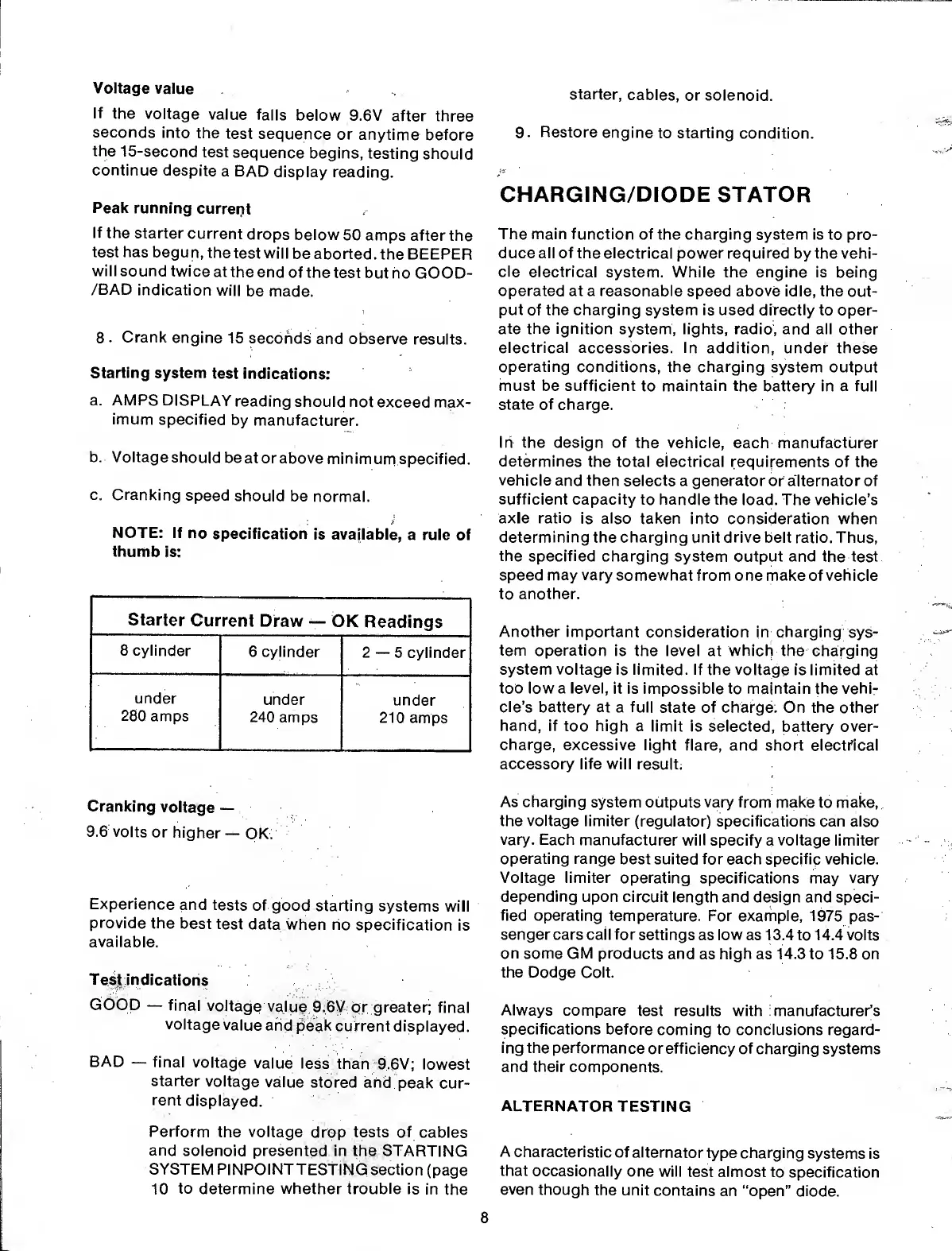
NOTE: If
no
specification
is available,
a rule of
thumb
is:
Starter
Current Draw
—
OK Readings
8 cylinder
6 cylinder
2
—
5
cylinder
under
280
amps
under
240
amps
under
210
amps
Cranking
voltage
—
9.6
volts
or
higher
—
OK.
Experience
and
tests
of good starting
systems
will
provide the
best
test
data
when no
specification
is
available.
Test
indications
GOOD
—
final
voltage
value
9.6V
or
greater;
final
voltage
value
and
peak
current
displayed.
BAD
—
final
voltage
value
less
than
9.6V; lowest
starter
voltage
value
stored and
peak cur-
rent
displayed.
Perform
the voltage
drop tests of
cables
and
solenoid presented in the
STARTING
SYSTEM PINPOINTTESTING
section
(page
10
to
determine
whether trouble
is
in
the
starter,
cables,
or solenoid.
9.
Restore
engine
to starting
condition.
CHARGING/DIODE STATOR
The main function
of the charging system is to
pro-
duce all of the electrical power required
by the vehi-
cle electrical
system. While the engine is being
operated at a reasonable
speed above idle, the
out-
put of the charging system is used directly
to oper-
ate the ignition
system, lights, radio, and all other
electrical accessories. In
addition, under these
operating conditions, the charging
system output
must be sufficient
to
maintain the
battery in a full
state of charge.
In
the design of the vehicle,
each manufacturer
determines
the total electrical
requirements
of the
vehicle
and then selects
a generator or alternator of
sufficient capacity
to handle the load. The vehicle’s
axle
ratio
is also taken into
consideration when
determining
the charging unit drive belt
ratio. Thus,
the specified charging
system output and the test
speed may vary somewhat from
one make of vehicle
to
another.
Another important
consideration
in
charging
sys-
tem operation
is the level at which the charging
system voltage is limited. If
the voltage is limited at
too low a level,
it is impossible to maintain the
vehi-
cle’s
battery at a full
state
of
charge. On the other
hand, if too high
a limit is selected, battery over-
charge,
excessive light
flare, and short electrical
accessory life
will
result.
As charging system
outputs vary from
make to make,
the voltage limiter
(regulator) specifications can also
vary. Each
manufacturer will
specify a
voltage
limiter
operating range
best suited for each specific vehicle.
Voltage limiter operating
specifications may vary
depending
upon circuit
length
and
design and speci-
fied operating
temperature. For example,
1975
pas-
senger cars call for settings
as
low
as 13,4 to 1 4.4 volts
on some GM
products and
as
high
as
14.3
to 15.8 on
the Dodge Colt.
Always compare
test results with manufacturer’s
specifications
before coming
to conclusions regard-
ing the
performance
or efficiency of charging
systems
and
their
components.
ALTERNATOR TESTING
A
characteristic
of
alternator
type charging
systems
is
that
occasionally
one
will
test
almost
to
specification
even
though
the
unit
contains
an “open” diode.
8


 To Next Page
 Loading...