TOWING CODE
24
BREAKAWAY CABLE
Determine whether or not the towing vehicle
towbar has a designated attachment point
(i.e. a part specifically designated for a
breakaway cable).
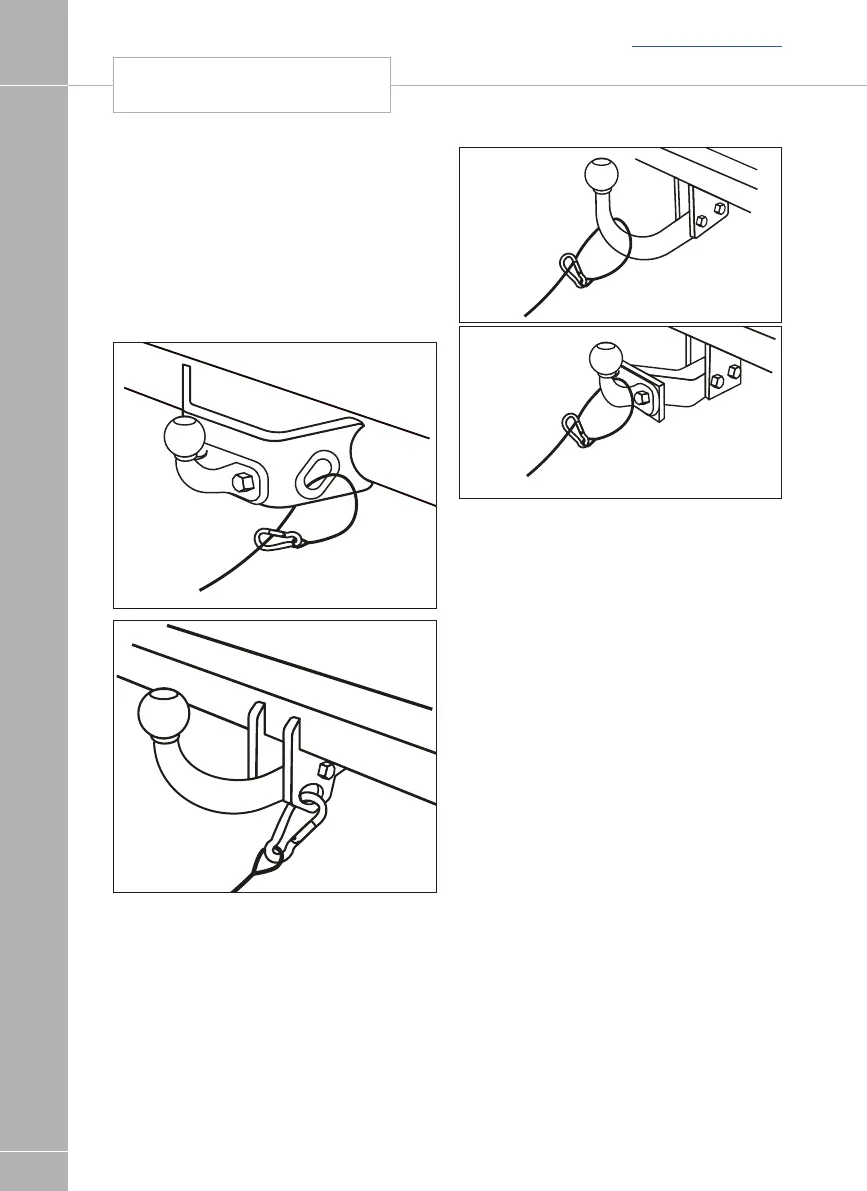
Where a point is designated on the towbar:
• Either pass the cable through the attachment
point and clip it back on itself (Fig 1)
or attach it directly to the designated point
(Fig 2).
Fig. 1
Fig. 2
Where there is no designated attachment point
on the towbar:
• Fixed ball: Loop the cable around the neck
of the towball in a single loop only. See figure
3A and 3B.
Fig. 3a
Fig. 3b
In some instances it may be possible
to attach the cable assembly either to a
permanent part of the towbar structure, as
long as this meets the approval of the towbar
manufacturer/supplier, or to an accessory sold
for the specific purpose of breakaway cable
attachment. For vehicles fitted with detachable
towbars, guidance must be sought from the
towbar manufacture/supplier on the correct
method for attaching the breakaway cable.
When the breakaway cable is attached it must
not snag in use on the trailer coupling head,
jockey heel or any accessories, e.g. a stabliser,
bumper shield, cycle carrier, etc. There should
also be sufficient slack in the cable to allow
the towing vehicle and trailer to articulate fully
without applying tension to the cable which
could otherwise cause the trailer brakes to be
inadvertently applied.
The cable must not be allowed to drag on the
ground. If there is too much slack, the cable
might drag on the ground and be weakened
so that it has insufficient strength to apply the
brakes in the event of the trailer becoming
detached when in motion. Excess slack may
also lead to the cable being caught on an
obstacle when in motion, leading to inadvert-
ent application of the trailer brakes. Care must
be also taken to ensure that the cable cannot
be entangled with the electrical cables.
Back to section menu






 To Next Page