CHARACTERISTICS OF ABRADING
WHEELS
The choice of which Genuine Taber abrading
wheels to use is best determined by preliminary
testing on the material to be investigated. The
abrasive action of the testing wheel should
reproduce, as nearly as possible, the wear that
the material will receive in actual use. It is
important to keep in mind that wear is a complex
phenomenon that may not be exactly replicated
through an accelerated abrasion tests.
Abrading wheels for the Taber Abraser can be
classified as:
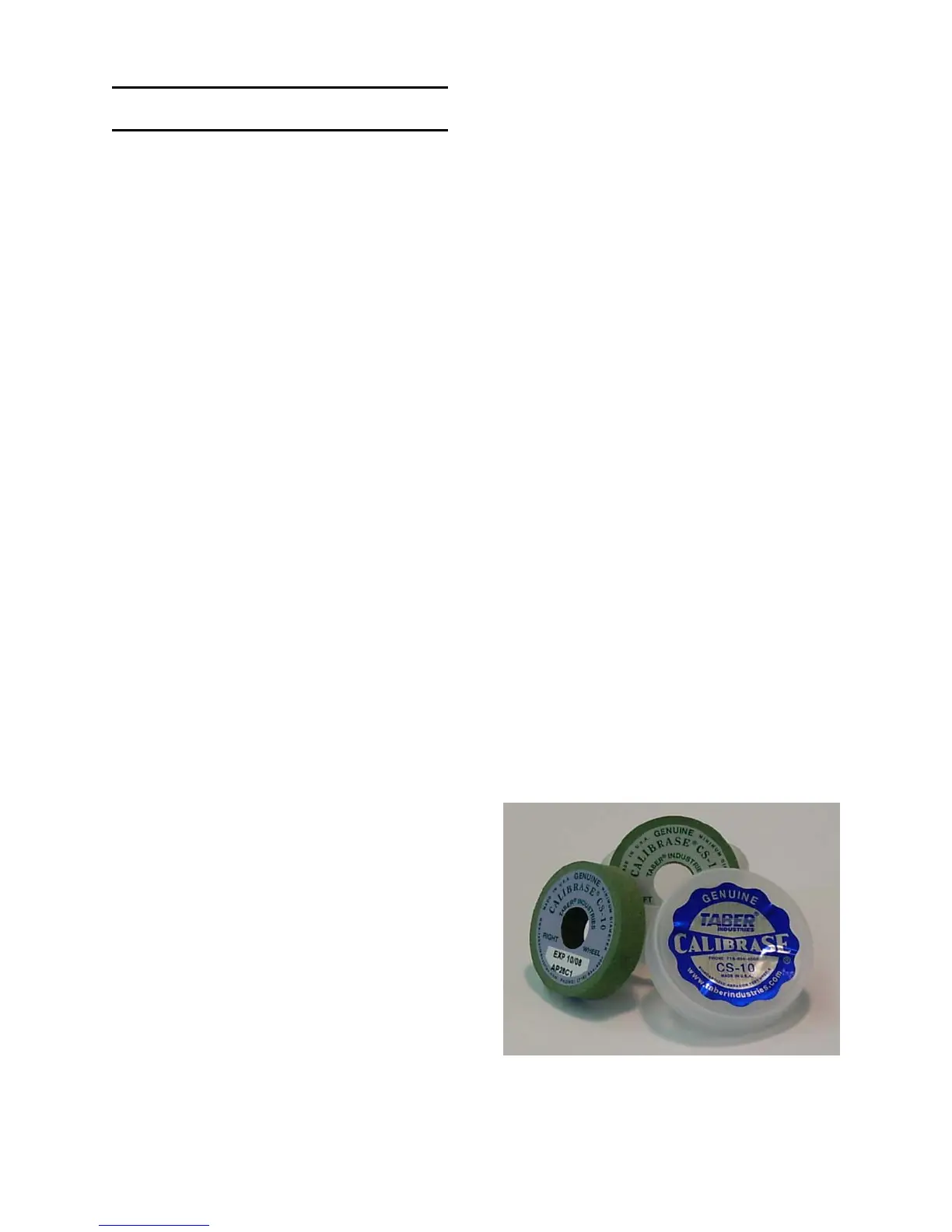
Calibrase
®
– A resilient wheel composed of
resilient binder and aluminum oxide or silicon
carbide abrasive particles. Frequently used
to evaluate rigid specimens.
Calibrade
®
– A non-resilient wheel
composed of a vitrified (clay) binder and
silicon carbide or aluminum oxide abrasive
particles. Frequently used to evaluate
flexible specimens.
Specialty – Used for special applications.
For both Calibrase and Calibrade wheels,
different grades are furnished to meet varying
requirements of abrasive action. During testing,
the wheel surface gradually wears away
exposing new abrasive particles. The minimum
usable diameter of Taber abrading wheels is 1-
3/4 inch, which corresponds with the wheel
label.
The composition of Genuine Taber abrading
wheels has been carefully chosen to reproduce
normal service wear. The quality and uniformity
of these wheels is maintained by continuous
inspection sampling and tightly controlled
manufacturing processes.
NOTE: The wear life of Calibrase or Calibrade
wheels will vary based on the load, surface texture
and frictional characteristics of the material tested and
frequency of refacing.
NOTE: The abrasive coefficient of the wheels can be
altered by oil or other contaminants. Handle only the
sides of the wheels.
U WARNING: Shelf life is dependent on proper
storage conditions (temperature 23°C±2°, relative
humidity 50 ±5%). When not in use, store
abrading wheels in their original container.
Calibrase Wheels
CS-10F Calibrase – A resilient wheel that offers
a mild abrading action, and was designed to
operate under loads of 250 or 500 grams. The
CS-10F is typically used to test materials such
as safety glazing materials and transparent
plastics, and must be refaced with the ST-11
refacing stone.
CS-10 Calibrase – Similar to the CS-10F, this
resilient wheel offers a mild – medium abrading
action like that of normal handling, cleaning, and
polishing. This popular wheel has been used to
evaluate a variety of materials including organic
coatings, plastics, textiles, leather and paper
products. Reface with the S-11 refacing disc.
CS-10P Calibrase – The abrasion rate is the
same as the CS-10, but this wheel has been
engineered so the wheel surface does not load
when testing paper products. Intended for tests
of short duration, with refacing after every tenth
test.
CS-10W Calibrase – This wheel is the same as
the CS-10 but white, to eliminate any color
transfer from the wheel to the specimen.
CS-17 Calibrase – Compared to the CS-10
wheel, the CS-17 produces a harsher abrasion.
Normally operated using loads of 500 or 1000
grams, this wheel is useful for testing materials
such as ceramics, plastics and enamels.
Reface with the S-11 refacing disc.
NOTE: Custom formulations can be developed
specific to your application.
U WARNING: Because of possible deterioration,
Calibrase wheels should NOT be used after the
expiration date printed on the wheel.
Figure 55
22 5135 / 5155 Operating Instructions ver 1.1


 To Next Page