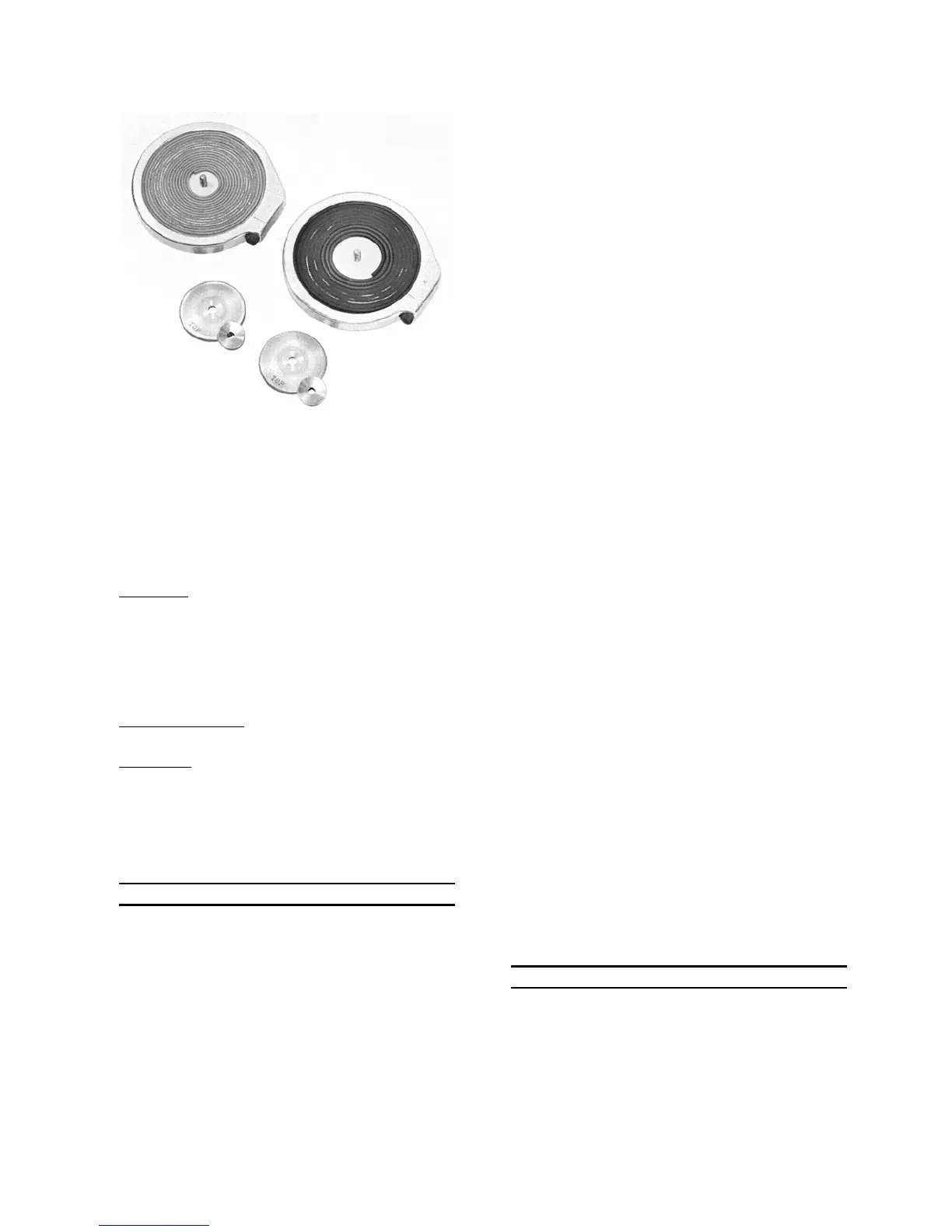
the wheels have worn through the insulation to
the wire.
Figure 81
Remark: Use of an electrical current to detect the end point
automatically, is suggested. One end of the specimen wire
may be grounded and a soft wire tinsel brush, in contact with
the wear path, conducted to a suitable electronic switch to
stop the abraser at a predetermined end point corresponding
to the breakdown of the insulation.
Wood
Specimen: 100 mm (4 inch) square with 6.35 mm
(0.25 inch) center hole for materials to 6.35 mm
(0.25 inch) thick. Alternatively, drill a 4.76 mm
(0.1875 inch) hole and thread the specimen onto
the center screw of the specimen holder. For
specimens 6.35 mm
(0.25 inch) to 12.7 mm (0.5
inch)
thick, use the S-21 Extension Nut.
Wheels and Load
: H-18 or H-22 Calibrade with
500 gram or 1000 gram load.
Evaluation: Weight loss or depth of wear method
Remark 1: The effect of moisture on the wear factor of wood,
such as decking, can be determined by soaking the wood in
water for a specified length of time and testing in that
condition using the rimmed specimen holder (E140-75).
INFLUENCES ON RESULTS
The measurement of abrasion resistance is a
complex phenomenon and may be influenced by
a number of factors. If there are significant
differences between reported test results for two
laboratories (or more), it is often attributed to
procedural errors, an instrument that is out of
calibration or one of the factors mentioned
below.
The resistance to abrasion is greatly affected by
the characteristics of the material itself. For
example, textile materials are affected by the
inherent mechanical properties of the fibers; the
dimensions of the fibers; the structure of the
yarns; the construction of the fabrics; and the
type, kind, and amount of finishing material
added to the fibers, yarns or fabrics. For rigid
materials, material surface roughness should be
considered.
The effect of age may impact the abrasion
resistance of organic materials and coatings.
Many coatings show low abrasion the first few
days but progressively improve during the
following 30 days as the coating cures.
The type of abradant used also plays an
important role. All abrasion tests are subject to
variation due to changes in the abradant during
specific tests. To minimize this variation, the
abradant must be cleaned at frequent intervals
and checked periodically.
Other factors to consider include the conditions
of the tests (i.e. temperature and humidity,
conditioning of specimens, etc.), and test
methodology (i.e. vacuum nozzle height,
pressure between the specimen and abradant,
etc.). For comparable and reproducible tests, it
is recommended that all testing be performed
under conditions covered by an established test
procedure.
The measurement of the relative amount of
abrasion may also be affected by the method of
evaluation. This is especially true with visual
assessments, as the results may be influenced
by the judgment of the operator.
If a thorough investigation does not uncover the
cause for the difference, comparative tests
should be performed to determine if there is a
statistical bias between the laboratories. The
test samples used must be as homogeneous as
possible, drawn from the material from which the
disparate test results were obtained, and
randomly assigned in equal numbers to each
laboratory for testing. The test results from the
laboratories should be compared using a
statistical test for unpaired data, at a probability
level chosen prior to the testing series. If bias is
found, either its cause must be found and
corrected, or future test results must be adjusted
in consideration of the known bias.
MAINTENANCE
The Rotary Platform Abrasion Tester is a
precision instrument that, if used and maintained
properly, should give you many years of trouble-
free service. This section will provide a general
guideline in caring for your instrument.
40 5135 / 5155 Operating Instructions ver 1.1


 To Next Page