TABLE 1
Wheel Status Refacing Cycles
New 2 refacings of 50 cycles
Used (previous test
<1,000 cycles)
25 cycles
Used (previous test
>1,000 cycles)
50 cycles
* During Test 25 cycles
NOTE: When refacing CS-10F wheels, adjust the
vacuum pick-up nozzle to 0.79 – 1.59 mm (0.0312 –
0.625 inch) above the ST-11 refacing stone.
NOTE: Properly refaced wheels must contact the
specimen their full width. Refacing can be checked
visually, wheel color should be uniform after two
refacings of 50 cycles each. If it is not, reface the
wheels a third time.
U WARNING: Do not reface Calibrase wheels by
placing a S-11 refacing disc over the specimen.
Mounting on top of a specimen may cause the
surface of the S-11 not to run absolutely true,
which would abrade a slight crown on the wheel
faces causing inaccuracies.
Wear Characteristics of Calibrase Wheels
Resilient wheels possess properties that cause
the working faces to disintegrate slowly as they
are used, continually exposing fresh abrasive
grains to the specimen being tested. This
characteristic is necessary for the proper
functioning of the Abraser.
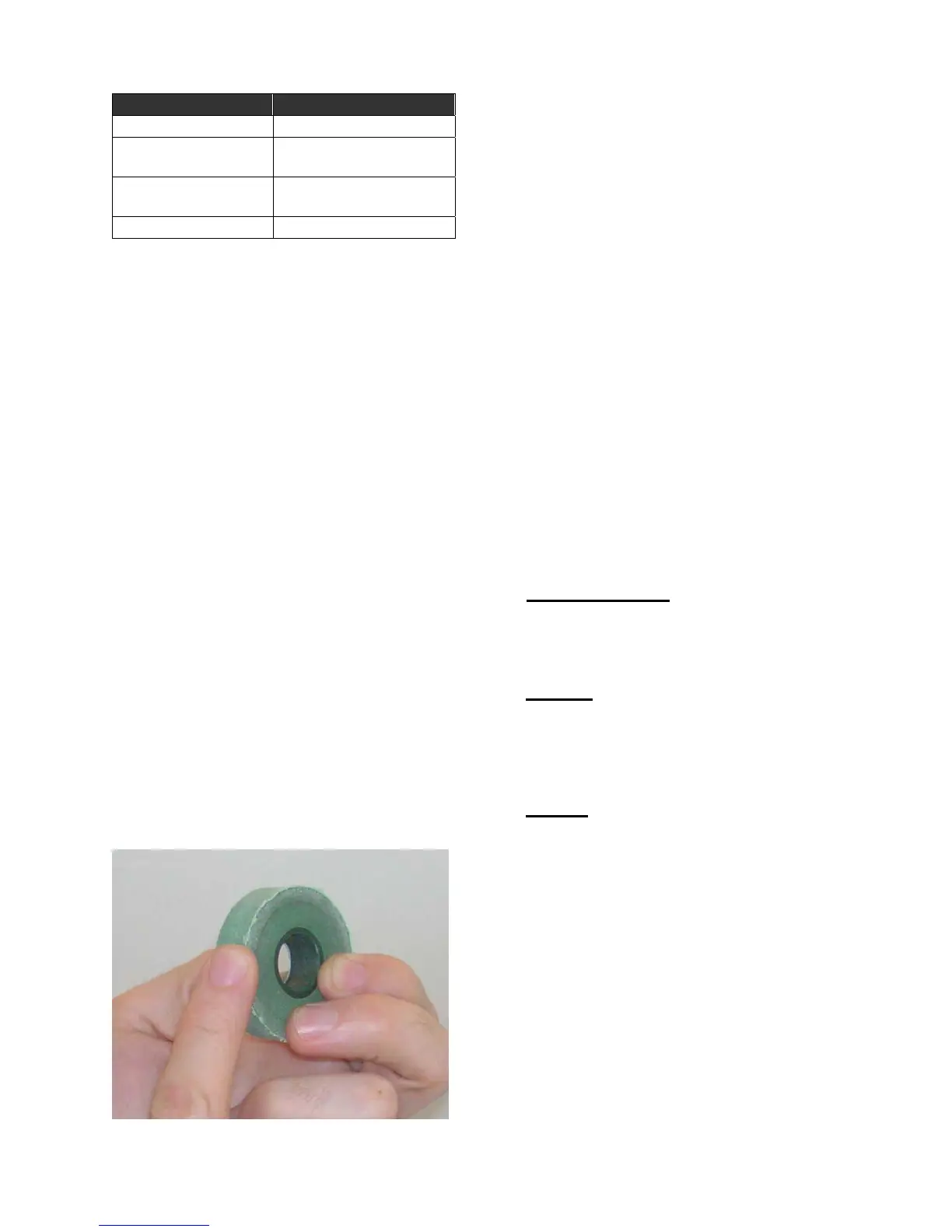
A thin film of rubber may form on the left hand
edge of Calibrase wheels as the main body of
the wheel wears down (Figure 64). Although a
narrow fin is not detrimental to the test, should it
extend more than 1.59 mm
(0.0625 inch) beyond
the work surface, remove it by gently rubbing the
edge with your finger. Do not rub excessively so
as to round the edge of the wheel.
Figure 64
Wear life of Calibrase wheels varies with the
surface texture and frictional characteristics of
the material tested, in addition to the load.
Under ordinary conditions Calibrase wheels
should give from 10,000 to 50,000 wear cycles.
Abnormally short wheel life indicates use of the
wrong wheel, load, or procedure for the material
tested, or too frequent refacing.
U WARNING: The abrasive coefficient of the
working faces of the wheels can be altered by oil
or moisture from the fingers. Touch only the sides
of wheels in handling.
Refacing Vitrified Wheels (Calibrade)
All Calibrade wheels are diamond trued at the
factory and may be used continuously without
further refacing until the abrading surfaces show
indications of becoming worn out of round,
crowned or clogged with abraded material.
Refacing is also advised when starting a series
of comparative tests or changing to an entirely
different material. In some instances, where
there is a tendency for the working surfaces of
the wheels to pick up excess material, it may be
desirable to reface the wheels before testing
each specimen. (This latter procedure is only
required in exceptional cases.)
A. Worn out of round
– Occasionally, wheels
become out of round due to unevenness of the
specimen being abraded or other reasons. The
normal abrading surface of these wheels should
be concentric with the hub.
B. Crowned
– The working surfaces of wheels
that are “crowned” appear slightly rounded. To
check for this condition, place a straight edge
against the two wheels. The straight edge
should be in contact with the full width of the
wheels.
C. Clogged
– “Clogging” can be identified as a
spot buildup on the working faces of the wheels
and should not be confused with the uniform
coloring of abrading dust from the specimen.
Procedure for Refacing Calibrase Wheels
To properly reface Calibrade wheels, a Taber
Wheel Refacer must be used. This instrument
utilizes a diamond tool that is traversed across
the working surface to precision dress the
abrading wheels (Figure 66).
Refacing Calibrade wheels leaves a sharp edge
that may sever threads when testing textile
fabrics. It is acceptable to remove this sharp
edge prior to testing. To do so, cut a small strip
from an S-11 refacing disc and hold it lightly
against the outer edge of each wheel. Manually
turn the nut to rotate the motor shaft. Reverse
26 5135 / 5155 Operating Instructions ver 1.1


 To Next Page