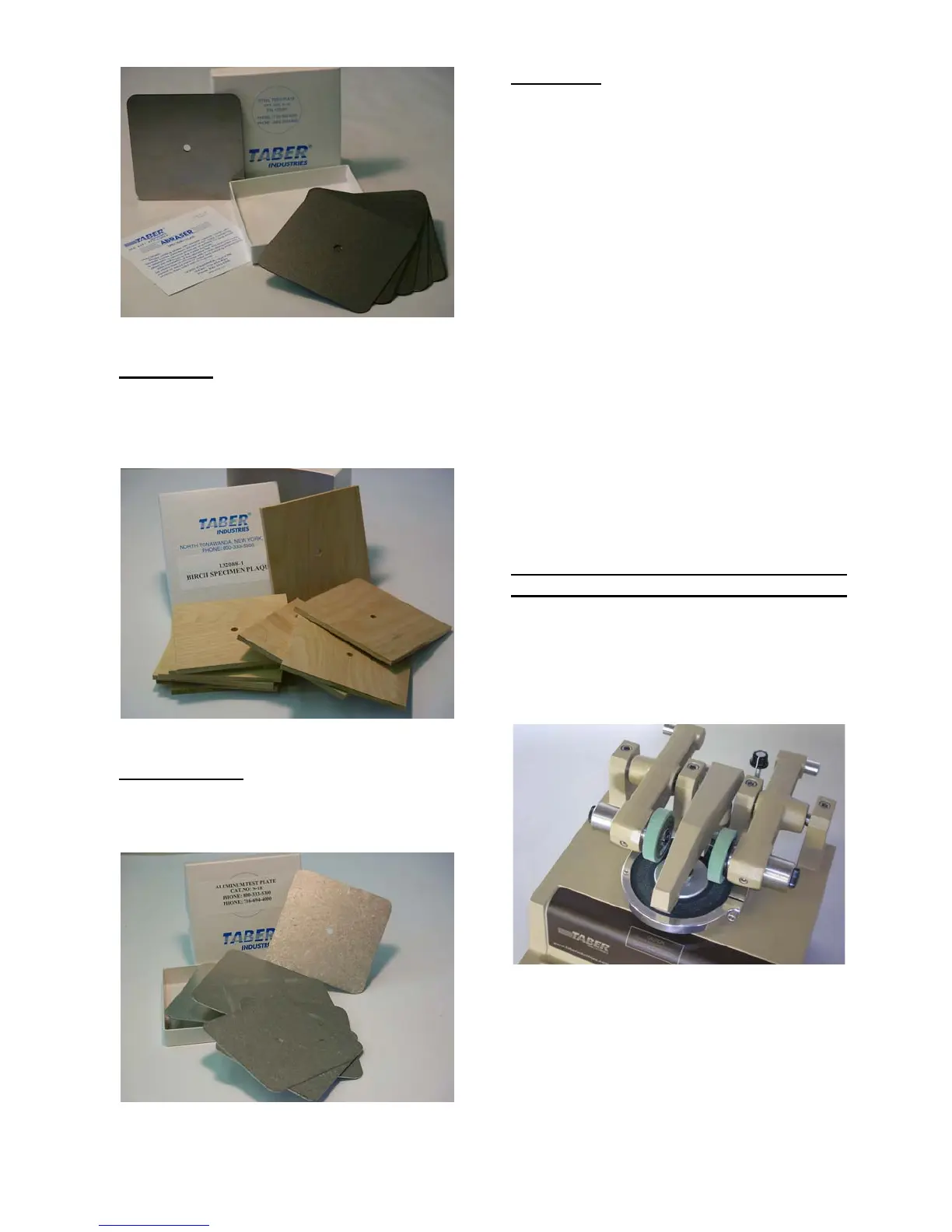
Figure 69
Wood (S-17) – S-17 plaques (Figure 70) are
manufactured from grade A1, 6.35 mm
(0.25 inch)
birch plywood. Sanded on both sides, the size
is 100 mm
(4 inch) square with a 6.35 mm (0.25
inch)
center hole.
Figure 70
Aluminum (S-18) – Produced out of #19 gauge
5052 aluminum, S-18 plates (Figure 71) are 100
mm (4 inch) square with rounded corners and a
6.35 mm
(0.25 inch) center hole.
Figure 71
Glass (S-31) – The S-31 is a quality plate glass,
approximately 3.17 mm
(0.125 inch) in thickness
with a 6.35 mm
(0.25 inch) center hole.
Panels dipped or sprayed on both sides should
be marked with an “A” or “B” to identify the front
and back surfaces and their respective tests. An
extra heavy application may not dry with the
same physical properties as a light coating.
When preparing your own test panels, ensure
the sides are flat and parallel. A simple means
to check for flatness is to place a straight edge
across the test panel surface, and verify there is
no gap. Use a file to remove any burrs from the
center hole and edges.
• To generate useful data, specimens must be
flat and have a uniform coating thickness.
• To subject specimens to a wet abrasion test,
the Rimmed Specimen Holder (E140-75)
may be used. This holder has a 9.5 mm
(0.375 inch) raised rim for retaining liquids
during test. Such tests might include paint
used to mark traffic lanes at busy
intersections, subjected to both wet and dry
abrasion in everyday use.
TEST PROCEDURES
The following suggestions are provided as a
starting point for using the Taber Rotary Abraser
to evaluate different materials. See page 47 for
a partial listing of internationally recognized test
methods that reference the Taber Abraser.
Figure 72
Prior to conducting any tests, the abrading
wheels should be prepared accordingly and a
consistent vacuum nozzle height should be used
(measured off the specimen surface). Other
factors to consider include specimen
conditioning, environmental conditions, vacuum
suction level, specimen cleaning, and test
cycles. Specimens must have a flat, even
surface and run true.
33 5135 / 5155 Operating Instructions ver 1.1


 To Next Page