Wheels and Load: CS-10 Calibrase with 250
gram or 500 gram load.
Evaluation
: Visual changes (i.e. loss of luster;
changes of surface; etc.); weight loss method.
Remark: Duration of the test is a predetermined number of
cycles (i.e. 300, 500 or whatever number is needed to reach
the degree of wear to be regarded as the end point of the
test). The loss in milligrams is calculated on a 1000 cycle
basis which gives a Taber numerical wear index directly
comparable with that of similar materials tested under the
same conditions.
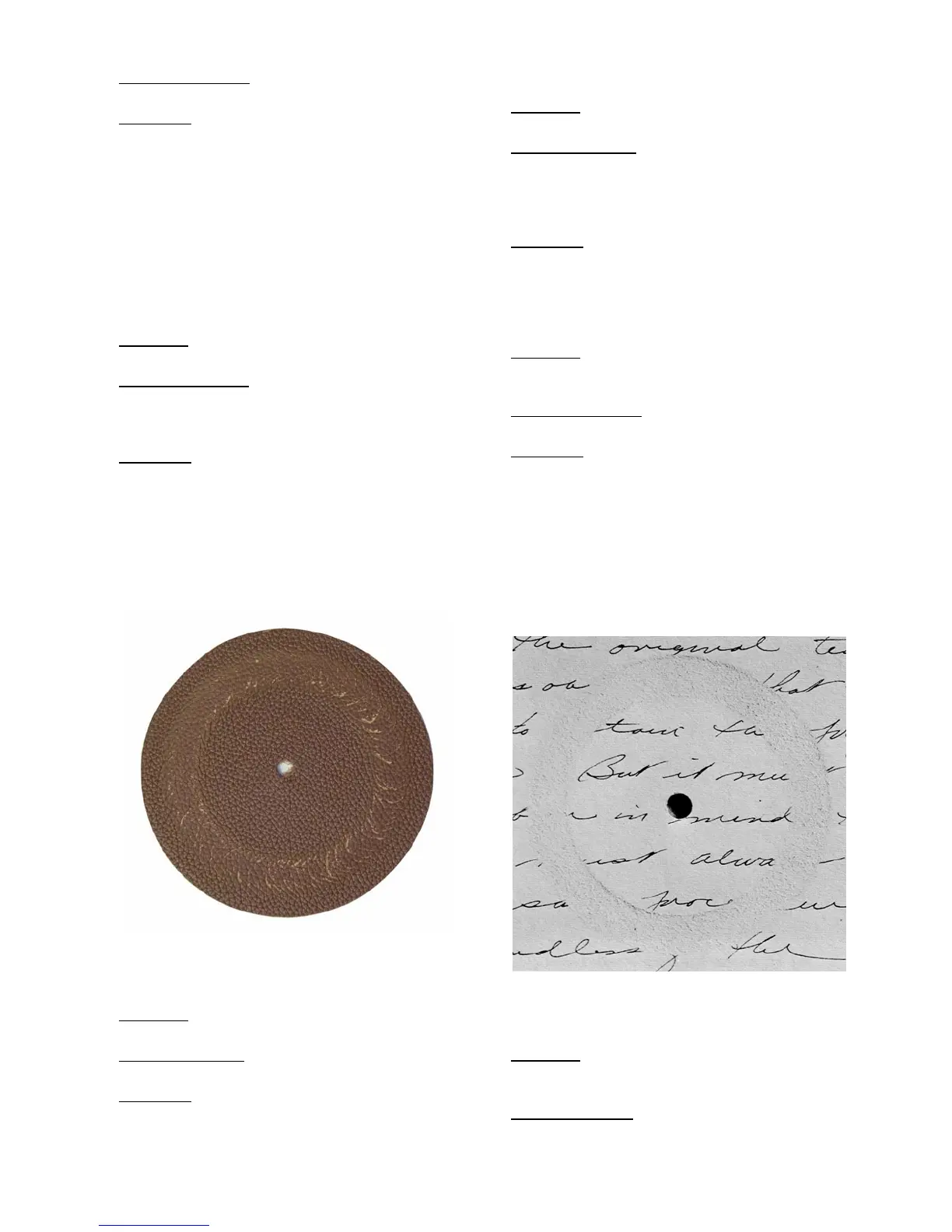
Leather Coverings – Luggage and
Upholstery (Figure 75)
Specimen: 100 mm (4 inch) diameter or square
with 6.35 mm (0.25 inch) center hole.
Wheels and Load
: CS-10 or CS-17 Calibrase
with 500 gram or 1000 gram load. Alternatively
use H-18 or H-22 Calibrade with 1000 gram
load.
Evaluation
: Weight loss method, visual changes
(i.e. loss of luster; changes of surface; color
changes; breakthrough of top coat).
Remark: H-22 Calibrade wheels can be used on the more
durable grades of leather subject to harsh wear; dyed,
surface colored leather may require less severe abrasion
with the CS-10 or CS-17 Calibrase wheels to produce a test
of sufficient duration to judge correctly the degree of
abrasion resistance.
Figure 75
Leather (Shoe Soles)
Specimen: 100 mm (4 inch) diameter or square
with 6.35 mm
(0.25 inch) center hole.
Wheels and Load
: H-18 or H-22 Calibrade with
500 gram or 1000 gram load.
Evaluation
: Weight loss method; or depth of
wear method [maximum depth of penetration
recommended is 0.8 mm
(0.0312 inch)].
Linoleum
Specimen: 100 mm (4 inch) diameter or square
with 6.35 mm
(0.25 inch) center hole.
Wheels and Load
: H-18 or H-22 Calibrade with
500 or 1000 gram load. For solid linoleum
subjected to extreme wear or cutting action, S-
35 Tungsten Carbide wheels with 1000 gram
load.
Evaluation
: Weight loss method or depth of wear
method [maximum depth of penetration
recommended is 0.8 mm
(0.0312 inch)].
Paper – Erasure Tests (Figure 76)
Specimen: 108 mm (4.25 inch) diameter with 6.35
mm
(0.25 inch) center hole, mounted on S-36 or
S-36-1 Mounting Card.
Wheels and Load
: CS-10 Calibrase with 250
gram or 500 gram load.
Evaluation
: Visual end point determined by
partial erasure of ink marks from wear path
surface.
Remark: The properties to be determined are: 1) ease of
erasure, 2) amount of damage to surface from abrasion, 3)
ability of specimen to accept rewriting after erasure, 4)
number of times the specimen will accept erasure and
rewriting. The specimen is prepared by writing or drawing
circular lines on the surface to be tested using a permanent
ink. The ink should be thoroughly dried on the conditioned
paper before testing.
Figure 76
Paper – Scuffing Test
Specimen: 108 mm (4.25 inch) diameter or square
with 6.35 mm
(0.25 inch) center hole center hole
mounted on S-36 or S-36-1 Mounting Card.
Wheels and Load
: H-10, H-18 or H-22 Calibrade
with 500 or 1000 gram load. Alternately, CS-5
36 5135 / 5155 Operating Instructions ver 1.1


 To Next Page