pressure is ordinarily used but the CS-10 may be substituted
when it is desired to extend the duration of the test for low
abrasion resistance finishes.
Rubber – Test A
Specimen: 100 mm (4 inch) diameter or square
for sufficiently thick and rigid materials; for thin,
flexible materials, 100 mm
(4 inch) square when
adhered to S-36 mounting card or 108 mm
(4.25
inch)
diameter when adhered to S-36-1 mounting
card.
Wheels and Load
: H-18 or H-22 Calibrade with
1000 gram load.
Evaluation
: Weight loss or depth of wear
method.
Remark: Flat sheet rubber samples subjected to unusually
severe abrading and cutting action in actual service may be
tested with the S-35 tungsten carbide wheels with 1000
gram load.
Rubber – Test B
Specimen: Wheels, molded or cut from sheet in
place of flat specimen; size: 50 mm
(2 inch)
diameter x 12.7 mm
(0.5 inch) thick with
15.875mm
(0.625 inch) center hole.
Abradant
: ST-11 stone mounted on standard
specimen holder.
Wheels and Load
: Molded wheel specimens
mounted on abrading wheel shafts with 1000g
load.
Evaluation
: Weight loss method.
Remark: When testing specimens molded and mounted as
wheels with the ST-11 stone, it should be noted that the
stone has a coarse and fine side; the side used should be
specified in the test report.
Safety Glazing Materials
Specimen: 100 mm (4 inch) square with 6.35 mm
(0.25 inch) center hole.
Wheels and Load: CS-10F with 500 gram load.
Evaluation
: Change in the percentage of
transmitted light and percent haze, before and
after exposure to abrasion as measured by a
hazemeter.
Remark 1: Reface wheels with fine side of ST-11 refacing
stone.
Remark 2: For transparent specimens, care must be taken to
mount the test specimen such that the bottom surface is not
scratched nor subjected to abrasion.
Remark 3: The use of an oversized nozzle is recommended
[11mm (0.4375 inch) opening vs. the nominal 8mm (0.3125
inch)].
Steel
Specimen: 100 mm (4 inch) square or diameter
with 6.35 mm
(0.25 inch) center hole.
Wheels and Load
: H-10 or H-18 Calibrade with
500 or 1000 gram load.
Evaluation
: Weight loss method.
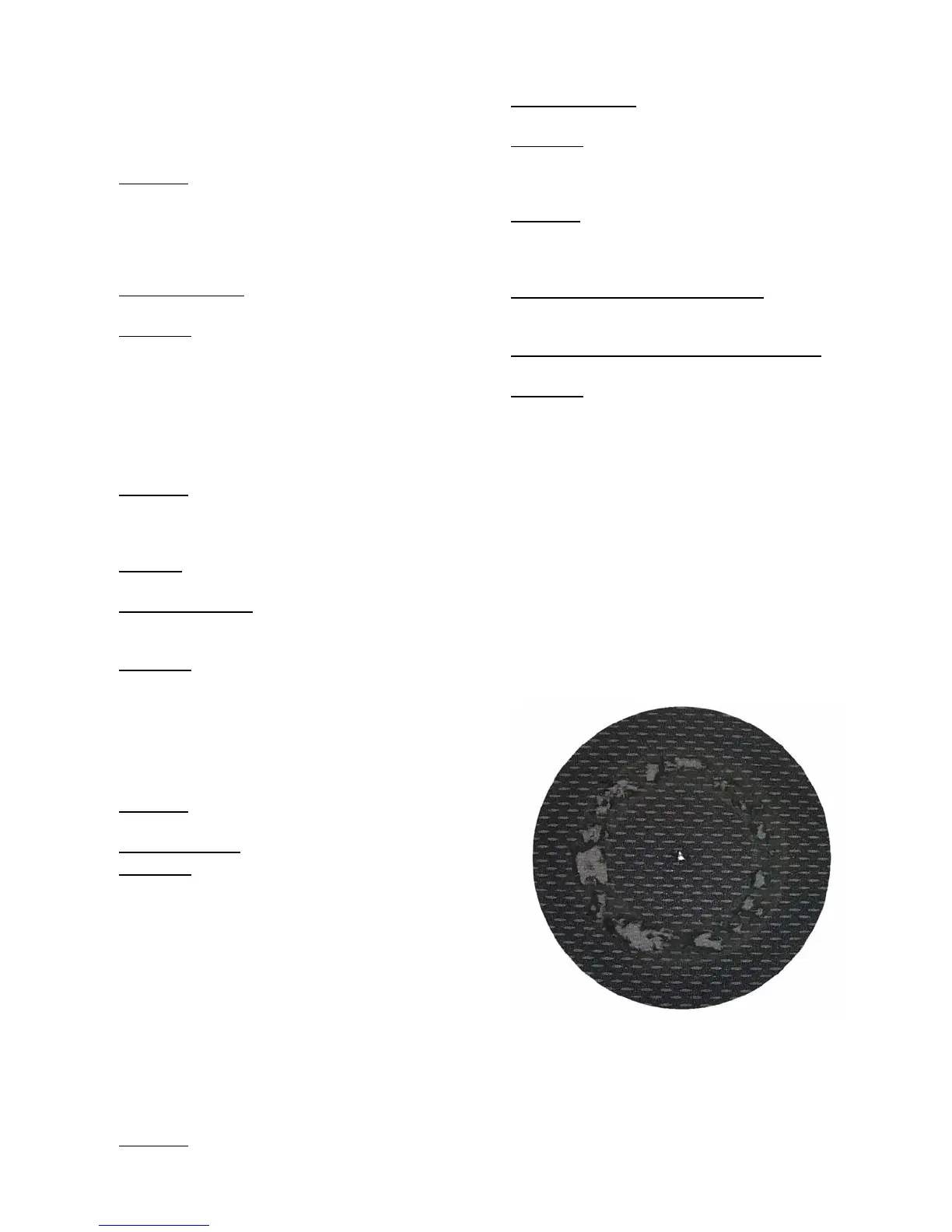
Textiles (Figures 78 & 79)
Specimen: 133 mm (5.25 inch) round with 12.7
mm
(0.25 inch) center hole, 108 mm (4.25 inch)
diameter with 6.35 mm
(0.25 inch) center hole
when mounted to S-36-1 Mounting Card.
Wheels and Load – Delicate Fabrics
: H-38 (fine)
Calibrade or CS-10 Calibrase with 500 gram or
250 gram load.
Wheels and Load – Medium / Heavy Fabrics
: H-
18 or H-22 Calibrade with 1000 gram load.
Evaluation
: Visual method, changes in luster;
surface; color; appearance of first broken
threads; appearance of a hole. Alternatively,
physical changes such as thickness; air
permeability; weight; strength.
Remark 1: Prepare center hole by folding a 133 mm (5.25
inch) round or square sample twice and cutting off the folded
corner to produce a small central hole for the clamp screw.
Mount the specimen on the holder and clamp tightly with
clamp plate and nut. Adjust the clamp ring to a tight fit over
the specimen and holder and draw taut by pressing the
clamp ring over the edge of the holder. When the desired
tension is obtained, tighten the clamp ring adjusting screw.
Avoid tightening to excess so as not to buckle the fabric.
Remark 2: Use of mounting cards prevents stretch and
wrinkles.
Remark 3: Vacuum control should be set to prevent
abradings from being trapped in the threads.
Figure 78
38 5135 / 5155 Operating Instructions ver 1.1


 To Next Page