EasyManua.ls Logo

tbs electronics TBS6909 - User Manual

Default Icon
29 pages
Print Icon
To Next Page IconTo Next Page
Loading...
TBS6909 Multi Standard Tuner Card User Guide
TBS6909 User Guide
Dear Customers,
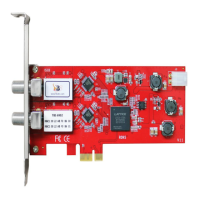
Thank you very much for using TBS products. The TBS6909 is a PCI Express TV tuner
card that supports a variety of digital TV standards including DVB-S2 / S, allowing
switching between different digital TV signals.
In order to use this item correctly, please read this user manual carefully at the
beginning.
1. Hardware Installation
1.1 Install TBS TV Tuner Card
Power off the computer, remove computer cover and take out cover panel of
PCI-e slot in which you want to put the card. Insert the card in PCI-e slot and fix
card bracket with screw. Make sure the card fit in PCI-e slot tightly. Then put
back computer cover.
Attention
When turn off the computer, please do not touch the PC internal components especially the
CPU and VGA chip, which has a high temperature with a risk of burns.
Please be sure to see the manual of PC and peripheral equipment.

Other manuals for tbs electronics TBS6909

Question and Answer IconNeed help?

Do you have a question about the tbs electronics TBS6909 and is the answer not in the manual?

Summary

TBS6909 Hardware Installation

Physical Card Installation

Steps to install the TBS6909 PCI-e TV tuner card into your computer's slot.

External Power Supply Requirements

Guidance on when and how to provide supplemental power to the tuner card for optimal operation.

Satellite Signal Input Configurations

Connecting satellite signal cables using various LNB types and input modes.

Multi-Satellite Usage

Multiswitch Setup with Multiple Inputs

Instructions for configuring multiswitch systems with multiple satellite inputs and using dvblast for channel scanning.

Windows Driver Installation Guide

Downloading and Installing the Driver

Procedures for downloading the TBS6909 Windows driver and performing the initial installation.

Manual Driver Update via Device Manager

Steps to manually update the device driver using Windows Device Manager if automatic installation fails.

Driver Installation Verification

How to confirm that the TBS6909 driver has been successfully installed on your Windows system.

Software and Usage Recommendations

Recommended Player Software and Videos

Links to download essential player software and video guides for using the TBS6909 tuner card.

Important Handling and Safety Precautions

Critical warnings regarding proper handling, device detection, and preventing damage to the tuner card.

Linux Open Source Driver Setup

Initial Linux Setup and Verification

Commands to check for the device and prepare the Linux environment for driver installation.

Downloading and Compiling Driver Sources

Cloning necessary source files and installing build tools for the Linux driver.

Building and Installing the Linux Driver

Executing make commands to compile and install the open-source driver for the TBS6909 card.

Installing Firmware for Linux

Downloading and installing the required firmware files for the Linux driver to function correctly.

Verifying Linux Driver Installation

Confirming the successful installation of the Linux driver by checking system logs.

Linux Operation with Dvblast

Connecting to LNB

Connecting the satellite cable to the LNB as the initial step for signal reception.

Locking DVB-S Channels with dvblast

Utilizing dvblast commands to scan and lock TV channels for DVB-S signals.

Locking DVB-S2 Channels with dvblast

Utilizing dvblast commands to scan and lock TV channels for DVB-S2 signals.

Tvheadend Configuration Guide

Initial Tvheadend Setup

Connecting the LNB, installing Tvheadend, and accessing its web interface.

Network and Mux Parameter Configuration

Configuring network names and mux frequencies for signal scanning in Tvheadend.

Adapter and Channel Mapping in Tvheadend

Setting up TV adapters, selecting LNB ports, and mapping services to channels for viewing.

Unicable Mode Setup in Tvheadend

Configuring the tuner card for Unicable mode within the Tvheadend interface.

Astra Software Usage Guide

Installing and Accessing Astra

Steps to install Astra software and log into its web UI for configuration.

Configuring Astra Adapters and Signals

Setting up Astra adapters with correct satellite signal and frequency parameters.

Scanning Channels and Saving Streams

Scanning for TV channels, selecting programs, and configuring stream output protocols in Astra.

Frequently Asked Questions (FAQ)

Linux Driver and Operation FAQs

Common questions and solutions related to installing and using the driver on Linux systems.

Windows Driver and Compatibility FAQs

Addressing common issues users face with Windows drivers, including detection, performance, and OS compatibility.

Overview

The TBS6909 is a PCI Express TV tuner card designed to receive various digital TV signals, including DVB-S2 and DVB-S. This device allows users to switch between different digital TV signals, offering flexibility in TV reception.

Hardware Installation

Installing the TBS6909 involves a few straightforward steps. First, ensure the computer is powered off. Then, remove the computer cover and locate an available PCI-e slot. Remove the cover panel for the chosen PCI-e slot. Carefully insert the TBS6909 card into the PCI-e slot, ensuring it fits tightly. Secure the card bracket with a screw. Once the card is fixed, replace the computer cover.

For situations where the power from the PCI-e slot might be insufficient, especially when connecting to a large motor, the TBS6909 requires an extra power supply. This ensures stable operation and optimal performance.

Connecting the TV signal cable to the TV tuner card is crucial for reception. The TBS6909 is a powerful DVB-S/S2 octa tuner card, supporting multiple signal input configurations. There are three primary ways to input signals:

  • Multiswitch Mode (Mode 0):

    • If using a quad LNB, connect the four cables directly to the four ports of the TBS6909.
    • If using a quattro LNB, which provides four cables (V/L, V/H, H/L, H/H), connect each cable to the corresponding input on the TBS6909 (Input 0 to V/L, Input 1 to V/H, Input 2 to H/L, and Input 3 to H/H).
    • For C band or Ku band single reception, two inputs are sufficient; connect the cables to Input 0 and Input 2.
    • Input 0 Interface: Receives DVB-S/S2 TV channels from low-frequency noise V/L TV signals. Allows simultaneous reception of SD/HD TV channels from eight different satellite transponders.
    • Input 1 Interface: Receives DVB-S/S2 TV channels from high-frequency noise V/H TV signals. Allows simultaneous reception of SD/HD TV channels from eight different satellite transponders.
    • Input 2 Interface: Receives DVB-S/S2 TV channels from low-frequency noise H/L TV signals. Allows simultaneous reception of SD/HD TV channels from eight different satellite transponders.
    • Input 3 Interface: Receives DVB-S/S2 TV channels from high-frequency noise H/H TV signals. Allows simultaneous reception of SD/HD TV channels from eight different satellite transponders.
    • To receive full TV channels from V/H satellite TV signals simultaneously, connect the satellite TV signal cable to the corresponding "Input" interface.
  • Normal Mode (Mode 1):

    • To enable this mode, create a configuration file /etc/modprobe.d/mxl58x.conf in the Linux system directory with the content options mxl58x mode=1. After saving, reboot the computer.
    • In Normal mode, all four interfaces (Input 0, Input 1, Input 2, Input 3) can search for full TV channels from high-frequency/low-frequency noise V/H TV signals.
    • Connecting to satellite cable in Normal mode:
      • Input 0: Works only for Tuner 0 and Tuner 1.
      • Input 1: Works only for Tuner 2 and Tuner 3.
      • Input 2: Works only for Tuner 4 and Tuner 5.
      • Input 3: Works only for Tuner 6 and Tuner 7.
    • To receive full TV channels from V/H satellite TV signals simultaneously, connect more than two satellite TV signal cables to the corresponding "Input" interfaces. For example, connecting cables to "Input 0" and "Input 1" interfaces allows separate searching of TV channels from V/H satellite TV signals at the same time.
    • In Normal mode, Input 0 corresponds to Tuner 0 or Tuner 1, and can only work with either V or H signal channels, not both simultaneously.
  • Unicable Mode (Mode 2):

    • Similar to Normal mode, create a configuration file /etc/modprobe.d/mxl58x.conf with the content options mxl58x mode=2. Reboot the computer after saving.

Multi-Satellite Usage

In scenarios where a multiswitch has more than one satellite input, the TBS6909 allows users to select the desired satellite by sending a DiSEqC command.

In this mode, if at least one of the inputs (0 to 3) has an active signal, all tuners can achieve a lock. For example:

  • If a VH signal from satellite B is connected to Input 1, users can scan channels using dvblast. For DVB-S, the command would be dvblast -f 12538000 -s 41250000 -v 13 -a 0. This means the VH port selects satellite B, and the other seven tuners can receive the satellite B VH signal.
  • If an HL signal from satellite A is connected to Input 2, users can scan channels using dvblast. For DVB-S2, the command would be dvblast -f 11080000 -s 43200000 -v 18 -m psk_8 -a 0. This means the HL port selects satellite A, and the other seven tuners can receive the satellite A HL signal.
  • If four different active signals (VL, VH, HL, HH) are connected to the correct four inputs, the device can receive all these signals.

Windows Driver Installation

For Windows users, installing the driver involves these steps:

  1. Start the PC and go to "Computer Management." If using Windows 7, a "Failed to install the device driver" notice might appear.
  2. To install the driver successfully, follow the prompts. Check the TBS TV tuner hardware device ID by opening "Computer Management," clicking "Other devices," and then double-clicking the correct hardware device for details.
  3. Download the TBS6909 Windows Driver from the official website.
  4. Unzip the downloaded driver package.
  5. Run "TBS_6909_driver_MultiSw_setup.exe." A setup wizard will guide you through the installation.
  6. If the quick installation fails, manually install the driver. Open the unzipped driver package, navigate to the appropriate system folder (e.g., tbs-6909 x86 or tbs-6909 x64), and copy the drive path.
  7. Open Device Manager, right-click on the "Multimedia Controller" (or the device with a yellow exclamation mark), and select "Update Driver Software."
  8. Choose "Browse my computer for driver software" and paste the copied drive path. Ensure "Include subfolders" is checked.
  9. Click "Next" to proceed.
  10. If a Windows Security dialog appears, select "Always trust software from 'SHENZHEN TURBOSIGHT TECHNOLOGY CO,.LTD'" and click "Install."
  11. Click "Next," "Install," and "Finish" to complete the installation.
  12. To verify the driver installation, right-click "My Computer," select "System Properties," then "Hardware" and "Device Manager." Expand "Sound, video and game controllers." If "TBS6909 Dual BDA Tuners" is listed, the driver is correctly installed.

Play Software Installation

To enjoy satellite TV on a PC or record video, player software is required. The TBS6909 is compatible with various software, including TBSViewer, DVBDream, and ProgDVB.

  • Player software can be downloaded from the official website. Refer to the Software Installation Instructions for detailed steps.
  • Video guides are also available on YouTube.

Attention during Maintenance:

  • If the card is not detected by the PC or not visible in Device Manager, try changing the PCIe slot. The golden finger might be oxidized; clean it with an eraser.
  • Never insert or pull out the card while the computer is working, as this can damage the tuner card.

Linux Open Source Driver Installation

For Linux users, the installation process involves command-line operations:

  1. Reboot the computer and open "Terminal." Input sudo -s and the Ubuntu default password to gain root access.
  2. Verify the device is detected using # lspci -vvv | grep 6909.
  3. Create a directory named "tbsdriver" (e.g., on the desktop) using # mkdir tbsdriver.
  4. Execute # apt-get install git to install the "git" package.
  5. Navigate into the "tbsdriver" directory and download "media build" and "media" files using:
    • # git clone https://github.com/tbsdtv/media_build.git
    • # git clone --depth=1 https://github.com/tbsdtv/linux_media.git -b latest ./media
  6. Execute # make distclean to clean up the build environment.
  7. Execute # make -j4 to compile the drivers.
  8. Execute # make install to install the compiled drivers.
  9. Install "firmware" by downloading tbs-tuner-firmwares_v1.0.tar.bz2 using wget http://www.tbsdtv.com/download/document/linux/tbs-tuner-firmwares_v1.0.tar.bz2.
  10. Unzip the firmware file to the /lib/firmware/ directory using tar jxvf tbs-tuner-firmwares_v1.0.tar.bz2 -C /lib/firmware/.
  11. After completing all commands, reboot the computer. Verify installation using # dmesg | grep frontend.

Updating Linux Drivers:

To get the latest source program, navigate to the "tbsdriver/media" directory and execute the following commands:

  • # cd media
  • # git remote update
  • # git pull
  • # cd ../media_build
  • # git remote update
  • # git pull
  • # make
  • # sudo make install
  • # reboot

Using dvblast under Linux

  1. Connect the satellite cable to the LNB.
  2. To lock TV channels from a DVB-S signal (e.g., VH DVB-S), use the command: dvblast -f 12538000 -s 41250000 -v 13 -a 0 (for Tuner 0). Adjust -a for other tuners (1-7).
  3. To lock TV channels from a DVB-S2 signal, use the command: dvblast -f 12660000 -s 45000000 -v 13 -m psk_8 -a 0 (for Tuner 0). Adjust -a for other tuners (1-7).
  4. For VH DVB-S2, use: dvblast -f 11080000 -s 43200000 -v 18 -m psk_8 -a 0 (for Tuner 0).

Tvheadend User Guide

  1. Connect the satellite cable to the LNB.
  2. Install Tvheadend software and run tvheadend -C.
  3. Launch a Firefox browser and input the IP address of your PC and port number 9981 (e.g., 192.168.8.30:9981) to log into the Tvheadend configuration web UI.
  4. In "Networks," set the "Network Name" with the product model number and the required TV signal via LNB, then save.
  5. In "Muxes," set the frequency parameters and save.
  6. Set the "Delivery System" to DVBS2 and "Modulation" (e.g., PSK/8).
  7. In "TV adapters," select the LNB port you want to use, open the TurboSight settings, and set the reference map to save.
  8. In "Advanced" settings, save the changes.
  9. In "Networks," click "Add" to add a new network.
  10. In "Networks," click "Force Scan" to lock TV channels.
  11. In "Services," live stream TV programs by mapping services.
  12. For Tuner 1 to Tuner 7, set the correct configuration parameters as per steps 7.4-7.11.
  13. For Unicable Mode setting, configure the "SatConfig" in "TV adapters" to "Unicable Switch (Universal LNB)" and set the SCR (ID), Pin, and Frequency.

Astra User Guide (Trial version)

  1. Connect the satellite cable to the LNB.
  2. Install Astra software and run the program.
  3. Open a Firefox browser and input the IP address of your PC and port number 8010 (e.g., 192.168.8.30:8010) to log into the Astra configuration web UI.
  4. Create new "Adapters" and set the satellite TV signal and frequency parameters via LNB, then click "Apply."
  5. Set the "Delivery System" to DVBS2 and "Modulation."
  6. Log in to "Adapters" again. If the LNB signal indication appears, the configuration is successful. Click it to enter the operation interface.
  7. In "Adapters," scan for TV channels and select the desired programs. Click "Save."
  8. Save all selected TV programs. They will appear in "Streams." Set the output protocol as needed and click "Apply."

Maintenance Features (General Attention)

  • High Temperature Risk: When the computer is off, avoid touching internal PC components, especially the CPU and VGA chip, as they can retain high temperatures and pose a burn risk.
  • Consult PC Manual: Always refer to the manual of your PC and peripheral equipment for specific instructions and safety guidelines.
  • PCIe Slot Issues: If the card is not detected, try changing the PCIe slot. Oxidized golden fingers can also cause detection issues; cleaning them with an eraser might resolve this.
  • Hot-Swapping Prevention: Do not insert or pull out the card while the computer is running, as this can cause permanent damage to the tuner card.

tbs electronics TBS6909 Specifications

General IconGeneral
Operating System SupportWindows, Linux
Power Consumption15W
Tuner TypeDVB-S2
Input Frequency Range950-2150 MHz
ModulationQPSK, 8PSK
InterfacePCIe
Input ConnectorF-Type

Related product manuals