Installation, Operation & Maintenance Manual
IM-995
15
Flexible Couplings (refer to safety section)
These instructions are general for the installation of several types of flexible couplings and should not be used as a substitute for more
specific manufacturer’s instructions. The coupling manufacturer’s installation data is available and will give specific dimensions for
alignment limits, lubricants, etc. Refer to Item 8 in "Factory Assembled Units" section for coupling alignment requirements.
Before preparing to mount the coupling, make sure that all bearings, inlet vanes, shaft seals or other components have been installed
on the shaft.
When mounting and keying the coupling halves to the shaft, follow supplied instructions for heating and shrink fitting. Set the coupling
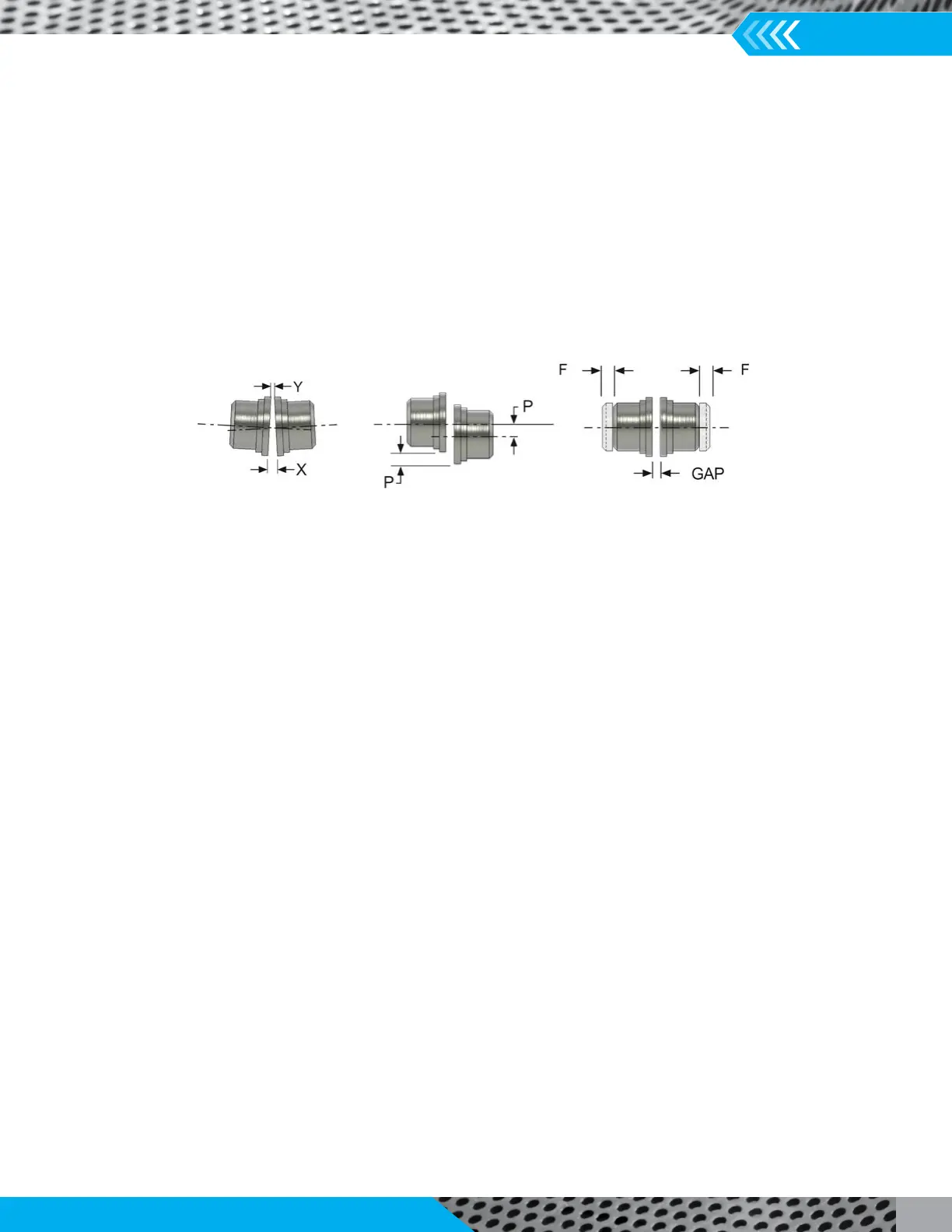
halves for the normal gap specified by the manufacturer. Coupling gap is illustrated below. It is advisable to set the motor on the
pedestal first to better determine the placement of the coupling on the shaft.
ANGULAR PARALLEL GAP AND
MISALIGNMENT MISALIGNMENT END FLOAT
*
The two types of misalignment are illustrated above. Alternatively angular alignment is checked with feeler gauges between the
hub faces. When angular alignment has been adjusted to manufacturer’s specification, parallel alignment can be checked with a dial
within specification, angular alignment and gap should again be checked, and adjustments made if necessary. A dial indicator or laser
alignment may be used to more accurately take the measurements described above.
Special adjustments may need to be made for couplings used with some equipment. As an example, when used with motors with
requiring the driver side to be set slightly low when not operating. A good rule of thumb is to set the motor low by 0.001 inches per
inch of motor shaft diameter up to 0.005". Refer to specific instruction manuals or assembly drawings.
Thoroughly clean the coupling halves after completion of alignment. Reassemble the coupling and tighten bolts, washers and locknuts.
Lubricate per manufacturer’s recommendations.
2. End float will allow for thermal movement
3. Limited end float couplings are often required in applications using motors with sleeve bearings
*


 To Next Page