IM-995
Installation, Operation & Maintenance Manual
8
Foundations & Supporting Structures (refer to lifting/safety section)
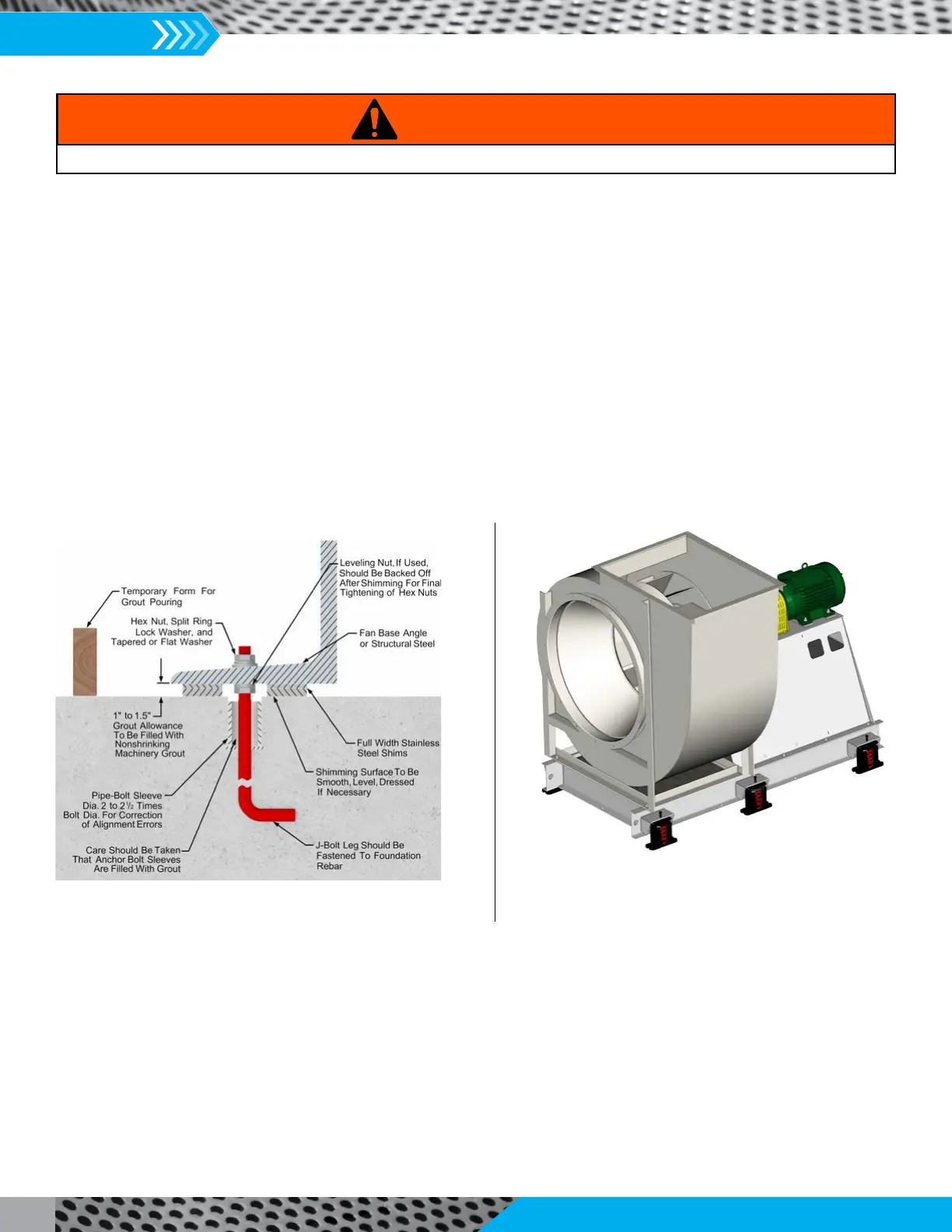
The best means of floor mounting a fan is on a well-designed, flat, level and prepared concrete foundation. The foundation should
have a mass of at least three times that of the supported assembly. Rigid foundation stiffness must be between 1x10
6
lbs./in. to 4x10
6
lbs./in. depending upon size and speed. The foundation should extend 6" beyond the outer dimensions of the fan and driver; however,
it should be no more than twice the area required for the equipment. If it is made larger, the mass should be increased accordingly
to resist rocking modes of vibration. Anchor bolts should be carefully located by a competent tradesman as impeller to inlet, bearing
location and motor location are critical to final fan alignment. J or T type anchor bolts of sufficient size should be used and should be
tied into the reinforcing bar for the foundation. Pipe sleeves may be incorporated when pouring the concrete. After the concrete is
poured, a pipe sleeve with a diameter of 2 to 2
1
2 times the anchor bolt diameter should be provided around the anchor bolt for final
adjustment. The mounting surface of the foundation should be smooth for good shim contact. It may be necessary to grind high spots.
When deciding the thickness of the foundation, approximately 1" to 1
1
2" height should be allowed for shimming, grouting, leveling,
washers, nuts, etc. The above represents industry best practice. Actual foundation design should be entrusted to a qualified engineer.
Anchor bolts should be accurately placed to coincide with the predetermined fan securing holes, or the manufactured base, to ensure
Fans mounted on a sub-floor or mezzanine must have adequate stiffness or be mounted on an inertia base with springs properly
selected. An inertia base is recommended for arrangement 8 fans to ensure alignment of the rotor and drive.
If a structural steel base or platform is to be used, the structure must be designed for the weight of the fan, live loads imposed by
rotation of the rotor and driver, and any external live loads. The structure should be designed to ensure that no natural frequency
will occur within 30% of the fan speed. This is especially true if the structure supports more than one fan. Inertia bases are generally
recommended to provide adequate mass and stiffness for fan operation.
distorted. The fan frame can be designed to carry some external loads. Consult the factory if this is a concern. Isolating the fan from
ductwork with flex connections eliminates transmission of vibration. Fans handling hot gases require expansion joints at both the inlet
and discharge to prevent excessive loads caused by thermal growth.
Fan mounted on an inertia base.
Base and pedestal shown filled with reinforced concrete.
WARNING
Refer to handling section prior to lifting equipment.


 To Next Page