Need help?
Do you have a question about the Technics RS-AZ6 and is the answer not in the manual?
Compares general specifications between RS-AZ7 and RS-AZ6 models.
Lists differing replacement parts between RS-AZ7 and RS-AZ6 models.
Schematics for the main audio path and power supply.
Diagrams for playback amplification and motor drive circuits.
Schematics for signal processing, input selection, and microcomputer interface.
Diagrams for mechanism drive, HX PRO, motor control, and signal processing.
Exploded view of the cassette deck's outer casing and visible parts.
Diagrams showing internal chassis layout and detailed mechanism parts.
Layouts for Motor, Mechanism, and HX PRO/Playback PCBs.
Layouts for Power Switch, Operation, and FL Display PCBs.
Detailed component layout for the primary main circuit board.
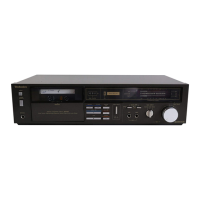
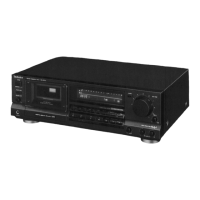
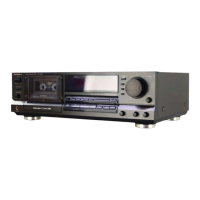
The Technics RS-AZ6 is a stereo cassette deck designed for high-fidelity audio playback and recording, incorporating advanced noise reduction and headroom extension technologies. This model is a subsequent version of the RS-AZ7, with minor differences primarily in component selection and power consumption.
The RS-AZ6 functions as a comprehensive stereo cassette deck, allowing users to play back pre-recorded cassette tapes and record audio onto blank tapes. It features a sophisticated playback/record amplifier, a Dolby B/C NR HX Pro system, and an input selector for various audio sources. The deck includes a mechanism for tape transport, with dedicated motors for capstan and reel drive, ensuring stable tape movement and accurate speed.
The Dolby B/C Noise Reduction system is integrated to reduce tape hiss during playback and recording, enhancing the dynamic range of the audio. The HX Pro headroom extension technology is designed to improve high-frequency recording linearity, preventing saturation and distortion in the treble range. These features work in conjunction to deliver a cleaner, more faithful audio reproduction.
For recording, the deck offers an automatic record muting function, which creates silent intervals between tracks. It also includes an auto tape calibration (ATC) system, which optimizes recording bias and equalization for different tape types (Normal, CrO2, Metal) to achieve the best possible recording quality. A record/pause switch allows for precise control over recording initiation and interruption.
Playback features include a play direct function for immediate playback, and a memory stop function, which allows the user to stop playback at a pre-set counter position. A counter reset function is also available for convenience. The deck provides a monitor switch, enabling users to compare the input source with the recorded signal in real-time.
The unit incorporates an FL display for clear visual feedback of operational status, tape counter, and other relevant information. An LED drive system illuminates various indicators, such as play, record, and direct modes.
The RS-AZ6 is designed for user-friendly operation with a clear layout of controls and indicators. The front panel includes buttons for basic tape transport functions: stop, playback/record, fast-forward search, rewind search, and record/pause. Dedicated switches are provided for activating Dolby NR (B/C), HX Pro, MPX filter, auto tape calibration (ATC), and memory stop.
The cassette holder features an open/close mechanism, making it easy to load and unload tapes. Detection switches for the cassette holder ensure proper operation and safety.
Audio input and output connections are located on the rear panel, allowing integration with other audio components such as amplifiers, receivers, and source devices. A terminal board is provided for record/play connections. For private listening, a headphone jack with an adjustable level control is available on the front panel.
The deck's power management includes a standby/on switch, allowing the unit to be powered on or placed in a low-power standby mode. A timer record function enables scheduled recordings, adding to the deck's versatility.
The internal circuitry is designed to manage power distribution efficiently, with buffer amplifiers and stabilizers ensuring stable voltage supply to critical components. The microcomputer controls various functions, including tape transport, display, and user interface interactions.
The service manual provides detailed information for experienced repair technicians, emphasizing the importance of using specified parts for replacements to maintain safety and performance. Components identified with a special mark have characteristics critical for safety, such as fire-retardant resistors, high-quality sound capacitors, and low-noise resistors.
When replacing any components, technicians are instructed to use only manufacturer-specified parts. This ensures that the device continues to meet its original specifications and safety standards.
The manual includes a comprehensive parts list detailing changes between the RS-AZ7 and RS-AZ6 models, indicating which parts have been deleted, added, or changed. This information is crucial for accurate troubleshooting and repair.
For maintenance involving integrated circuits (ICs) and large-scale integration (LSI) components, caution is advised due to their sensitivity to static electricity. Technicians are instructed to cover plastic parts boxes with aluminum foil, ground the soldering iron, use a conductive mat on the work table, and avoid touching IC/LSI pins directly with fingers. These precautions prevent secondary damage during repair.
Schematic diagrams and printed circuit board layouts are provided to assist technicians in understanding the internal structure and signal paths, facilitating diagnosis and repair. Test points are indicated on the circuit boards for measuring voltages and signals, aiding in troubleshooting.
Adjustments for tape speed and bias are also outlined, allowing for calibration to ensure optimal performance. For instance, the MR Head Bias Adjustment Test Point and HX Pro ADJ Test Points are provided for precise calibration of the magnetic recording head.
The cabinet parts location and mechanism parts location diagrams help in disassembling and reassembling the unit, with specific instructions for applying grease to certain areas of the mechanism during parts changes to ensure smooth operation.
 General
| Track System | 4-track, 2-channel stereo |
|---|---|
| Tape Speed | 4.8 cm/s |
| Type | Cassette Deck |
| Heads | 1 x Erase |
| Frequency Response | 20Hz to 19kHz (Metal tape) |
| Total Harmonic Distortion | 0.8% |
| Output | 0.4V (line) |
| Dimensions | 430 x 135 x 310 mm (W x H x D) |

 To Next Page