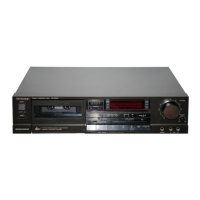
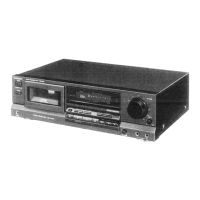
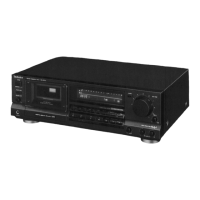
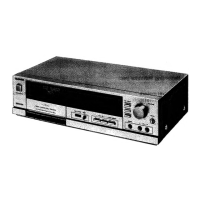
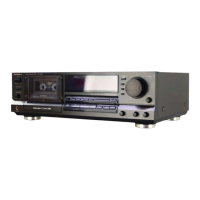
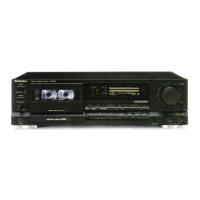
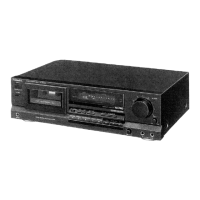
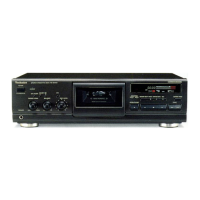
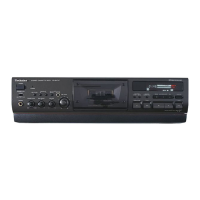
The Technics RS-B655 is a stereo cassette deck designed for high-quality audio recording and playback. It incorporates advanced features to enhance sound fidelity, ease of use, and tape longevity.
Function Description
The primary function of the RS-B655 is to record and play back audio on cassette tapes. It supports various tape types, including normal, CrO2, and metal, automatically detecting the tape type and adjusting bias and equalization accordingly.
Key recording features include:
- Recording-level control: Allows users to adjust the input level to prevent distortion and ensure optimal recording quality. The input level meter (peak level meter) provides visual feedback, indicating the level of the sound being recorded.
- Recording-balance control: Balances the left and right sound levels during recording, crucial for stereo imaging.
- Dolby Noise Reduction (B-type and C-type): These systems reduce the annoying high-frequency "hissing" noise typically heard from tapes. During recording, the system increases the level of high-frequency sound, and during playback, it weakens that portion, returning it to its original level. The B-type reduces noise by about one-third, suitable for prerecorded music tapes. The C-type reduces noise by about one-tenth, ideal for wide dynamic range sources like FM broadcasts or live performances.
- Dolby HX PRO Headroom Extension: This system improves the maximum output level of the tape's high-frequency range, allowing recordings without a drop in high-frequency level. When combined with noise reduction, it enables recordings with a greatly extended dynamic range.
- Bias-adjustment control: Compensates for differences in frequency response between various tape brands and types, ensuring consistent treble tone quality during recording. This is particularly useful for achieving accurate recordings, especially when noise reduction is employed.
- Multiplex filter: Filters out the 19 kHz pilot signal during FM stereo broadcasts. This prevents misoperation of Dolby noise reduction, which could otherwise deteriorate tone quality. It should be switched off when recording from sources other than FM broadcasts.
- Automatic-record-muting button: Creates silent intervals (approximately 4 seconds long) on the tape, useful for separating tunes or omitting unwanted material like commercial messages. Holding the button down allows for longer silent intervals.
- Microphone recording: The unit includes microphone jacks for recording instrumental or vocal performances, allowing users to create original tapes. Microphones should be disconnected when recording from line input sources.
- APRS (Advanced Precise Recording-level System): This system holds and displays the maximum peak level of the input signal, simplifying recording level adjustment. Once the peak level is held, there's no need to re-input the source signals repeatedly, making it easier to set the optimum recording level. This function is active only in recording stand-by mode.
Playback features include:
- Playback button: Initiates tape playback.
- Pause button: Temporarily stops playback or recording.
- Rewind/fast-forward/search buttons: Allows for quick navigation through the tape, including searching for the beginning of tunes.
- Memory stop: Rewinds the tape to a designated "0000" point (set by the counter-reset button) and stops, allowing playback to begin from that specific point. This is useful for replaying specific sections.
- A→B repeat play ("memory repeat"): Designates a beginning ("0000") and an end point on the tape, allowing that section to be played repeatedly up to 16 times.
- Music select function: During playback, pressing the rewind/fast-forward/search button locates the beginning of the next or previous tune and starts playing it.
The unit also features a Timer switch, enabling automatic recording or playback at a preset time when connected to an external audio timer.
Usage Features
The RS-B655 is designed for intuitive operation with clearly labeled controls and indicators.
- Display section: Includes an input level meter (peak level) to monitor sound levels during playback and recording, a tape/linear counter to indicate tape movement or elapsed time, memory-mode indicators (memory stop/repeat), and tape-select indicators.
- Meter-range selector: Allows selection of the input level meter's display range for more precise level adjustment.
- Headphones jack and volume control: For private listening and monitoring.
- Counter buttons (reset/mode): Used to select between tape/linear counter indications and reset the counter to "0000".
- Memory-mode buttons (repeat/stop): Set memory stop or A-B repeat modes.
Maintenance Features
Proper maintenance ensures the longevity and optimal performance of the cassette deck.
- Head care: Regular cleaning of the record/play head, erase head, pinch roller, and capstan shaft is recommended approximately every 10 hours of use. This should be done with a cotton swab lightly moistened with alcohol.
- Head demagnetization: If distortion or poor sound quality persists after cleaning, demagnetizing the heads is recommended. Magnetized heads can cause noise, high-frequency loss, or accidental erasure. Demagnetizers can be purchased at electronics stores.
- External surfaces: The unit's cabinet should be cleaned with a soft, dry cloth. For dirtier surfaces, a soft cloth dampened with a weak soap-and-water solution can be used, followed by a dry cloth. Harsh chemicals like alcohol, paint thinner, or benzine should be avoided as they can damage the finish.
- Tape handling: Users are advised to avoid 120-minute or longer tapes due to their thinness, which can lead to stretching or tangling. Tapes without detection holes for metal tape should also be avoided as they result in distorted recordings. Loose tape in cassettes should be taken up with a pencil or similar object to prevent damage.
- Tape storage: Tapes should be stored away from high temperatures, humidity, strong magnetic fields (e.g., near speakers or TVs), and direct sunlight to prevent damage.

 Need help?
 Power
Power Audio Specifications
 Weight and Dimensions

 To Next Page