tecn@ SALDATRICI ART. 3401 - 3406 - 3407 - 3408 WELDERS ITEM 3401 - 3406 - 3407 - 3408
Documento numero / Document number: MAN1063 Edizione / Edition: Settembre / September 1997 PAG. 12 / 32
Durante la produzione è consigliabile tenere sotto controllo
quei parametri che possono variare le condizioni di lavoro e di
conseguenza la qualità della saldatura ottenuta.
Tenere sempre controllati gli elettrodi che devono essere
sempre puliti, privi di deformazioni e mantenuti del diametro
necessario al lavoro da eseguire.
Non utilizzare prodotti sigillanti per eliminare perdite
sull'attacco conico degli elettrodi. Per facilitare l'estrazione
dell'elettrodo ed evitare il grippaggio del cono e le perdite può
essere utilizzato grasso ad elevata conducibilità.
L'acqua di raffreddamento deve circolare nella saldatrice per
alcuni minuti dopo che si è terminata la produzione per
permettere il raffreddamento della macchina. Non lasciare
comunque inutilmente il circuito di raffreddamento aperto a
macchina inutilizzata per evitare perdite e la formazione di
condensa.
Gli elettrodi non devono essere utilizzati per avvicinare
forzatamente i pezzi da saldare.
Si consiglia di annotare per ogni tipo di pezzo le regolazioni
effettuate. Nelle ultime pagine di questo manuale abbiamo
inserito un modulo per facilitare questo compito.
4.1 REGOLAZIONE MECCANICA
Regolazione dei bracci e degli elettrodi
I bracci sono regolabili in lunghezza per adattare la macchina
alle diverse esigenze di lavoro. L’aumento della lunghezza dei
bracci provoca una riduzione delle prestazioni per cui è
sempre consigliabile lavorare con la regolazione minore
possibile. Regolare la lunghezza del pedale per per adattarlo
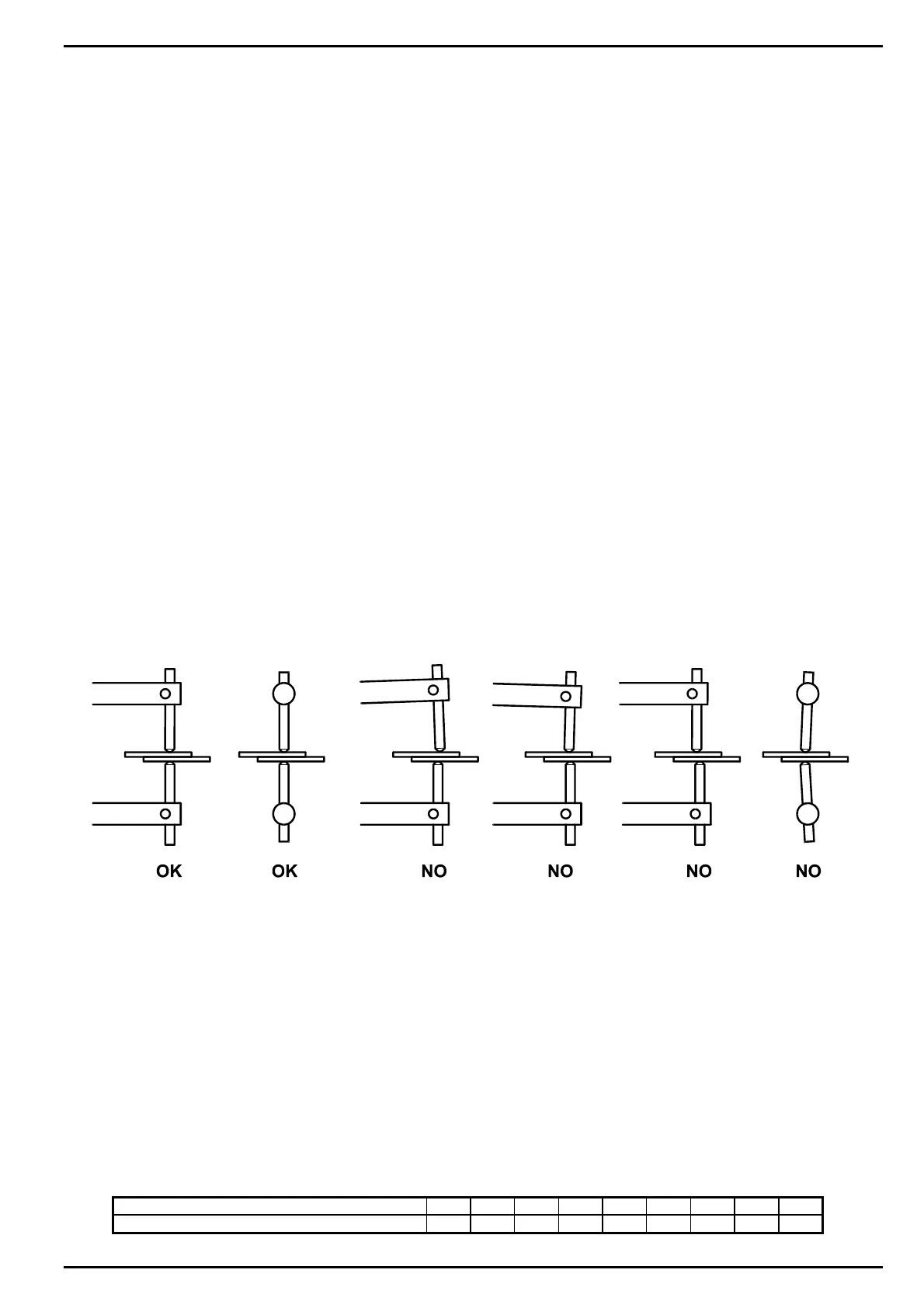
alla regolazione dei bracci. I bracci ed i portaelettrodi devono
essere regolati in modo che le punte degli elettrodi, nella
condizione di lavoro, coincidano perfettamente. I bracci,
quando stringono i pezzi da saldare, devono risultare paralleli.
Eseguire delle prove con il controllo regolato in modalità NON
SALDA, alla forza agli elettrodi necessaria per eseguire il
lavoro, interponendo fra gli elettrodi uno spessore pari a quello
che si deve saldare. Se necessario sfilare il bracci e i
portaelettrodi ed effettuare la regolazione.
E' sempre opportuno sistemare gli elettrodi con una lima fine o
con tela abrasiva. I migliori risultati si ottengono utilizzanto
della tela abrasiva avvolta su un sostegno dello stesso
spessore delle lamiere da saldare.
Il diametro degli elettrodi deve essere portato ad un valore
adatto alla saldatura che si deve eseguire, tenendo conto dello
spessore delle lamiere, del tipo di materiale e della classe di
saldatura prescelta. Per la saldatura di acciaio si consigliano i
seguenti valori:
During the production it is advisable to monitor those
parameters which can alter the working conditions, and thus
the welds quality.
Always monitor the electrodes which must always be clean,
without any deformation and must have the proper diameter
according to the work to be carried out.
Do not use sealing products to remove water losses on the
electrodes conic connection. To facilitate the electrode removal
and to prevent from both cone seizure and water losses, use
high conductivity grease.
The cooling water must circulate inside the welder for a few
minutes after having completed the production in order to allow
the welder cooling. To prevent from both losses and moisture
deposits, do not leave the cooling circuit open when the unit is
not used.
Electrodes must not be used to force the clamping of the
pieces to be welded.
We recommend you to notice the adjustments carried out for
each type of piece. In order to make it easier, a specific table
has been added at the end of this manual.
4.1 MECHANICAL SET UP
Arms and electrodes adjustment.
The arms length can be adjusted in comparison with the
different working exigencies. The lengthening of the arms
causes a decreasing of the performances, so that it is
advisable always to work with the shortest available length.
Adjust the foot-control length according to the arms set-up.
Under working conditions, both arms and electrodes holder
must be adjusted in order to have the electrodes tip coincide.
When clamping the pieces to be welded, the arms must be in
a parallel position.
Carry out some tests with the control unit on NO WELD mode,
using the same electrodes force employed to carry out the
work; place between the electrodes a thickness equal to that
which must be welded. If it is necessary, pull out both arms
and electrodes holder and carry out the adjustment operations.
It is advisable to adjust electrodes with a fine file or with
sandpaper. The best performances can be reached by using
sand paper folded upon a support having the same thickness
of the sheets to be welded.
The diameter of the electrodes must be adjusted to a value
suitable for the welding to be carried out. The sheets
thickness, the kind of material and the chosen welding class
must be taken into account. The following values are
suggested when welding steel:
Spessore lamiere - Sheet thickness mm 0,5 0,8 1 1,5 2 2,5 3 3,5 4
Diametro elettrodi - Electrodes diameter mm 4 4,5 5 6 7 7,5 8,5 9,5 11


 To Next Page
 Loading...