
 Need help?
Do you have a question about the Tecnodom PERFEKT and is the answer not in the manual?
Document purpose, aimed at operators and specialised personnel for correct equipment use.
Manual is supplied in paper/electronic format and is an integral part of the equipment.
Symbols emphasize important information for operator and equipment safety.
Equipment designed per regulatory framework, declarations of conformity, and identification plate.
Warranty terms established by law apply; contact Authorised Service Centre for faults.
Lists user obligations and forbidden actions for safe operation and maintenance.
Details about the identification plate on the back of the equipment.
Specifies the professional use of the refrigerated cabinet and its limitations.
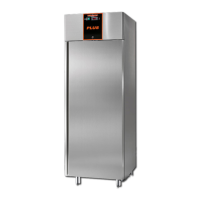
Details the available versions, construction materials, and insulation of the cabinet.
Lists and identifies the main parts of the refrigerated cabinet with a diagram.
Instructions for checking the equipment upon delivery and verifying packaging integrity.
General instructions and precautions for handling the refrigerated cabinet.
Requirements for the environment where the refrigerated cabinet should be installed.
Procedure for positioning and levelling the refrigerated cabinet using adjustable feet.
Instructions for connecting the condensate water drain system with a siphon.
Guidelines for safely connecting the refrigerated cabinet to the power supply.
Details the buttons, LEDs, and their functions on the control panel.
Explains how to access and navigate the control panel menus.
Pre-use checks, including first start-up by skilled personnel.
Steps to turn on and activate the refrigerated cabinet.
Proper procedure for opening and closing the door to avoid injuries.
Guidelines for loading products, including temperature and load limits.
Procedure for adjusting the desired temperature on the control panel.
Information on automatic and manual defrosting procedures.
Safety precautions to be taken before and during cleaning operations.
Table listing cleaning tasks and their recommended frequencies (daily, weekly, etc.).
General guidelines for cleaning the cabinet using soft cloth and non-aggressive products.
Procedure for cleaning the condenser unit, emphasizing power disconnection.
Instructions for cleaning glass surfaces without abrasive materials.
Performing periodic checks and maintenance for smooth operation.
Service, repair, and replacement of faulty components.
Lists common alarm labels, faults, causes, effects, and troubleshooting steps.
Explains alarm signalling by buzzer and alarm icon, and specific model alarms.
Steps to take when the appliance is not used for an extended period.
Guidelines for the proper disposal and recycling of electrical and electronic equipment.
 General
| Brand | Tecnodom |
|---|---|
| Model | PERFEKT |
| Category | Refrigerator |
| Language | English |

 To Next Page
