Need help?
Do you have a question about the TES TES-593R and is the answer not in the manual?
Essential safety advice, including cautions and dangers related to device operation and environment.
Defines electromagnetic pollution, electric field (E), magnetic field (H), and power density (S).
Lists various practical uses of the TES-593R meter in different scenarios.
Outlines general device characteristics like measurement method, display type, and dimensions.
Details electrical parameters such as sensor type, frequency range, and measurement accuracy.
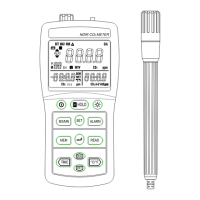
Identifies and explains the function of each button and indicator on the meter's front panel.
Explains the various symbols, numbers, and indicators shown on the meter's LCD screen.
Provides guidance on how to use the E-field sensor for accurate measurements.
Details the different units used for electric field, magnetic field, and power density measurements.
Explains the display modes: Instantaneous, Max. Instantaneous, and Max. Average.
Describes the function and application of the calibration factor for accuracy.
Explains how to set and use the alarm limit for exceeding measurements.
Guides users on how to configure various settings on the meter.
Guides users on how to change the measurement units displayed on the meter.
Instructions on how to switch between instantaneous, max, and average display modes.
Step-by-step instructions for configuring the alarm threshold for different units.
Procedure for adjusting the calibration factor to improve measurement accuracy.
How to enable or disable the audible and visual alarm features.
Instructions to disable the audible sound alerts on the device.
Guide to disable the automatic power-off feature.
Guidelines and procedures for taking accurate measurements.
Procedure for taking quick measurements in various locations.
Guidance for measurements related to prolonged exposure scenarios.
Using the alarm feature in different measurement modes for warnings.
Procedures for managing stored measurement data.
How to save measured data points into the meter's memory.
Instructions for retrieving stored measurement data from memory.
Procedure to clear stored data from the meter's memory.
Steps to configure the device's internal clock and date.
How to turn the LCD backlight on or off.
 General
| Display | LCD |
|---|---|
| Diode Test | Yes |
| Power Supply | 9V battery |
| Temperature Range | -20°C to 1000°C |
| AC Current Accuracy | ±1.5% + 3 digits |
| Continuity Test | Yes |
| Measurement Range (Insulation) | 20MΩ, 200MΩ |
| Test Voltage | 500V, 1000V |


 To Next Page