7 Using the product
12
Methane (main component of natural gas) or hydrogen are lighter than
air, detection should be carried out above the pipe / suspected leak.
Testing propane and butane gas lines: Propane and butane are heavier
than air, detection should be carried out below the pipe / suspected
leak, starting from the bottom and working upwards.
Selecting the gas to be detected
Use the GAS key to select the gas types.
After switching on the instrument, the process of cycling through starts
with methane (CH
4
).
Carrying out the measurement
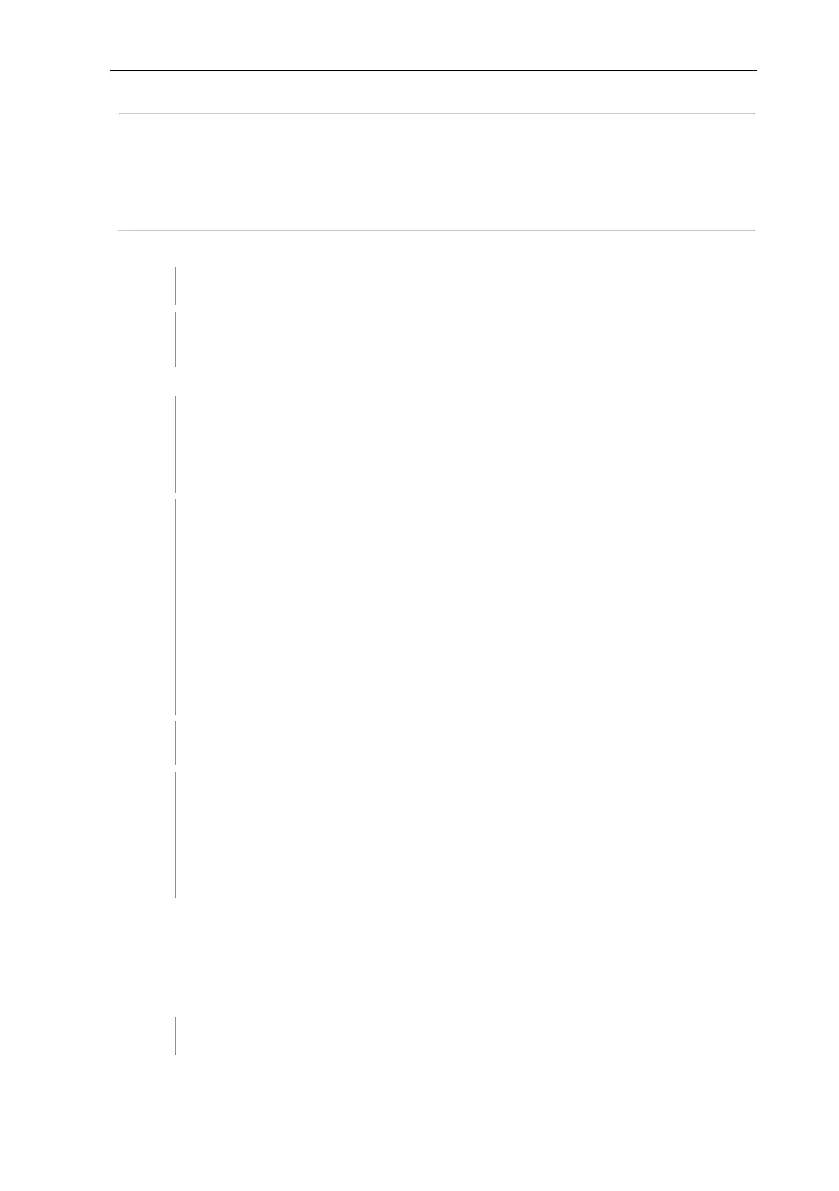
Move the sensor head as close as possible and at low speed
(approx. < 1 in (2 cm) per second) over the components that are to
be checked for leaks.
The surface of the sensor must not be covered.
Concentration < 100 ppm: The sensor LED and the display
illumination light up green. In addition, the bar display increases.
Concentration > 100 and < 999 ppm: The sensor LED and the
display illumination light up yellow. In addition, the bar display
increases.
Concentration > 999 ppm: The unit changes to VOL% and the bar
display increases.
Concentration > 9999 ppm / > 0.99 VOL%: The sensor LED and the
display light up red (alarm threshold).
When the lower explosive limit is reached, ">LEL" is displayed. Higher
values are not displayed.
If the warning threshold (100 ppm) is exceeded, the sensor LED and
display illumination light up yellow. If the acoustic alarm is enabled, an
additional warning sound is emitted when the warning threshold is
exceeded, the frequency of which increases as the concentration
increases, and changes to a continuous tone when the second alarm
threshold (10,000 ppm) is exceeded.
Changing units
By default, the display shows ppm (concentration in parts per million). From a
concentration of >999 ppm, the display changes to vol% (1000 ppm=0.1 vol%).
In addition, %LEL (the percentage of the lower explosive limit that has been
reached) can be selected.
Press the unit key to change the unit.



 To Next Page