Pagina 13 di 48
STDITR01ADP2090EV TECNOFRIGO TUSCANY srl
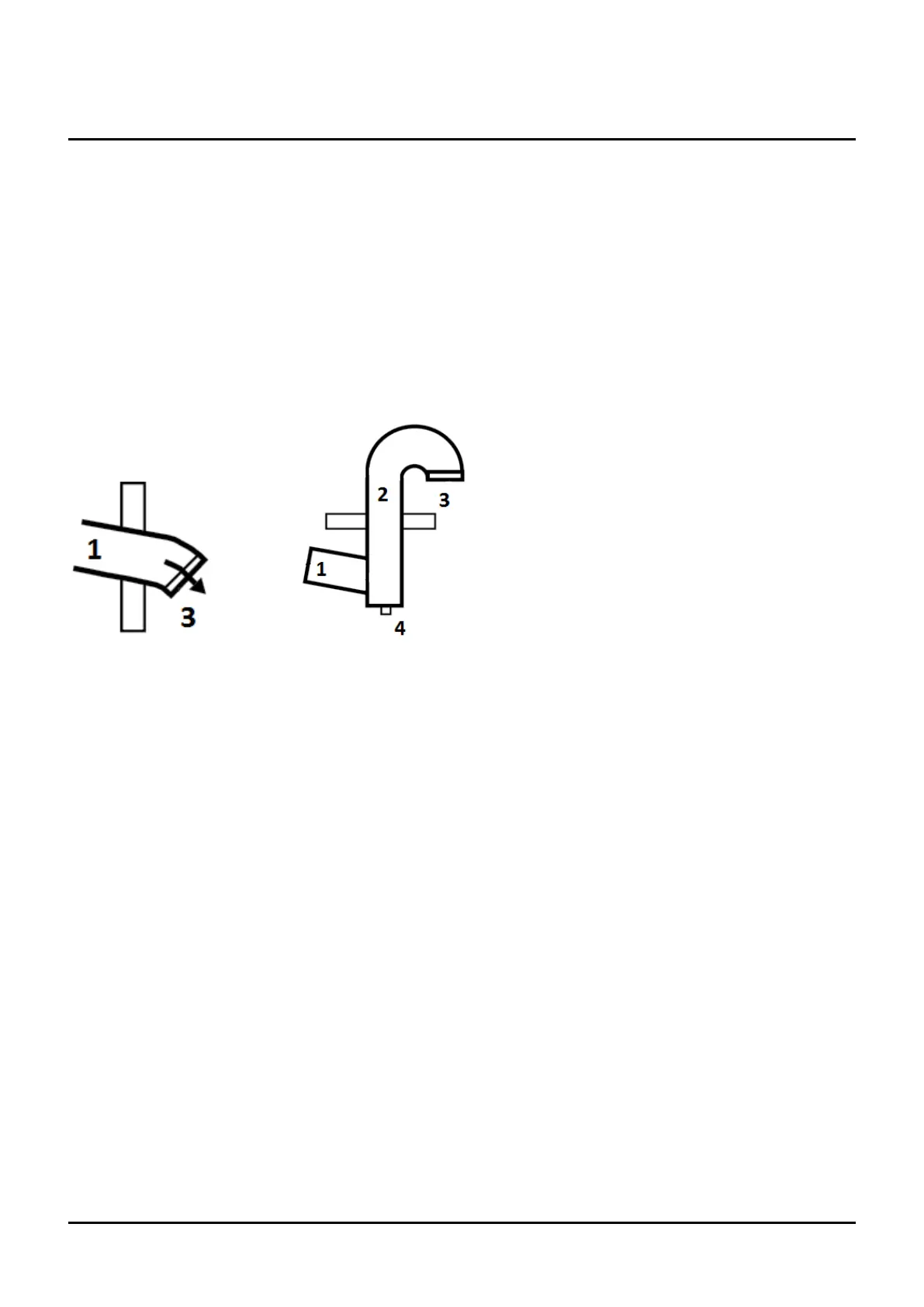
Specification for the expulsion channel of moist air
The humid air from the dehumidifier must be expelled outside. The channels must be as short as possible
to minimize the possibility of condensation of moist air within them. This channel should be slightly
sloped to prevent any return of condensate inside the dehumidifier. If the channel of the moist air is very
long or needs to be upwards, realize a drainage hole of 5 mm at the lowest point of the discharge
channel. It must be installed an air flow regulation damper. Protect the channel output with a grid. If
there is a risk that the temperature external to the conduit is very low, it is mandatory to insulate piping
to prevent the formation of condensation inside the duct.
Horizontal Vertical
Expulsion Expulsion
1. Slop down
2. Vertical expulsion of moist air
3. Wire mesh
4. Condensate drainage
Specifications for the input channel of reactivation air
This channel must be as short as possible. To prevent the entry of foreign bodies, protect the entrance
channel with a grid. It is not necessary to isolate the pipe, which may be inclined downwards. In some
installations, the reactivation air can be aspired from the room where the dehumidifier is installed and
in this case it is not necessary any channel.
It is advisable to install a damper on the reactivation circuit to allow a proper air flow calibration.
Specifications for the channels of process air and dry air in case the dehumidifier is installed
inside the room to be dehumidified
In this case, it’s not necessary the addiction of aspiration channels for the process air; the installation of
a protective grille is only required. The dry air produced must be ducted for the distribution inside the
dehumidified room.


 To Next Page