23
Installation – Remote Air-
Cooled Condenser
Chillers designed for use with a remote air-cooled
condenser include a factory-selected remote
condenser. The remote air-cooled condenser ships
separately and in most cases will ship from a
different location than the chiller so it will most likely
be on a separate truck shipment from the chiller.
Location
The remote air-cooled condenser is for outdoor use.
A primary concern when designing your unit was
serviceability; therefore, the condenser should be
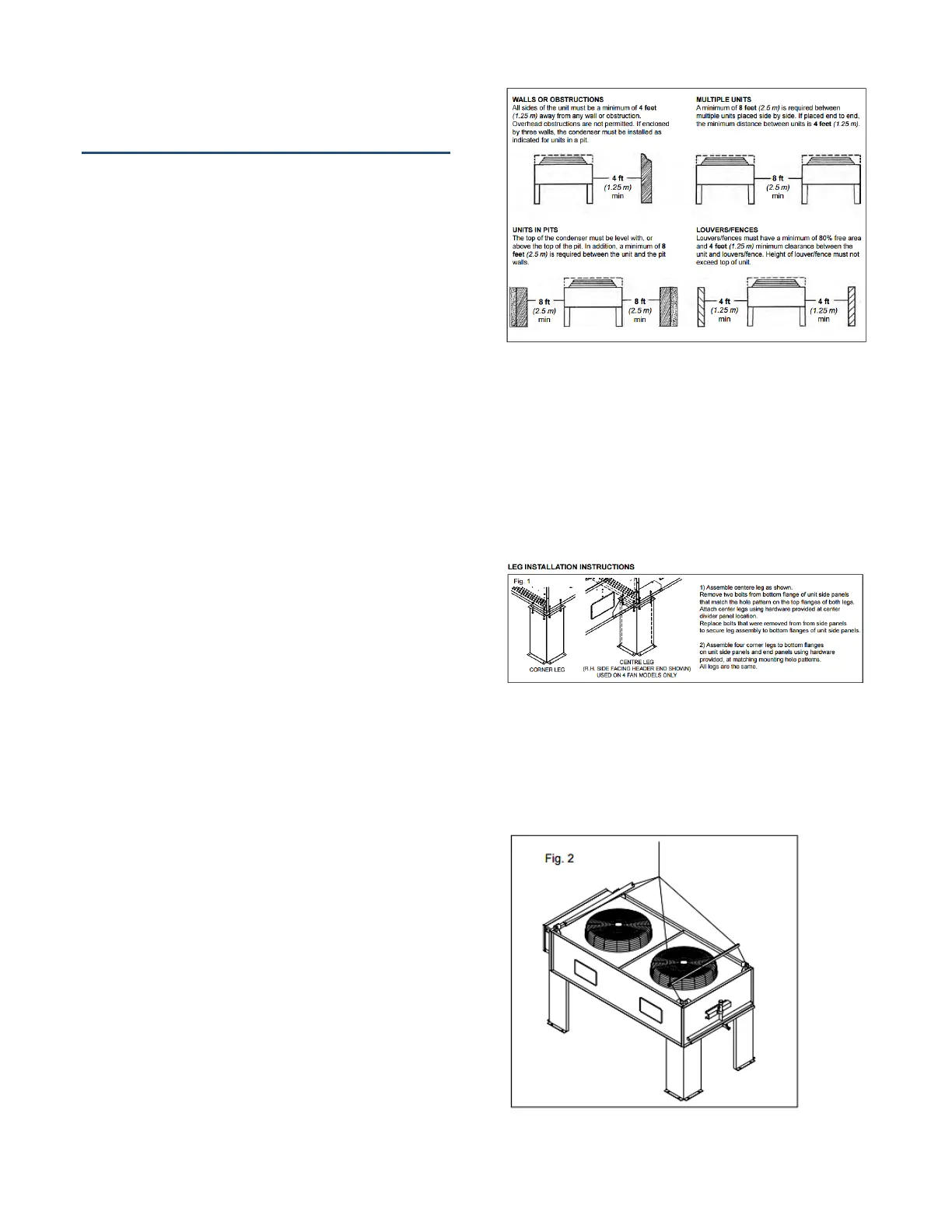
located in an accessible area. Install the unit on a
firm, level base no closer than their width from walls
or other condensers. Avoid locations near exhaust
fans, plumbing vents, flues, or chimneys. Fasten the
mounting legs at their base to the steel or concrete
of the supporting structure. For units mounted on a
roof structure, the steel support base holding the
condenser should be elevated above the roof and
attached to the building.
Avoid areas that can create a “micro-climate” such as
an alcove with east, north, and west walls that can be
significantly warmer than surrounding areas. The
condenser needs to have unrestricted airways so it
can easily move cool air in and heated air away.
Consider locating the condenser where fan noise
and vibration transmission into nearby workspaces is
unlikely.
Allow a minimum of the width of the remote
condenser in clearance between the remote
condenser and any walls or obstructions. For
installations with multiple condensers, allow a
minimum of the width of the largest remote
condenser between condensers.
Mounted Legs and Lifting (5 - 10 ton
Units)
The unit ships on its side with the legs removed to
reduce shipping dimensions and provide more
protection to the coil from possible damaged caused
by impact loading over rough roads and transit
conditions. Follow the below for mounting of the
legs and lifting into position.
Use only qualified persons using the proper
equipment when lifting and positioning the
condenser. Lifting brackets or holes are at the
corners for attaching lifting slings. Use spreader bars
when lifting to apply the lifting force vertically.



 To Next Page