Need help?
Do you have a question about the TierTime UP300D and is the answer not in the manual?
General safety guidelines for operating the printer and handling materials.
Recommended environmental conditions for optimal printing and print quality.
Details of the manufacturer's warranty policy for the product.
Regulatory compliance information, including FCC and RoHS certifications.
Step-by-step instructions for safely unpacking the UP300D 3D printer.
Lists all components and accessories included in the UP300D package.
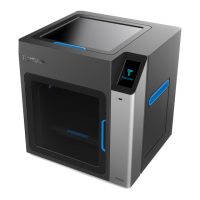
Identifies and labels the key physical components of the UP300D printer.
Instructions for correctly installing the build platform into the printer.
Guide to downloading and installing the necessary UP Studio 3.0 software.
Steps to update the printer's touchscreen firmware for optimal performance.
Overview of supported connection methods for the UP300D.
Explains the auto calibration process for build plate leveling and nozzle height.
Detailed steps for performing auto calibration using the printer's touchscreen interface.
Instructions for loading the primary filament spool into the printer's designated slot.
Instructions for loading the secondary filament spool for support material.
Guides through slicing models in UP Studio 3, including setup, STL loading, and print preview.
Instructions for connecting the printer and sending sliced print jobs via USB.
Procedures for safely removing finished prints from the build plate.
Explains the importance and process of setting the correct nozzle height for the first layer.
Detailed steps for setting nozzle height using the UP Studio 'Wand' software.
Describes the 9-point compensation for build plate leveling to ensure even prints.
Instructions for manual calibration of the build plate, offering more control.
Overview of the main interface elements and layout of the UP Studio slicing software.
Description of the Quick Setting Bar for rapid adjustment of essential print parameters.
Explanation of the tools available for manipulating 3D models within the build space.
Introduces the Support Editor, its types, and parameters for generating support structures.
Details on Basic, Advanced, and Expert print modes and their parameter settings.
Defines key terms and concepts related to print parameters like Perimeter, Infill, and Support.
Details on quality settings, layer height, adaptive ratio, and custom layer height configurations.
Explains path modes, infill density, support density, and perimeter settings.
Covers special print options like fill mode, perimeter gap, tolerance, and fuse gap settings.
Details on various speed settings for different print elements like perimeters, infill, and supports.
Explains temperature adjustments, support peel, Z-hop, and extrusion scale parameters.
Details on printer configuration, origin settings, build volume, and acceleration parameters.
Configuration options for Extruder 1 and Extruder 2, including filament and nozzle settings.
Locations where users can insert custom G-codes for printer functions.
How to manage and customize material profiles, including print, retract, temperature, and shrink settings.
Explains functions like saving mesh, adding child models, and linking settings for part sub-setting.
Overview of the Wand software interface, including connection, status, and axis controls.
Steps to connect the UP300D printer to a Wi-Fi network using the Wand software.
Instructions for establishing an Ethernet connection for the UP300D printer.
How to edit network settings like IP, Mask, Gateway, and DNS for the printer.
Describes the components of the printer's status bar for monitoring printer status.
Overview of the six main menu buttons and their associated functions.
Details on managing filament, including extruding, withdrawing, and setting material weight.
How to start, manage, and view print jobs in the current queue or history.
Instructions for calibrating the printer, focusing on nozzle height and build plate leveling.
Displays printer information such as model, firmware version, and MAC addresses.
Configuration options for printer name, sound, preheat, private mode, and password.
Settings for establishing and managing Ethernet and Wi-Fi network connections.
Step-by-step guide to connecting to and configuring Wi-Fi networks for the printer.
The essential initialization process required before the printer can operate.
Describes the perforated glass build plate and its suitable materials.
Describes the flex glass build plate and its suitable materials.
Information on using the glass side of build plates for printing.
Details on the available single extrusion print heads (HT and LT types).
Step-by-step guide for safely replacing the printer nozzle.
Covers single extruder replacement, disassembly, and dual extruder maintenance.
Guides on diagnosing and resolving partial and complete blockages in the extruder.
Instructions for removing and emptying the printer's waste tray.
Information on the dual filtration system and filter replacement recommendations.
 General
| Max. Nozzle Temperature | 300°C |
|---|---|
| Heated Bed | Yes |
| Max. Heated Bed Temperature | 110°C |
| Enclosed Build Chamber | Yes |
| Filament Diameter | 1.75 mm |
| Material Runout Sensor | Yes |
| Power Failure Recovery | Yes |
| Print Speed | Up to 150 mm/s |
| Print head | Single |
| Nozzle Diameter | 0.4 mm |
| Filament Compatibility | PLA, ABS, TPU, Nylon, PC |
| Connectivity | USB, Wi-Fi |
| Display Screen | 4.3-inch Touch Screen |
| Camera | Yes |
| Power Requirements | AC 100-240V, 50/60Hz, 350W |
| Layer Resolution | 0.05 - 0.4 mm (50 - 400 microns) |

 To Next Page